Ruby Jewellery: How to Judge the Stone Before You Buy the Piece
A sourcer’s guide to what you actually pay for in ruby jewellery: colour, heat, origin claims, and the one document that settles all three.
Ruby jewellery at a glance
| What buyers ask | The short answer |
|---|---|
| Hardness (Mohs) | 9. Only diamond scratches it, so ruby handles daily wear better than almost any coloured stone. |
| The colour that costs | Red to slightly purplish red, vivid saturation, medium-dark tone. That is the look the trade calls "pigeon’s blood". |
| Does "pigeon’s blood" prove origin? | No. It is a trade term for an appearance. GIA notes it has been used for the finest stones regardless of origin. |
| Price per carat (fine) | Heated Mozambique roughly $3,000 to $8,000. Unheated Mozambique roughly $8,000 to $25,000. Unheated Burma roughly $15,000 to $80,000. |
| Treatment | Heat is near universal. GIA advises assuming a ruby is treated unless a report proves otherwise. |
| The treatment to refuse | Lead-glass filling. It props up a fractured stone, it is not durable, and it collapses the value. |
| Mineral species | Corundum, the same species as sapphire. Red is ruby, everything else is sapphire. |
| What settles an argument | An independent report from GIA, Gübelin, SSEF or GRS stating species, treatment and origin. |
Introduction
Ruby jewellery is priced by the stone, not by the setting. Two rings can look identical on a screen and sit ten times apart in value, and the gap is almost never the metal.
Ruby jewellery is set with corundum coloured red by chromium. Value is decided by colour first, then treatment, then origin, then clarity and size. Because heat treatment is close to universal, an independent laboratory report is the only thing separating a routinely heated stone from a rare unheated one, and that report is most of what you are paying for.
Let us be honest about the part most shop pages skip. "Pigeon’s blood" is a trade term for a look, not a birth certificate for a mine. We will come back to why that matters, with GIA’s own wording. This guide takes the stone first and the piece second, because that is the order the money actually moves in. If you want to see certified loose stones before any of this becomes theory, our ruby collection is where the same checks get applied one stone at a time.
What Really Decides the Price of Ruby Jewellery
The 4Cs of colour, clarity, cut and carat were standardised for the diamond, and they still give the trade a shared vocabulary. For rubies, though, a fifth factor usually moves the price more than any of them: country of origin. A ruby’s geology shapes its exact hue, its fluorescence and its internal character, and the market prices those differences hard.
Ruby Gemstone Guide: Quality and Buying Tips. Video: GIA, Gemological Institute of America.
The fifth C: what origin actually changes
Three sources dominate the conversation, and they do not produce the same stone.
Origin | Dominant colour profile | Key characteristics | Market position |
|---|---|---|---|
Burma (Myanmar) | Red to slightly purplish red, vivid, medium-dark | Glowing red fluorescence, fine "silk" inclusions that soften the colour | The historical benchmark. Commands the highest price per carat. |
Mozambique | Bright red, sometimes leaning slightly orange or pink | Often cleaner, more available in larger sizes | The modern supply that keeps fine ruby obtainable at all. |
Thailand | Darker red with a brownish or purplish cast | Higher iron damps the fluorescence, giving a garnet-like tone | A major commercial and trading centre, especially for heated stones. |
"Pigeon’s blood" is a trade term, not an origin certificate
This is the sentence the category does not want printed. Per GIA, the label "Burmese colour" "has been used to indicate the finest-quality stones regardless of origin", and the institute warns that "it’s best to be cautious about using or accepting place names as proof of origin." GIA is equally direct about why: "a single source never consistently yields gems that are all the same color and quality."
So when a listing leads with "pigeon’s blood", it is describing an appearance, red to slightly purplish red, vivid saturation, medium-dark tone, with a glowing fluorescence. That appearance is genuinely rare and genuinely worth paying for. It is the word doing double duty as a provenance claim that should make you ask for the report. Buy the stone in front of you, not the adjective attached to it.
What ruby jewellery actually costs
Prices move with colour and treatment far more than with size, which is why a 1 ct stone can outprice a 3 ct one. The bands below are dealer-level figures for fine material published by specialist ruby dealers in 2026, and they are per carat, before any setting.
Tier | Treatment and origin | Indicative price per carat |
|---|---|---|
Commercial | Heated, Mozambique or Thai | $500 to $3,000 |
Fine | Heated, Mozambique | $3,000 to $8,000 |
Fine | Unheated, Mozambique | $8,000 to $25,000 |
Fine | Unheated, Burma | $15,000 to $80,000 |
Two practical consequences. A "ruby" ring under a few hundred pounds is either a very small stone, a heavily included one, a lead-glass-filled one, or not a ruby. And a laboratory designation of "pigeon’s blood" typically adds another 30 to 50 percent at dealer level, which is a lot of money riding on one line of a report. For a stone-by-stone walk through grading and value, our guide to identifying and grading natural ruby goes deeper than this page needs to.
Heated or unheated: the question worth the most money
Heat is the standard, permanent, disclosed enhancement. Rough is brought up to temperature to clear brown or purple overtones and dissolve fine inclusions. A heated ruby is still a fully natural ruby, and it is the vast majority of what is sold. GIA puts the default plainly: "when particular treatments are common, as heat treating is for rubies, you must assume any rubies you’re selling have been treated unless proven otherwise."
Unheated fine ruby is the rarity. Nature already delivered the colour and the clarity, so nothing was done. Expect a premium of roughly 2 to 5 times an equivalent treated stone, and more than that for Burma material. The same logic governs its sister species, which we unpack in unheated versus heated sapphire.
Two treatments deserve a flat no. Lead-glass filling pumps high-lead glass into surface-reaching fractures so a broken stone reads clean. It is not stable, it does not survive a jeweller’s torch or an ultrasonic bath, and it destroys value. GIA also flags the older Thai practice of packing rubies in borax during heating: the borax melts into fractures and cavities and hardens there, "giving a false impression of the stone’s face-up appearance and weight." Lattice diffusion and dyeing sit in the same bin. None of this is visible to you across a photograph, which is the entire argument for a report.
Origin and treatment are the two lines on a report that move the price most. You can see both stated, stone by stone, in our collection of certified rubies.
Choosing the Piece: Cuts, Settings and Metals That Suit a Ruby
Once the stone holds up, the design question becomes real. Ruby is a 9 on the Mohs scale, second only to diamond, so it takes daily wear better than almost any other coloured gem. The job of a setting is to serve the colour, not to compete with it.
The cut decides how the colour reads
- Oval and cushion. The workhorses. Elongated or softened outlines hold carat weight and deepen saturation, which is exactly what you want from a red stone.
- Emerald cut. A step cut that trades sparkle for broad flashes of deep red and a very architectural look. Unforgiving on clarity, so it rewards a clean stone.
- Round brilliant. Classic, but the faceting is engineered to throw white light. On a top-colour ruby that brilliance can pull attention away from the colour you paid for.
Ring styles that work with a red centre stone
- Solitaire. Nothing to argue with the colour. It also gives you nowhere to hide a mediocre stone, which is a feature.
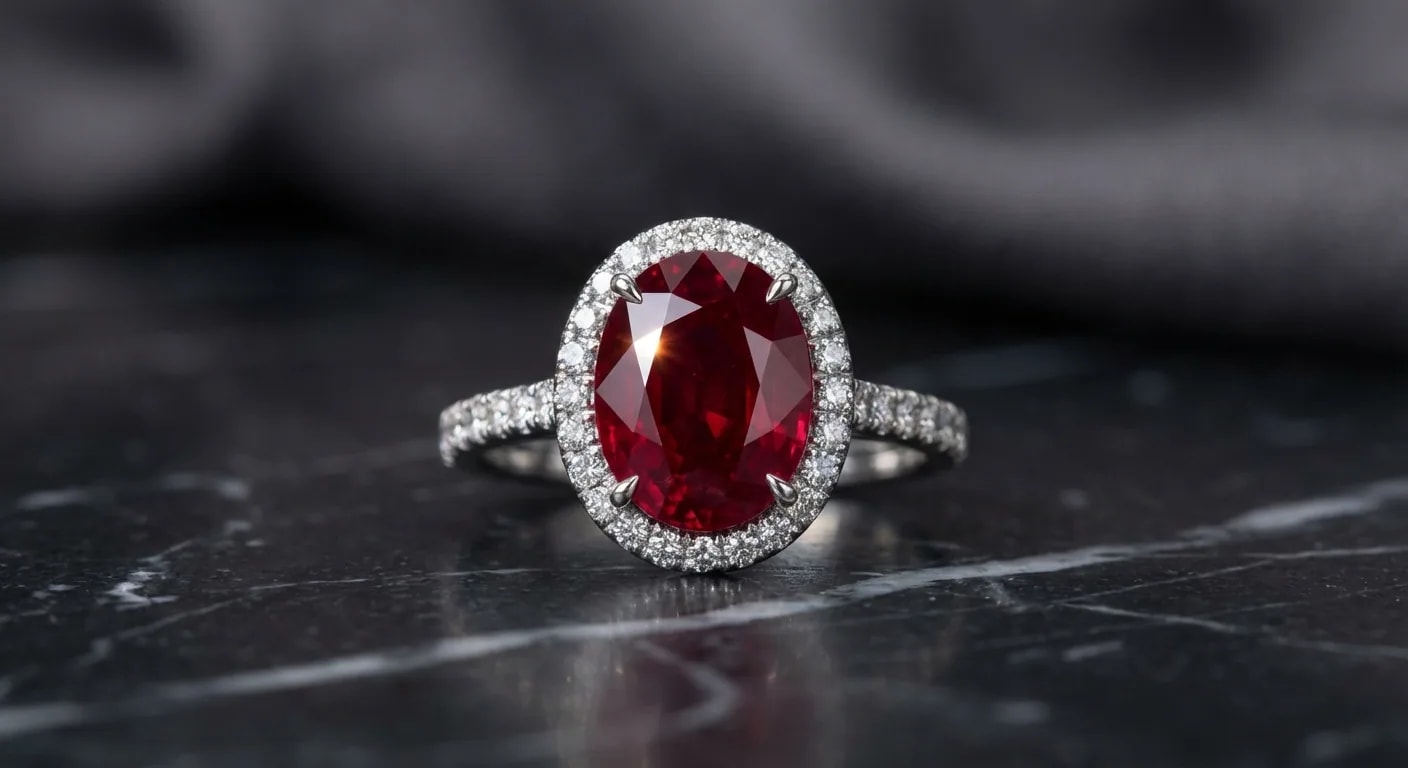
- Halo. A ring of small diamonds lifts the apparent size and makes the red look more saturated by contrast.
- Three-stone. A ruby flanked by two diamonds. It reads formal and it lets a smaller centre stone carry a bigger ring.
Ruby is a serious candidate for a ring meant to be worn every day, and it shares that durability with its sister species, the sapphire.
Necklaces, bracelets and earrings
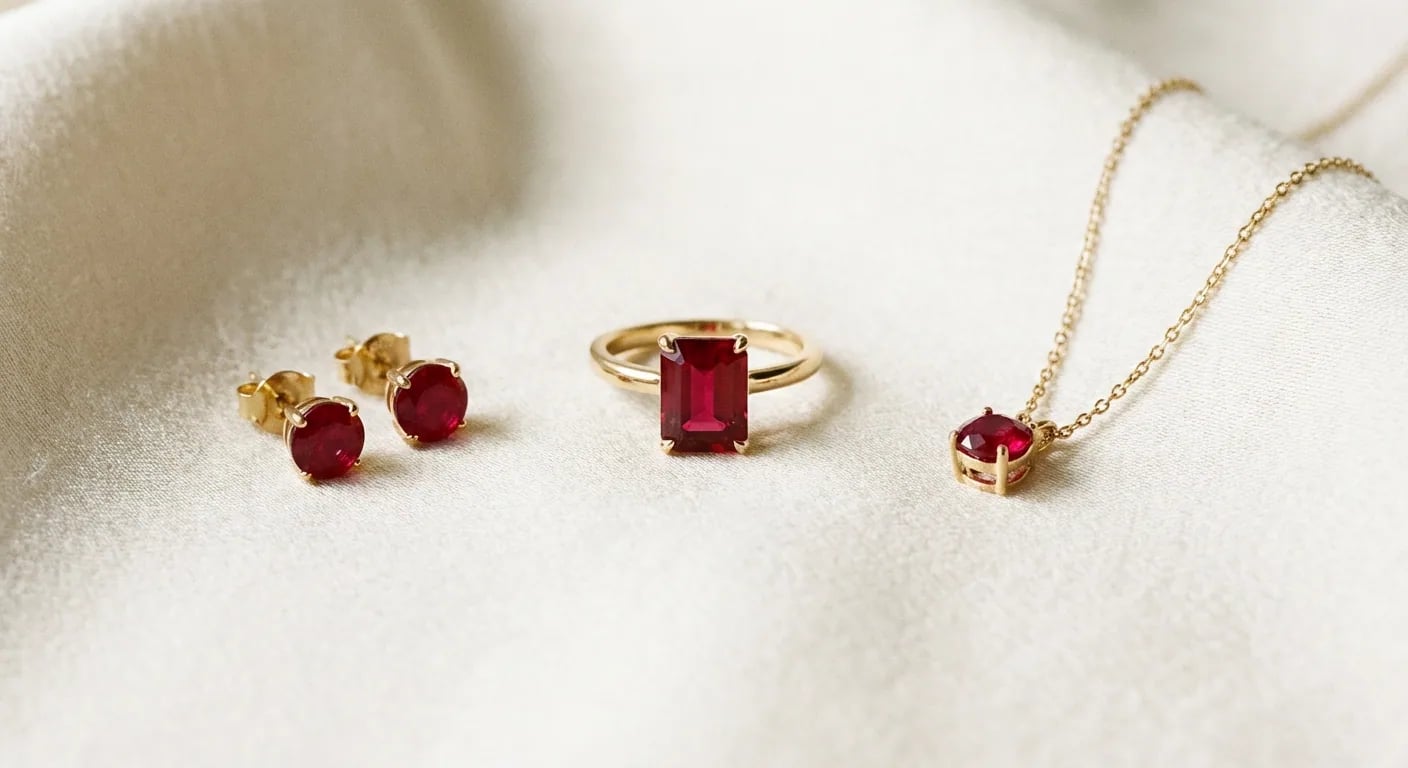
- Necklaces. A single ruby pendant on a fine chain is the most wearable piece in the category. A riviere, where matched stones run in a continuous line, is the formal end and the one where matching costs more than the stones.
- Bracelets. A ruby tennis bracelet turns a familiar form warm. Bezel-set stations on a delicate chain are the version you can actually wear to work.
- Earrings. Studs are the versatile staple and the easiest entry point, since a pair of small clean rubies costs far less than one large one. Drops and chandeliers add movement and bring the colour up beside the face. Since ruby is the July birthstone, a single stone on a charm bracelet or a stud pair is the most common gift version of all this.
Choosing the metal
Metal changes how the red is read by the eye, so this is a colour decision before it is a taste one.
| Metal | Visual effect on a ruby | Best for |
|---|---|---|
| Yellow gold (18k) | Warm and traditional. Pushes the ruby towards its orange side and makes the whole piece read richer. | Vintage-leaning designs, warmer skin tones, stones that are slightly light in tone. |
| Platinum or white gold | Cool contrast. The neutral metal makes the red look more saturated than it measures. | Contemporary settings and any piece where the colour is the whole point. |
| Rose gold | Harmonious rather than contrasting. The pink metal blends into the stone instead of framing it. | Soft, tonal designs. Be careful with pinkish rubies, where the line between stone and setting can disappear. |
One opinion, freely given: with a genuinely fine ruby, the cheapest good decision is a plain setting. Every extra diamond on the shank is money not spent on colour, and colour is the only thing on that ring that cannot be upgraded later.
How to Buy Ruby Jewellery Online Without Getting Burned
Buying a significant ruby remotely comes down to two things: verifiable data about the stone, and a seller who has committed to something in writing. Neither requires a leap of faith. Both require you to ask.
Reading the report
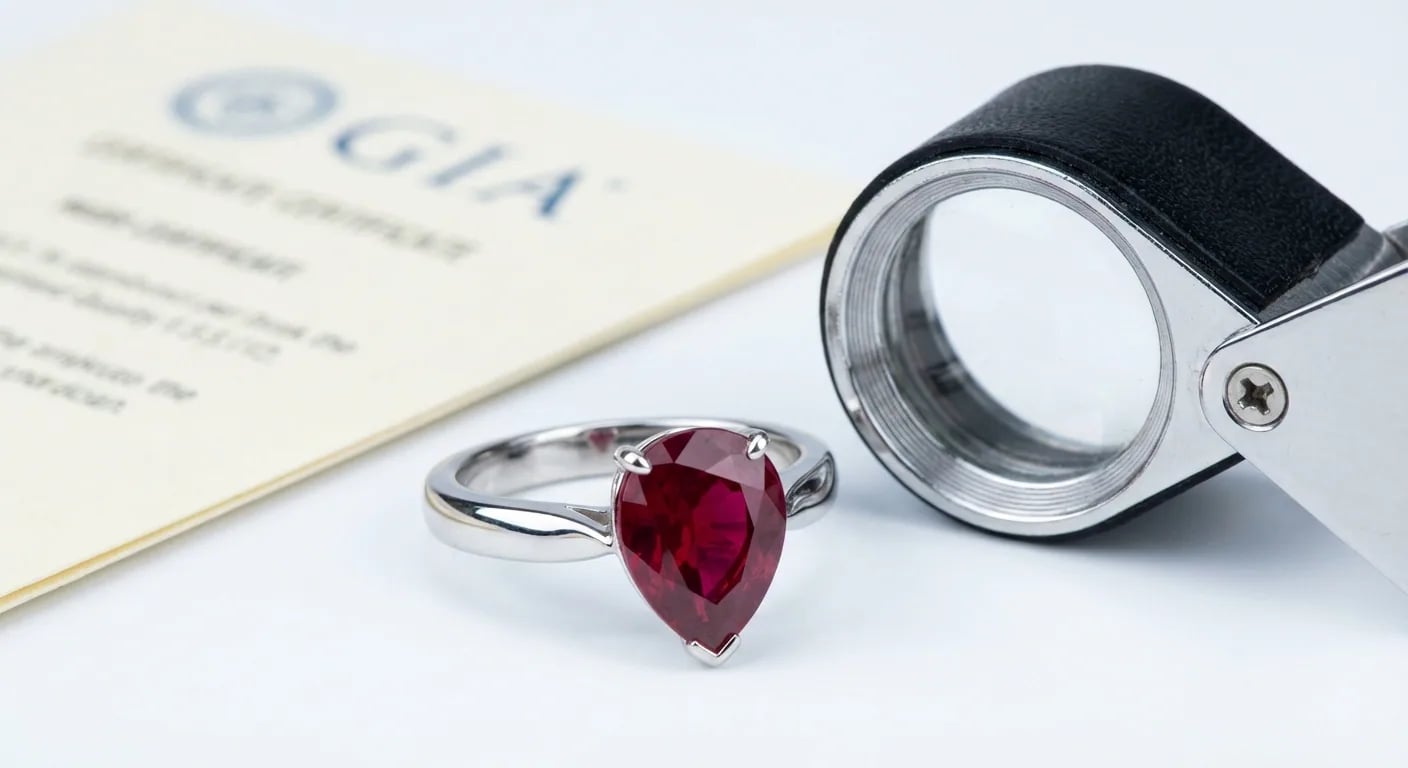
A report from an independent laboratory is the most important document in the transaction. It is not a seller’s appraisal, it is a scientific opinion from a party with nothing to gain. For ruby, GIA, Gübelin, SSEF and GRS are the names the trade actually accepts. What a full report confirms, and why each line matters more for ruby than for most stones:
| Report section | What it confirms | Why it matters for a ruby buyer |
|---|---|---|
| Identification | Species (natural corundum) and variety (ruby). | Rules out a synthetic and rules out the other red stones that get sold as ruby, above all red spinel, which fooled European crown jewellers for centuries. |
| Geographic origin | The country or region, where the lab is willing to call it. | The single biggest price multiplier. Note that origin is an expert opinion, not a measurement, and good labs say so. |
| Treatments | "Heated", "no indications of heating", or a named treatment. | This one line can be worth several times the price of the stone, and it is the line lead-glass filling shows up on. |
| Colour | Hue, tone and saturation, sometimes with a trade designation. | An independent read on the value factor that decides most of the price. A lab "pigeon’s blood" call typically adds 30 to 50 percent. |
| Measurements and weight | Dimensions in millimetres and carat weight. | Confirms you are paying for the size you think, and tells the setter what they are working with. |
If you want the longer version of what these documents do and do not guarantee, we wrote a whole guide on what a gemstone certificate actually proves.
Judging the seller
The report validates the stone. The seller’s practices validate everything else. What we would look for, and what we hold ourselves to:
- Third-party certification, named. Not "certified" as an adjective. Which laboratory, and can you see the document before you pay?
- Unretouched imagery. High-resolution photographs and video of the actual stone, not a stock render of the variety. Ruby photographs redder than it is under almost any lighting, so ask what light it was shot in.
- A written dispute policy. This is the one almost nobody offers. Ours is published: every Joalys stone ships with a Lanka Gem Laboratory certificate recorded on-chain, and you keep the right to have the stone re-certified by an accredited laboratory such as GIA, IGI, AGL, Gübelin or SSEF. If a material discrepancy comes back, wrong species, undisclosed treatment, a synthetic sold as natural, quality overstated, the stone comes back to us and you are refunded in full, premium certification and shipping included, within 90 days. A claim anyone can copy in a sentence is worth less than a contract.
- Stone first, setting second. The stone is selected and inspected in hand before any design work begins. It removes the pressure and it means the centrepiece is settled before anyone talks about metal.
On expertise, we will be precise, because the category is loose with it. Ilyes is a sourcer, not a gemmologist. He spent two years on the ground in Sri Lanka learning how parcels are actually traded in Beruwala and Ratnapura. The gemmological calls are made by a laboratory, in writing, and you get to challenge them. That division is the point, not a limitation.
Pick the stone before anyone talks to you about settings. Browse our certified rubies and see the origin and treatment lines stated up front.
Caring for Ruby Jewellery: Storage, Cleaning and What to Avoid
Ruby is tough. At 9 on the Mohs scale nothing in a normal day scratches it except a diamond. That does not make it indestructible: hardness resists scratching, it does not resist a sharp knock on a corner, and any stone with fractures near the surface is more fragile than its hardness suggests.
Daily wear and storage
Take pieces off for gardening, sport, cleaning with abrasives and chlorinated pools. Chlorine attacks the alloys in gold settings far faster than it bothers the stone, and most "the stone fell out" stories start with a weakened claw, not a broken gem.
Storage matters more than people expect, precisely because ruby is so hard.
- Keep it away from softer stones. A loose ruby will happily scar pearls, opal or emerald sitting next to it in a box.
- Keep it away from diamonds. Diamond is the one natural material that scratches ruby, so a diamond tennis bracelet rattling against a ruby ring is a slow accident.
- Use compartments. A fabric-lined box with separate slots, or an individual soft pouch per piece, solves both problems for the price of a takeaway.
How to clean ruby jewellery at home
For an untreated or conventionally heated ruby, the routine is boring and effective. Warm water, a drop of mild washing-up liquid, a soft toothbrush worked around the back of the setting where the film actually builds up, then a rinse and a lint-free cloth. Most of the "dull ruby" complaints we hear are hand cream trapped under the stone, not anything wrong with the gem.
What to avoid, and this part is not optional. No ultrasonic cleaner and no steamer if the stone is fracture-filled, dyed or you simply do not know, because ultrasonic vibration can pull filler straight out of a fracture and the damage is permanent. No bleach, no ammonia, no abrasive paste. If a report says "no indications of heating" and you would rather not gamble, take it to a bench jeweller once a year and have the claws checked at the same time. Our broader jewellery care and maintenance guide covers the other stones in the box.
Frequently Asked Questions
Conclusion
The value of ruby jewellery lives in the stone, and specifically in four lines of a report: species, treatment, colour and origin. Get those settled and the rest of the decision, cut, metal, setting, is taste, and taste is allowed to be personal. Get them wrong and no amount of design rescues the piece.
Our order of operations is deliberately unfashionable. You pick a certified loose ruby first and inspect it in hand. Only once the stone convinces you does the design conversation start, and you keep the written right to have the stone re-certified elsewhere and returned if a laboratory disagrees with ours. Buy the ruby that does something to you, not the one that proves something.