Turquoise Jewelry: How to Wear It Every Day, and How to Care for It
A 5-to-6 on the Mohs scale, porous enough to drink your hand cream. Which metals suit it, where it survives on the body, how to clean it without stripping the color, and why that color moves.
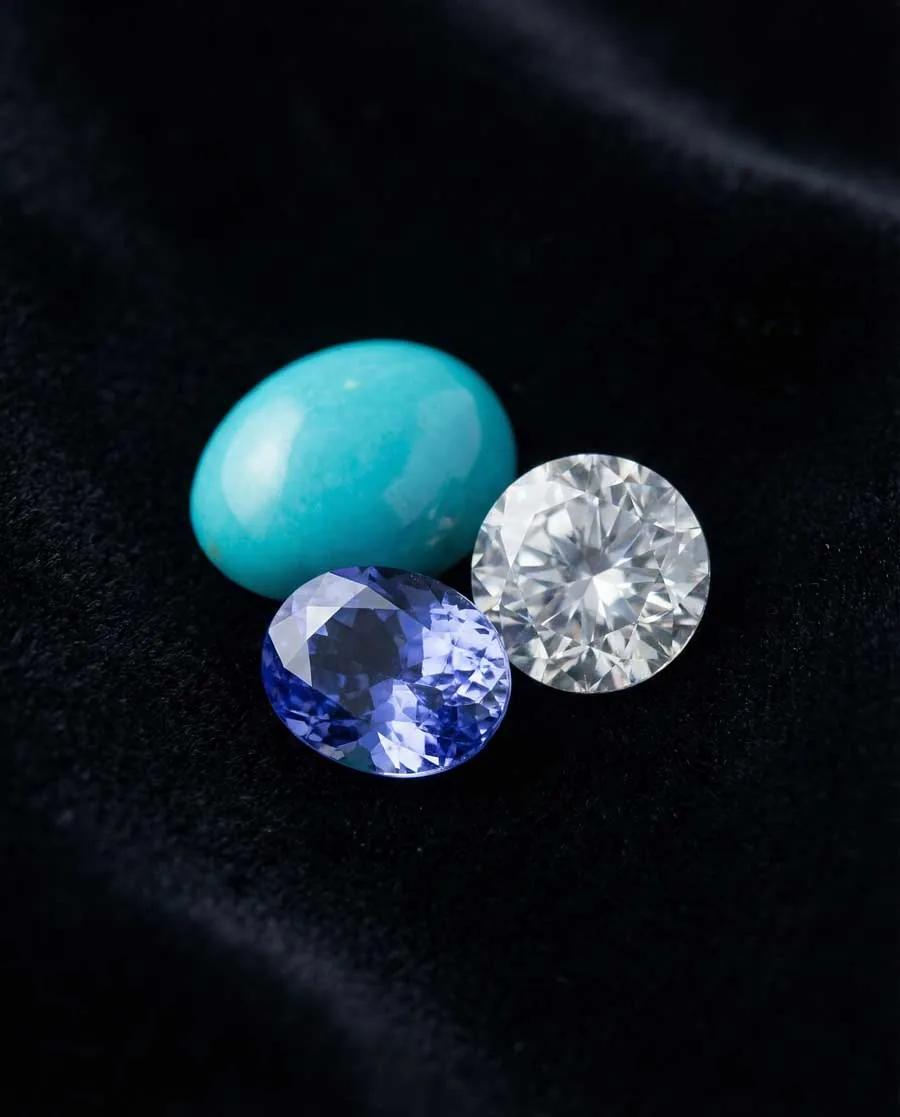
Turquoise sits at 5 to 6 on the Mohs scale. Sapphire sits at 9. That gap is the whole story of owning turquoise jewelry, and almost nobody raises it before the sale.
Here is the short answer. Yes, you can wear turquoise every day, and plenty of pieces look better for it. But turquoise is porous, so it drinks whatever is on your skin, and it is soft enough that a kitchen counter wins the argument. Where you wear it on your body matters more than what you paid for it.
This guide covers what happens after the purchase. Which metals actually flatter the stone. What to pair it with, and how much is too much. Whether it survives real life. How to clean it without stripping the color, and why a stone drifting from sky blue toward green is behaving exactly as it should.
If you are still working out whether a stone is genuine or what it ought to cost, start with our turquoise buying guide. That one handles imitations, grading and price. This one assumes the piece is already yours.
One disclosure first. We source in Sri Lanka, and Sri Lanka has no turquoise, so we do not keep it in stock. Nothing below is written to move inventory.
- Hardness (Mohs)
- 5 to 6. Softer than the quartz in household dust, which is what dulls it
- Everyday wear
- Excellent for earrings and pendants. Occasional for rings and cuffs
- Best setting for a ring
- Bezel or channel inlay. Never exposed prongs
- Cleaning
- Dry microfiber cloth. No soap, no dips, no ultrasonic, no steam
- Water
- Remove before showering, swimming, the gym and washing up
- Metals
- Silver keeps it crisp, yellow gold deepens the blue, rose gold suits green stones
- Color change
- Slow drift is normal patina. Sudden change means chemical or heat damage
- Treatment
- Most quality pieces are stabilized with resin, which locks the color in place
How to Wear Turquoise Jewelry: Metals, Outfits and How Much Is Too Much
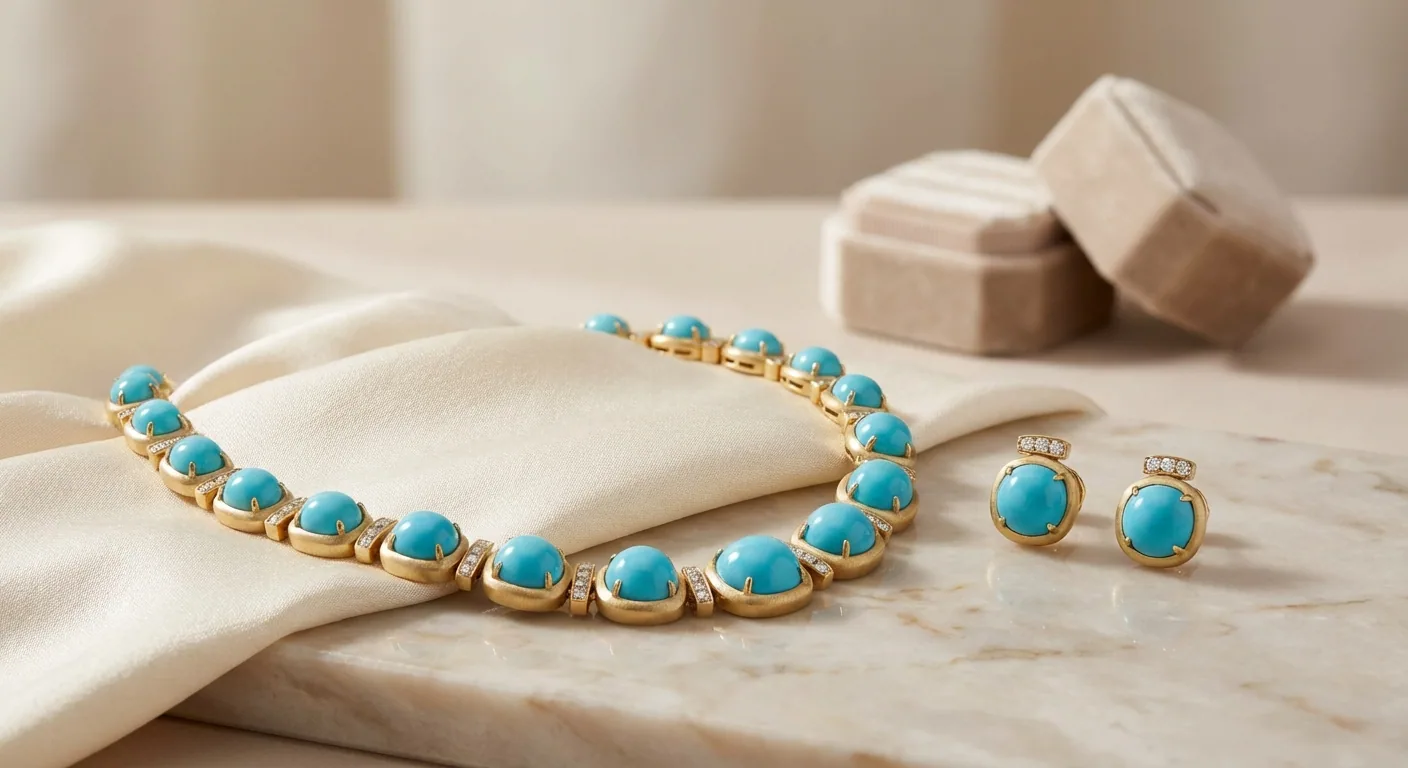
Turquoise is one of the few opaque stones that reads as rustic or refined depending on nothing more than its setting. A 30 mm cabochon in hand-stamped silver says one thing. A 6 mm bezel on a thin gold chain says something else entirely. Same mineral, completely different sentence.
Silver or gold: what the metal does to the color
The metal is a frame, and it changes how the blue reads. Sterling silver is the traditional partner: cool against cool, which keeps the stone crisp. Yellow gold does the opposite. Warm metal against cool blue pushes the contrast, and the same stone looks deeper and more saturated than it did in silver.
One personal opinion, offered as an opinion. Green-leaning turquoise in yellow gold is the most underrated pairing in the category, and almost everyone reaches for blue in silver by default.
Metal | What it does to the blue | Best with |
|---|---|---|
Sterling silver | Cool against cool. Keeps the stone crisp and slightly graphic, the traditional Southwestern read. | Sky blue and high matrix stones, bold cuffs, inlay work |
Yellow gold | Warm against cool. Pushes the contrast so the blue looks deeper and more saturated than it does in silver. | Fine matrix-free blue, small bezels, evening pieces |
Rose gold | Fights pure sky blue. Genuinely good with the greener material, where it reads soft rather than clashing. | Green and blue-green stones, modern minimal settings |
What to wear with turquoise jewelry
Turquoise is a saturated color on an opaque body. It behaves like an accent, not like a diamond, and it needs a quiet background to do its work.
Black. The easiest pairing there is, and the reason turquoise with a black dress gets searched so often. Maximum contrast, nothing competing. One strong piece: the neckline or the ears, not both.
White and cream. Softer contrast, reads coastal rather than western. Suits the paler Sleeping Beauty style blue.
Denim and leather. The classic, and it works for a reason. Indigo and turquoise sit close together, so the effect is tonal rather than a clash.
Warm neutrals. Camel, rust, olive. Green turquoise belongs here far more comfortably than blue does.
Busy prints. Skip it. Turquoise loses every fight with a loud pattern.
How much turquoise is too much
There is a real answer to this one. Pick a single area of the body and commit to it. A statement cuff with bare ears. A squash blossom with plain hands. Stacked rings and nothing at the throat.
It goes wrong when three separate pieces compete at three different scales, because the eye has nowhere to rest and the whole thing tips over into costume. If you do want to layer, hold the stones inside one narrow color range and vary only the size.
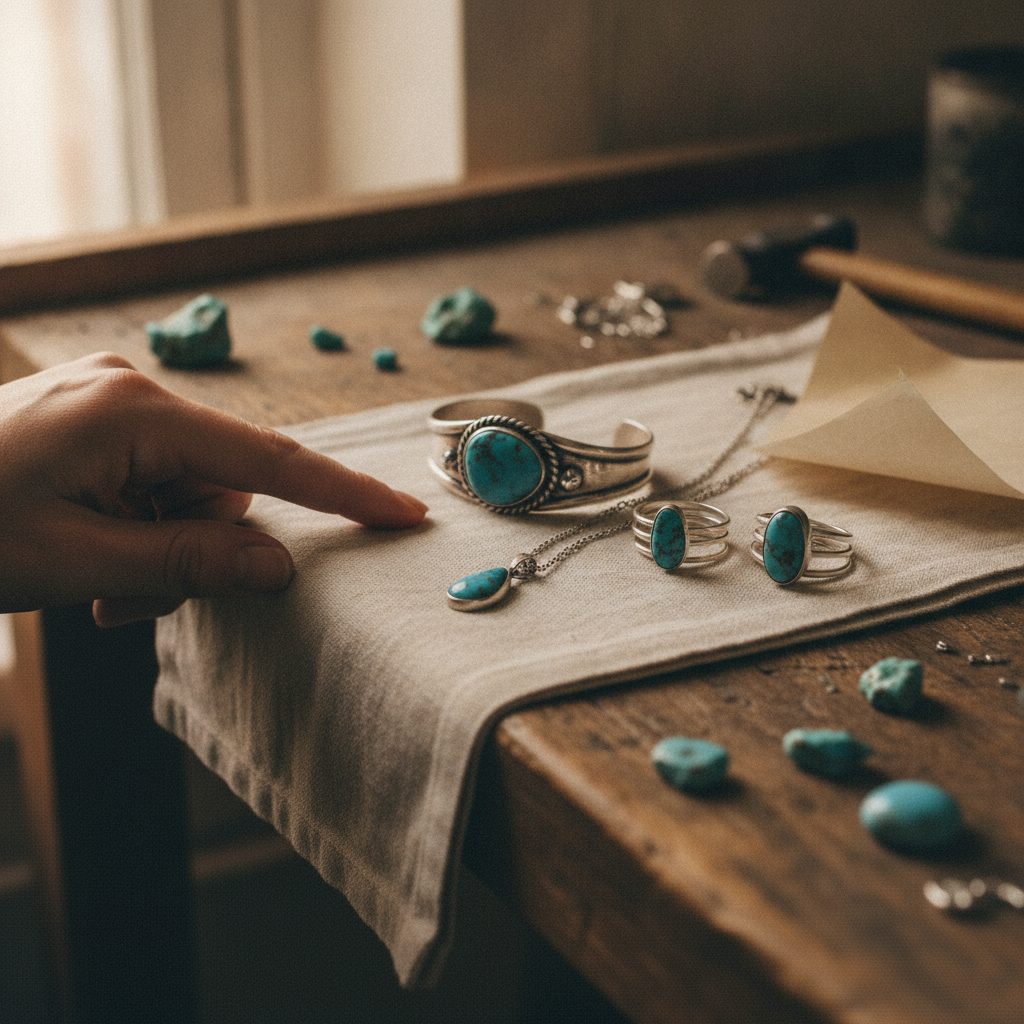
Can You Wear Turquoise Jewelry Every Day?
Yes, on one condition. The piece has to be built for it, and it has to sit in the right place on your body.
At 5 to 6 on the Mohs scale, turquoise is softer than window glass and much softer than the sapphire and spinel we handle week to week. Here is the part that surprises people: ordinary household dust contains quartz, which sits at 7. That is the real mechanism behind the dulling everyone notices after a year or two. Not one dramatic knock, but thousands of tiny abrasions from grit caught under a polishing cloth.
Where turquoise survives, and where it does not
Piece | Exposure to knocks and grit | Verdict for daily wear |
|---|---|---|
Earrings | Very low. They hang free and touch almost nothing. | Excellent. Wear them every day. |
Pendant or necklace | Low. Sits on fabric, rarely struck. | Excellent, provided the chain is sound. |
Brooch | Low, though pin backs fail before stones do. | Good. |
Bracelet or cuff | High. Drags across desks, doorframes and car doors all day. | Occasional. Take it off to work at a desk. |
Ring | Highest of anything you own. Hands hit things. | Occasional, and only in a protective setting. |
The setting matters more than the stone
A bezel wraps a continuous wall of metal around the girdle of the cabochon and absorbs the hits the stone cannot. Prongs leave the edges exposed, and edges are exactly where turquoise chips. For a ring you genuinely intend to wear, a bezel is not a style preference. It is structural.
Shadow box mounts and channel inlay work on the same principle: the metal stands proud of the stone surface, so the metal takes the abuse. This is also why so much antique Southwestern silverwork survives a century of wear while a modern prong-set turquoise ring chips in a season.
What actually damages it
Chlorine and salt water. Both attack the resin in stabilized stones and sink straight into untreated ones. A single pool session can flatten the color.
Sunscreen, hand cream and perfume. Oils soak in, and the alcohol in perfume strips the wax or resin on treated stones.
Heat. A hot dashboard, a hair dryer held close. Turquoise is a hydrated mineral, and heat drives the water out. Dehydrated turquoise turns chalky and green, and it does not come back.
Ultrasonic and steam cleaners. The two fastest ways to destroy a piece. Every jeweller who owns a tank has a turquoise story.
The order of operations is simple. Jewelry on last, jewelry off first. Dress, spray, moisturize, then put the turquoise on. Take it off before the shower, the pool, the gym and the washing up.
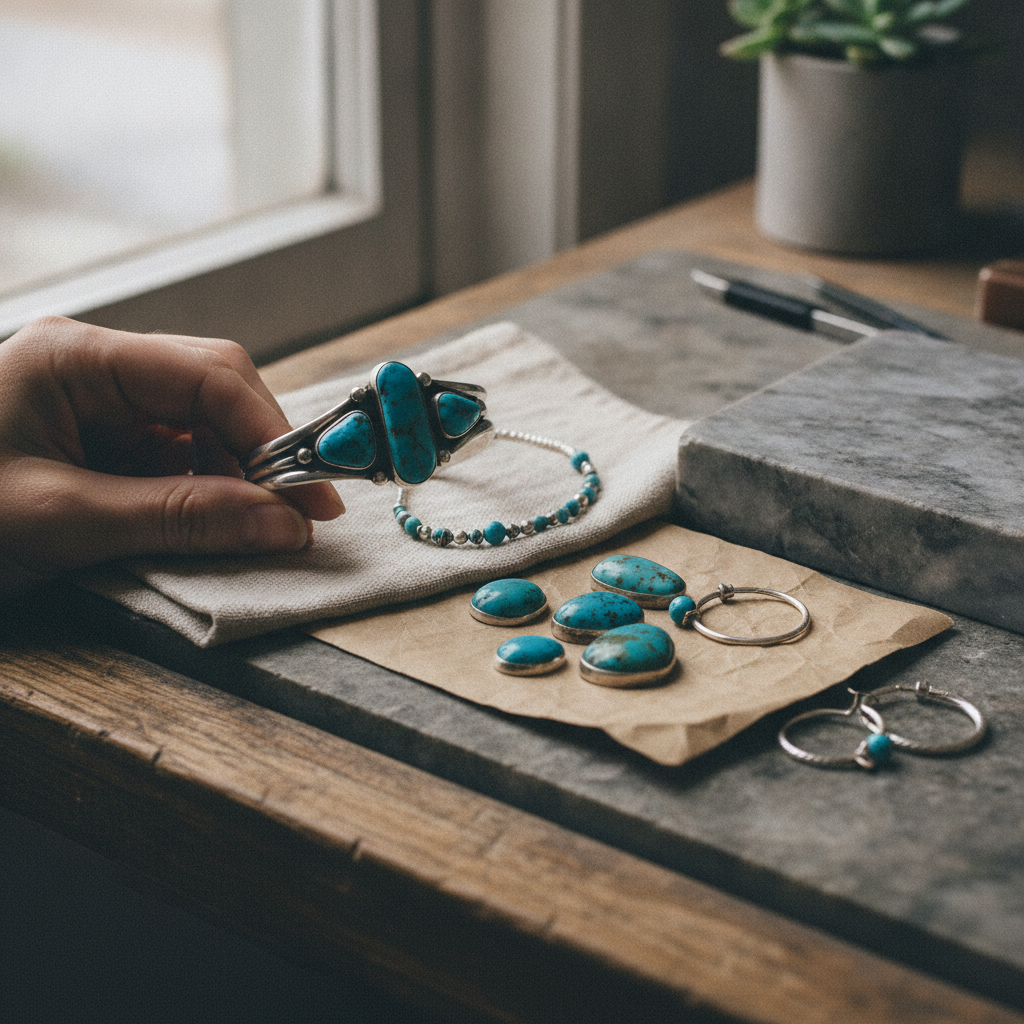
Natural, Stabilized or Reconstituted: the Treatment Decides Your Care Routine
The word "real" does more damage in the turquoise trade than any other. Three very different materials are all sold as real turquoise, and they behave in completely different ways once you start wearing them. This is the one piece of buying knowledge you cannot skip after the fact, because it sets your care routine.
Material | What it actually is | How it behaves once you wear it |
|---|---|---|
Natural, untreated | Hard enough to cut and polish with nothing added. Under 3 percent of what reaches the market. | Porous. Takes up skin oils, drifts in color over years. Rewarding and demanding in equal measure. |
Stabilized | Infused with clear epoxy resin under pressure, which fills the pores and hardens the stone. | Sealed. Color stays where it started. The practical choice for something worn daily. |
Reconstituted or block | Turquoise powder and fragments bonded with resin, usually dyed. | Uniform, flat color that never develops. Wears like plastic, because it largely is plastic. |
Stabilization is not a scam and it is not a dirty word. It is the reason most turquoise on the market is wearable at all, and any honest seller will tell you which of the three you are holding. The problem in this trade is silence, not treatment.
If you do not know which one you own, assume it is natural and treat it gently. Nothing is lost by being careful with a stabilized stone. A great deal is lost by scrubbing an untreated one. Our turquoise buying guide walks through the tests that separate the three, along with what each grade should cost.
For the color and durability ranges we work to, and an honest note on why a Sri Lankan sourcer does not stock this stone at all, see our turquoise page. Turquoise is also the traditional December birthstone, which is where most people meet it for the first time.
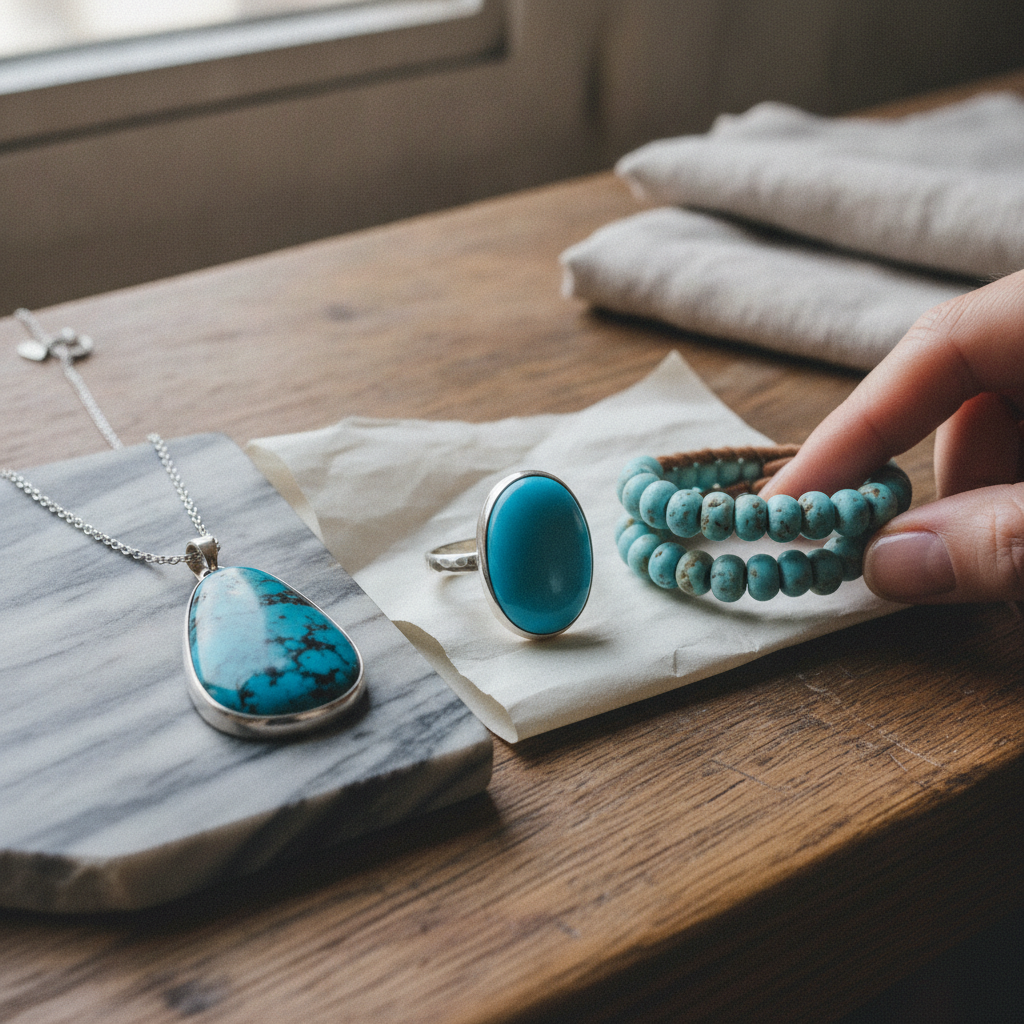
How to Clean Turquoise Jewelry (and the Silver Around It)
Cleaning turquoise is mostly an exercise in doing less than you want to. No soak, no solution, no machine. A dry cloth handles most of it.
The routine that works
Wipe the stone after each wear. Soft, dry microfiber, ten seconds. This single habit matters more than everything else combined, because it lifts skin oils before they soak in.
Every few weeks, damp and not wet. Barely dampen one corner of the cloth with plain water, wipe the stone, then dry it immediately with the other end. Never hold it under a tap.
Use a dry brush for the settings. A soft artist brush or a baby toothbrush, no water, lifts dust out of the crevices around a bezel or an inlay channel.
Dry it properly before it goes away. Moisture trapped under a bezel is a slow problem you will not see until it is done.
Never use soap, dish detergent, jewelry dip, ammonia, alcohol, an ultrasonic tank or a steamer. Commercial cleaners are formulated for hard, non-porous stones. On turquoise they strip wax, cloud resin and pull color out.
The silver problem nobody warns you about
This is the question that actually stumps people, and it is fair, because the two halves of the piece want opposite treatment. Sterling silver tarnishes and wants a chemical polish. Turquoise is porous and that same polish will ruin it. So you separate the jobs.
Fold a treated silver polishing cloth small and work the metal only. Keep the cloth off the stone entirely, including the join where they meet.
Never put a piece with a set turquoise into a liquid silver dip. The stone wicks the solution in through the girdle line and it does not come back out.
For heavy tarnish in deep stamp work, a silversmith can polish it properly with the stone masked off. It costs very little and it is the right call.
Prevention beats cleaning. Store the piece in a closed pouch with an anti-tarnish strip and the silver will barely turn in the first place.
Situation | Do | Do not |
|---|---|---|
Routine cleaning | Wipe the stone with a soft dry microfiber cloth after each wear. | No soap, detergent, jewelry dip, ammonia or alcohol. Never soak it. |
Getting dressed | Jewelry goes on last, after cosmetics, hairspray, lotion and perfume have dried. | Do not spray perfume over a piece you are already wearing. |
Water | Take it off for showers, pools, the sea and washing up. | No ultrasonic tanks, no steam cleaners, no running it under a tap. |
Heat and light | Keep it out of hot cars and away from a hair dryer at close range. | Do not leave it on a sunny windowsill. Turquoise is a hydrated mineral and heat drives the water out. |
Storage | Its own pouch or a lined compartment, with an anti-tarnish strip if the setting is silver. | Do not store it loose beside sapphires, rubies or anything else harder than it. |
For everything else in the box, our jewelry care and maintenance guide covers the harder stones, which tolerate a great deal more handling than this one does.
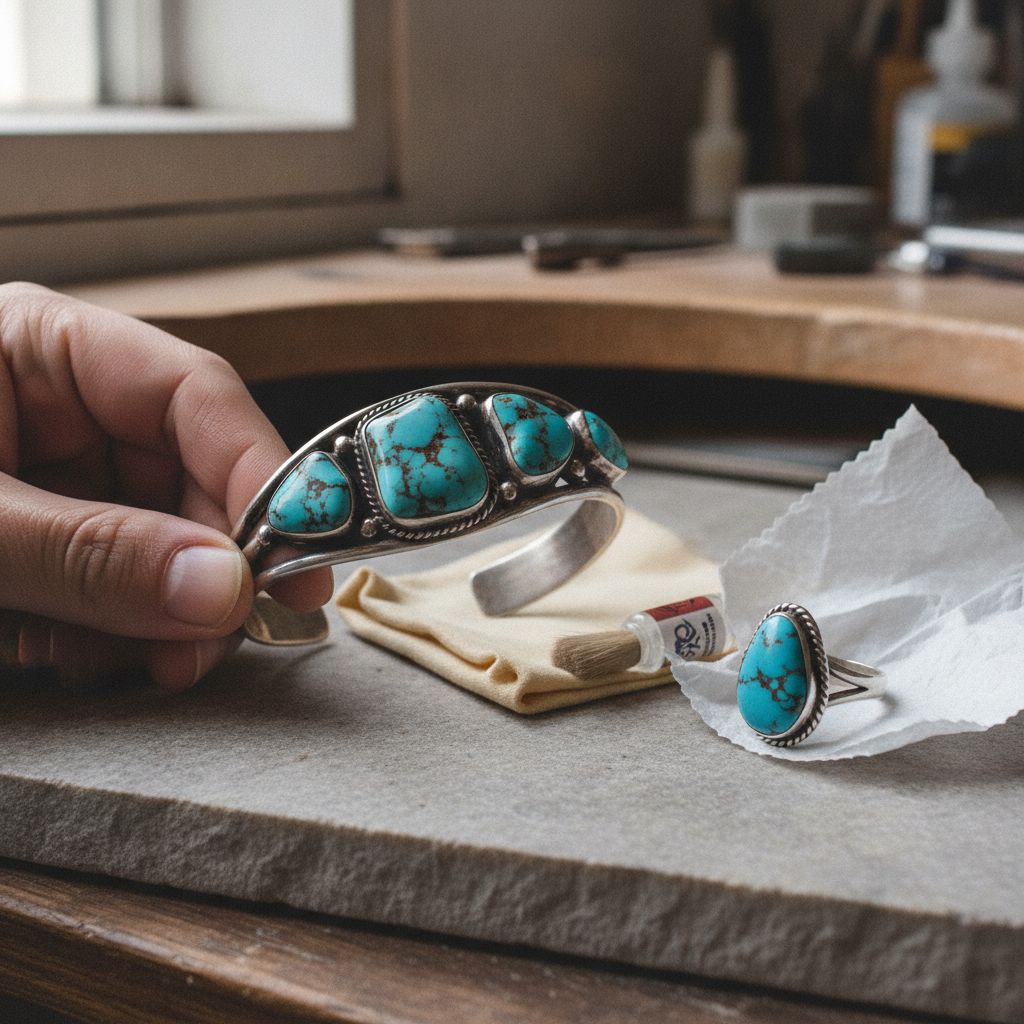
Why Turquoise Changes Color, and Why That Is Not Damage
One day the stone is not quite the blue you remember. It has gone slightly green, or a shade deeper, and the first assumption is always that something has been ruined.
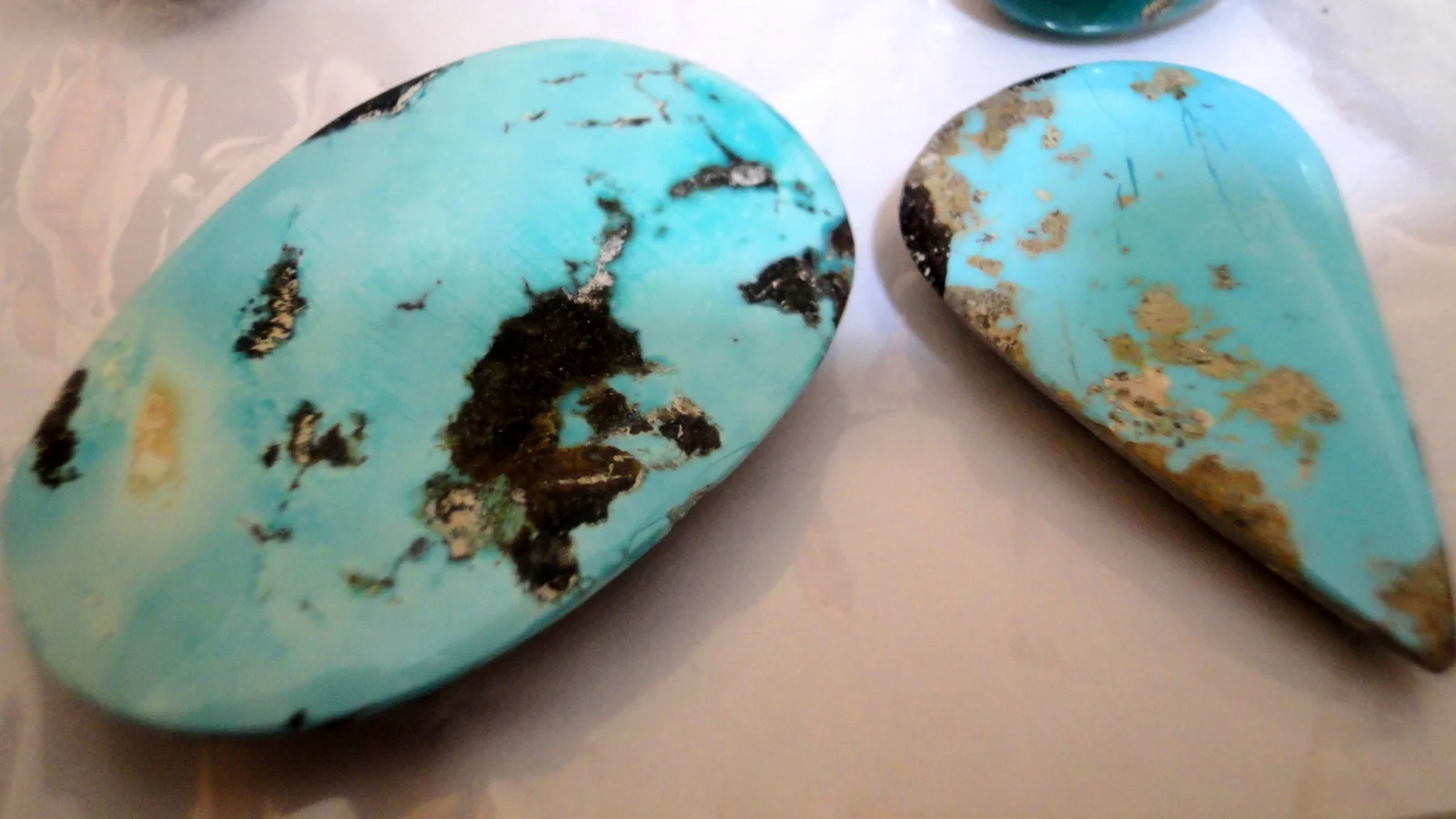
Usually nothing has. Untreated turquoise is porous by nature, and across years of skin contact it takes up trace oils. The copper that gives turquoise its blue is sensitive to that chemistry, so the hue drifts. Collectors call the result a patina, and in the old pawn market it counts as a mark of authenticity, because dyed howlite and reconstituted block cannot do it.
There is a distinction worth holding onto, and the timescale is what tells you which one you have. Slow drift over years, spread evenly across the stone, is patina. A sudden shift, a chalky surface, a milky patch, or green that arrives in days rather than seasons, is chemical damage from a solvent, a cleaner or heat.
Stabilized turquoise mostly will not do this at all. The resin seals the pores, the color is locked at the moment the stone left the workshop, and it will look much the same in twenty years. That is a perfectly legitimate preference. It also means the stone will never carry any record of you.
Which is the part worth sitting with. Nearly every stone we handle is prized for not changing. A sapphire at 9 on Mohs gets bought precisely because it will outlast the person wearing it, unchanged and indifferent. Turquoise offers the opposite deal. It is the rare stone that is altered by the person who wears it, and the alteration is the whole point.
That makes it a poor thing to buy as a store of value and an unusually good thing to buy because you like it. A turquoise cuff worn daily for thirty years is not a preserved asset. It is a record of a life. We would take that trade every time.
Quick answers
Can you wear turquoise jewelry every day?
How do you clean turquoise jewelry at home?
How do you clean silver and turquoise jewelry together?
Can you shower or swim with turquoise jewelry?
What should you wear with turquoise jewelry?
Does turquoise look better in silver or gold?
Can you wear turquoise jewelry with a black dress?
How much turquoise is too much at once?
Why did my turquoise jewelry change color?
Is turquoise a good stone for a ring you wear daily?
Is turquoise jewelry worth anything?
What is the birthstone for December?
The short version
Turquoise asks more of you than a sapphire does, and it gives back something a sapphire never will. Keep it off your hands and away from water. Wipe it after wearing. Let the silver be polished on its own. Choose a bezel if it is going on a finger. Do that much and the piece will outlast every revival that keeps rediscovering this stone.
We do not stock turquoise, because we buy where we know the ground and that is Sri Lanka. The rules above hold wherever your turquoise jewelry came from. If you want to see the stones we do hold, or you would rather we went looking for something specific, both doors are open.