3 Carat Diamond Ring: Everything You Need to Know Before Buying
Discover how to select the perfect 3 carat diamond ring. This expert guide reveals how to maximize brilliance, balance the 4Cs, and ensure your investment truly shines.
3 Carat Diamond Ring Quick Facts
| Property | Details |
|---|---|
| Carat Weight | 3.00 carats (600 milligrams) |
| Visual Size (Round) | ~9.3mm diameter (varies by cut) |
| Recommended Cut | Excellent (GIA) or Ideal (AGS) |
| Recommended Clarity | VS1 or higher (for eye-clean large facets) |
| Recommended Color | G-H (white metals), I-J (yellow/rose gold) |
| Certification | GIA (Gemological Institute of America) essential |
| Recommended Metal | Platinum (for superior strength and security) |
| Setting Security | 6-prong or cathedral setting advised |
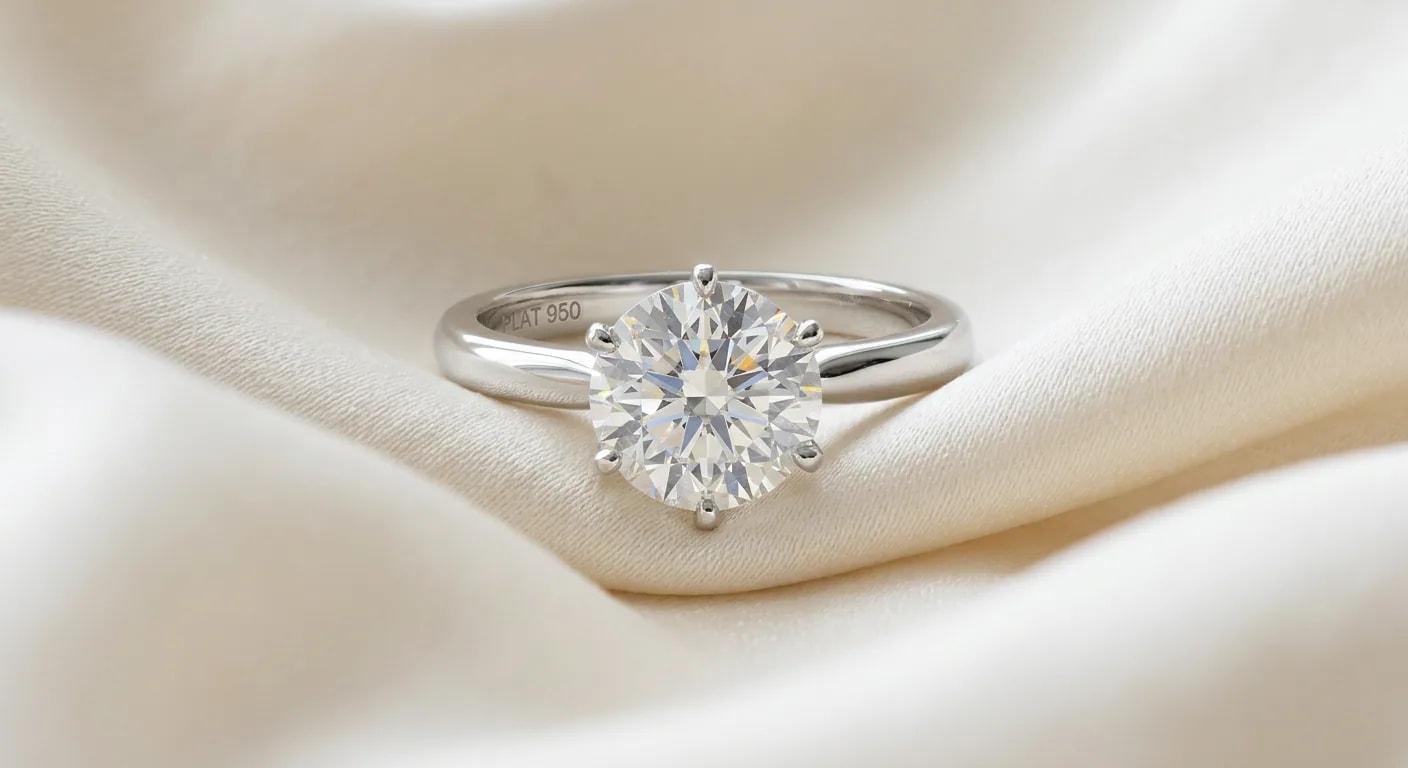
A 3 carat diamond ring stops people mid-sentence. We've seen it at our Colombo showroom — clients walk in asking for "something substantial," and the moment they slip on a 3 carat round brilliant, the conversation changes entirely. This size isn't just bigger. It's a different category.
A 3 carat diamond ring features a center stone weighing 0.6 grams, typically measuring 9.3mm in diameter for a round brilliant cut. It's significantly larger than the average engagement ring and coveted for both its visual impact and genuine rarity.
Here's the thing: buying a 3 carat diamond isn't just about the budget. It's about knowing which quality factors actually matter at this size — because at 9mm+, every flaw is magnified, every cut decision shows. We source directly from cutters in Sri Lanka, so we've handled hundreds of these stones. The choices that matter most might surprise you.
How Big Is a 3 Carat Diamond, Really?
Let's be honest — carat weight is one of the most misunderstood specs in diamond buying. "3 carats" tells you the mass (0.6 grams, to be exact), not how large the stone looks on a finger. Two 3 carat diamonds can look completely different depending on cut and shape.
Carat Weight vs. Visual Size
A well-cut 3 carat round brilliant measures roughly 9.3-9.4mm in diameter. A poorly cut stone of identical weight might measure only 8.8mm — hidden weight in the depth, less stone on the finger. When we evaluate stones at our cutting partners in Sri Lanka, we reject anything that buries weight where no one can see it.
The shape you choose also changes the perceived size dramatically:
| Diamond Shape | Typical Dimensions (3ct) | Surface Area | Visual Impact |
|---|---|---|---|
| Round Brilliant | 9.3-9.4mm diameter | ~68mm2 | Standard benchmark |
| Oval | 11.5 x 8.0mm | ~72mm2 | Appears larger |
| Pear | 12.5 x 8.0mm | ~74mm2 | Appears larger |
| Marquise | 14.0 x 7.0mm | ~77mm2 | Significantly larger look |
| Cushion | 8.5 x 8.5mm | ~65mm2 | Slightly smaller face-up |
| Emerald Cut | 9.5 x 7.0mm | ~66mm2 | Slightly smaller face-up |
Elongated shapes (ovals, pear cuts, marquise) run the length of the finger, making the ring look larger overall. If finger coverage matters, these shapes win every time over a round of the same weight.
Finger Size Changes Everything
A 3 carat round on a size 4 finger is a statement piece that dominates the hand. On a size 8, it reads as balanced and proportional. Neither is wrong — but it's worth trying both before committing. We always recommend clients see the stone on their actual finger, not just in a display tray.
Looking for the right stone? Explore our certified collection of hand-selected gems.
The 4Cs at 3 Carats: What Changes
The 4Cs apply to every diamond, but their weight shifts dramatically at 3 carats. What's forgivable in a 1 carat stone becomes visible at 9mm+. Here's how we think about each one when sourcing at this size.
Cut: Non-Negotiable at This Size
Cut is the single most important factor for a 3 carat stone. Full stop. An Excellent (GIA) or Ideal (AGS) grade is the only starting point worth considering. A superior cut drives brilliance (white light), fire (colored flashes), and scintillation (movement sparkle) — and at this size, cutting inaccuracies show up fast. A shallow cut leaks light out the bottom; a deep cut creates a dark center. We personally prefer buying just below Excellent rather than stretching the budget on a larger stone with a mediocre cut.
Clarity: VS1 or Better
For stones under 1 carat, VS2 is often fine. At 3 carats, the larger facets act like a magnifying window. Inclusions that were invisible at 1 carat become noticeable. Our recommendation: VS1 as the floor, especially for step cuts like emerald or Asscher where the open table leaves nothing to hide. Check the grading plot carefully — a single inclusion under the table is far more visible than multiple smaller ones near the girdle.
Color: G-H Is the Sweet Spot
At 3 carats, body color shows more than in smaller stones. D-F (colorless) costs a significant premium for a difference that's invisible once the ring is set. We consistently recommend G or H for white metal settings — they look colorless in real life, and you can redirect that budget to cut quality. For yellow gold or rose gold, I-J works beautifully; the warm metal complements any faint warmth in the stone rather than fighting it.
Carat Weight: The Rarity Jump
Here's what most buyers don't realize: diamond prices don't scale linearly. A 3 carat stone is exponentially rarer than three 1 carat stones of equivalent quality. That rarity is priced in. The table below shows why quality beats raw weight every time:
| Scenario | Weight | Cut | Clarity | Color | Result |
|---|---|---|---|---|---|
| A: Max Weight | 3.10ct | Good | SI2 | J | Visible inclusions, dull, warm tint |
| B: Balanced | 3.01ct | Excellent | VS2 | H | Brilliant, eye-clean, appears white |
| C: Max Brilliance | 2.90ct | Excellent | VS1 | G | Exceptional sparkle, very clean, best value |
Scenario C is what we'd buy. A 2.90ct stone with an Excellent cut simply outperforms a 3.10ct with compromised quality in every category that matters visually.
How Much Does a 3 Carat Diamond Ring Cost?
There's no single answer, but there are honest ranges. The price of a 3 carat diamond isn't linear — rarity compounds. Finding a gem-quality rough capable of yielding a polished 3 carat stone is exponentially harder than finding one for a 1 carat. That scarcity shows up in the price per carat.
What Drives the Price
- Cut quality: An Excellent cut commands a 10-20% premium over Very Good — worth every cent at this size.
- Clarity and color: Moving from VS2 to Flawless, or from G to D, can add $20,000-$50,000 for no visible difference to the naked eye.
- Shape demand: High-quality ovals are currently commanding premiums due to strong market demand relative to supply (as of early 2026).
- Certification: GIA certification is non-negotiable. Without it, you're trusting a seller's word on a $40,000+ purchase.
Realistic Price Ranges (2025-2026)
| Quality Tier | Color | Clarity | Cut | Price Range (USD) |
|---|---|---|---|---|
| Good Value | I-J | SI1-VS2 | Very Good+ | $25,000-$40,000 |
| Excellent Quality | G-H | VS1-VS2 | Excellent | $40,000-$65,000 |
| Investment Grade | D-F | VVS2-IF | Excellent | $70,000-$120,000+ |
The "Excellent Quality" tier at $40-65K is where we'd focus for most buyers — it's visually identical to investment grade for anyone without a loupe.
Looking for the right stone? Explore our certified collection.
Online vs. In-Person Pricing
Online retailers run lower overhead, so prices are genuinely more competitive — 15-30% cheaper is common. But for a $50,000 stone, due diligence matters: insist on 360-degree video of the actual stone (not stock photos), secure insured shipping, and a real return policy. Always verify the GIA report number on gia.edu directly before any payment is made.
Settings for 3 Carat Diamonds
Choosing a setting for a 3 carat stone isn't just about looks — it's an engineering decision. A stone this size and value needs a setting built to hold it securely for decades of daily wear.
The Best Setting Styles
- Solitaire: The classic choice. Nothing competes with the diamond for attention. A cathedral solitaire — where arched metal rises to support the head — adds structural integrity while elevating the stone. Our top recommendation for maximizing visual impact.
- Halo: A ring of smaller diamonds around the center stone adds overall sparkle and makes the 3 carat look even larger. Also provides some girdle protection.
- Three-stone: Flanking the center with two smaller stones (pears, trillions, or rounds) creates a rich, substantial look. The side stones must complement the center rather than compete with it — we prefer a 60/40 size ratio minimum.
- Pave band: Small diamonds set along the band add brilliance without competing with the center. Requires regular prong checks to keep tiny stones secure.
Metal: Platinum First
For a 3 carat stone, platinum is our default recommendation. It's denser and more durable than white gold — prongs don't wear away over time, meaning the stone stays put. Its naturally white color also keeps D-H color grades looking their best without any yellow cast. White gold works too, but factor in rhodium replating every 12-24 months. Yellow and rose gold pair well with I-J color stones, where the warm metal masks any faint body color.
Securing the Stone
| Feature | Recommendation | Why |
|---|---|---|
| Prong count | 6 prongs over 4 | If one prong bends, five still hold the stone |
| Prong style | Claw prongs | Stronger grip, less diamond surface covered |
| Band width | 2.0-2.5mm minimum | Prevents warping under the weight of the head |
| Setting height | Medium cathedral | Balances light entry with snag protection |
Have the prongs inspected every six months. At this value, that's not excessive — it's just good practice.
How to Buy a 3 Carat Diamond Safely
At $40,000-$65,000+, this is one of the most significant purchases most people will ever make. Here's how we'd approach it.
GIA Certification Is the Starting Point
Every 3 carat diamond worth considering comes with a GIA or AGS grading report. These two labs maintain the strictest, most consistent standards globally. The report tells you the precise weight, color, clarity, and — critically at this size — the cut grade. Without independent certification, you're trusting a seller's word on a major investment. Don't.
Verify Before You Buy
Every GIA-graded diamond has its report number laser-inscribed on the girdle — invisible to the naked eye, but readable under 10x magnification. Plug that number into GIA's online report database and confirm every detail matches what you're being sold. For online purchases, this step is non-negotiable. Also insist on HD 360-degree video of the actual stone — not a generic render — before committing.
Ready to find your perfect stone? Browse our certified collection.
Budget Optimization Strategies
| Strategy | Recommendation | Why It Works |
|---|---|---|
| Prioritize cut | Excellent/Ideal only | Biggest impact on beauty — masks lesser color or clarity |
| Optimize clarity | VS1 or VS2 (eye-clean) | IF/VVS costs a huge premium for zero visible gain |
| Optimize color | G-H in white metal, I-J in yellow/rose | D-F premium rarely justified visually |
| Buy under the mark | 2.90-2.99ct instead of 3.00ct | Prices jump at round carat weights — 0.05ct difference, big savings |
| Consider fancy shapes | Oval, pear, marquise | Larger face-up appearance for the same weight and often lower price |
We personally think the "buy under the mark" trick is underused. A 2.97ct Excellent cut looks identical to a 3.00ct on the finger and can save $3,000-$8,000 depending on the stone.
Caring for a 3 Carat Diamond Ring
A stone this valuable deserves proper maintenance. Diamonds are tough — hardest natural material on Earth — but the setting and prongs aren't, and daily wear takes its toll.
Cleaning: Simple and Regular
- At home: Warm water, mild dish soap, 20-30 minutes soak, soft toothbrush underneath the stone. Rinse well, dry with a lint-free cloth. Do this weekly if you wear it daily.
- Professional cleaning: Every six months at a qualified jeweler — ultrasonic cleaning reaches where a toothbrush can't, and the jeweler checks prong security at the same time. For a 3 carat stone, this is worth scheduling in the calendar.
What to Avoid
Remove the ring before exercise, gardening, swimming in chlorinated pools, or cleaning with bleach. Diamonds don't scratch — but settings do, and a sharp enough impact can chip a stone. When you're not wearing it, store it separately in a soft pouch or padded box. A loose diamond will scratch every other piece of jewelry it touches.
Insure It
Standard homeowner or renter's insurance has low limits on jewelry — often $1,000-$2,500. That covers nothing for a 3 carat diamond ring. Get a dedicated jewelry insurance policy. You'll need a current appraisal from a certified gemologist (reference the GIA report for accuracy). Cost is typically 1-2% of the stone's value annually — a small price for real peace of mind on a $50,000+ piece.
Create Your Perfect Ring
Create Your Perfect Ring
Your unique ring starts here. Joalys' 3-step process:
- Select Your Stone - Browse certified gemstones
- Receive & Inspect - Luxury authentication case
- Design Your Setting - Work with expert jewelers
Frequently Asked Questions
Conclusion
Selecting a 3 carat diamond ring is a significant decision, requiring a careful balance of size, quality, and value. Prioritizing cut quality ensures maximum brilliance, while aiming for eye-clean clarity and a near-colorless grade optimizes the substantial investment required for such a rare stone.
Begin the journey to finding a perfect 3 carat diamond ring with Joalys' unique process: first, select a stunning, certified 3 carat diamond from the curated collection. Next, receive the chosen stone in a luxury authentication case, allowing for personal inspection of its beauty and quality. Finally, design a bespoke setting to perfectly complement the diamond when ready. For personalized guidance at any stage, contact a Joalys expert gemologist to create a truly extraordinary piece.