Ruby Gemstones Guide: Buying Real Rubies & Spotting Fakes
Looking for ruby gemstones? Learn how to buy real rubies, spot fakes, and avoid costly mistakes. Our expert guide covers quality, value, and treatments.
Quick Facts: Ruby Gemstones
| Property | Details |
|---|---|
| Mineral Variety | Corundum (Red) |
| Hardness (Mohs) | 9 (extremely durable) |
| Most Valued Color | Pigeon's Blood (vibrant red, slight blue undertone) |
| Rarity Factor | Unheated rubies are <1% of gem quality |
| Primary Sources | Myanmar (Burma), Mozambique, Madagascar |
| Common Treatments | Heat treatment (widely accepted), glass-filling (avoid) |
| Key Value Drivers | Color (saturation/hue), Treatment Status, Origin |
| Birthstone | July |
Introduction
Rubies have outpriced diamonds per carat at the top end of the market for decades. A 25.59-carat Burmese ruby sold for $30.3 million at Sotheby's Geneva in 2015, setting a world record. That kind of demand has flooded the market with synthetics and misleading treatments. Updated April 2026.
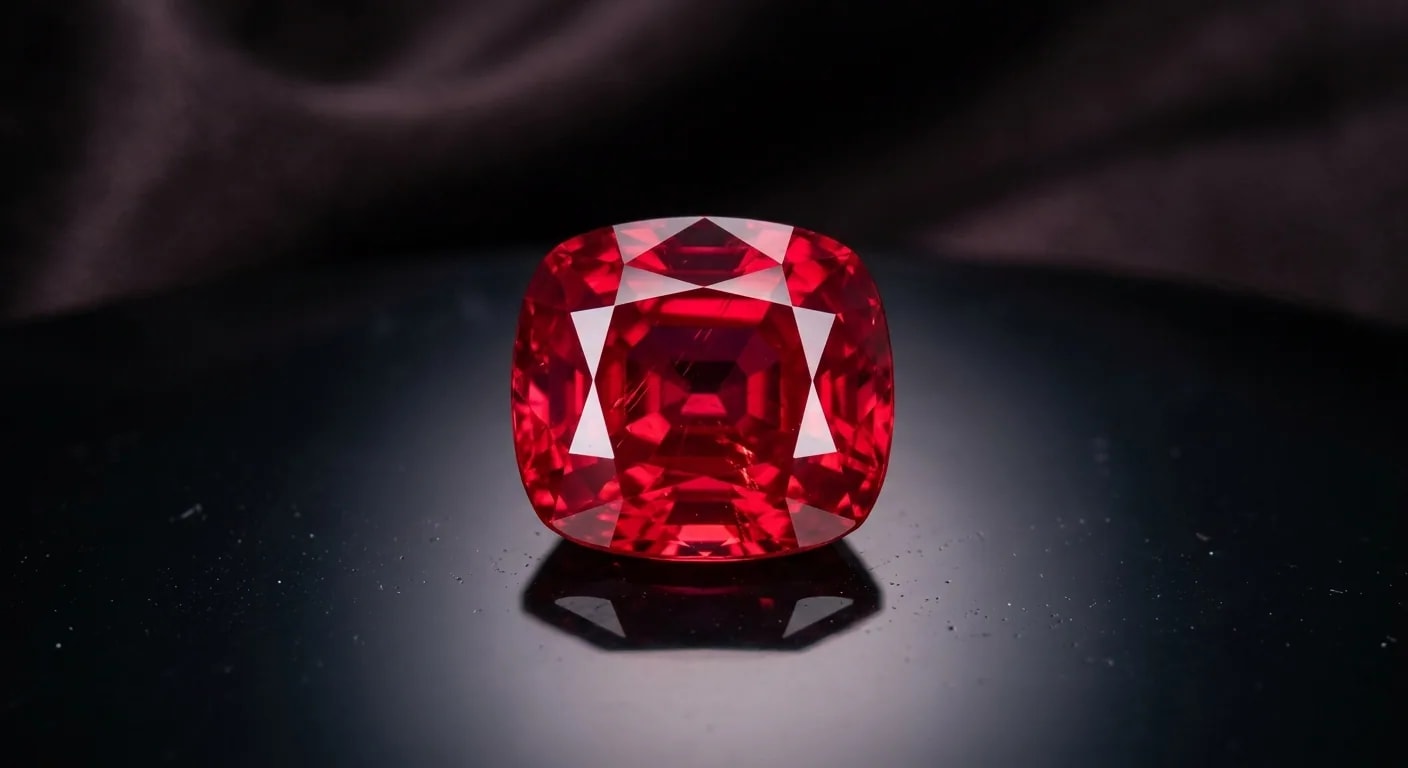
Ruby gemstones are the red variety of corundum, the same mineral family as sapphire. Chromium gives them that vivid red. At 9 on the Mohs scale, they are among the hardest gems you can buy. Fine natural rubies are genuinely rare, especially unheated ones, and value comes down to three things: color, origin, and treatment status.
Here's the thing: over 95% of rubies sold today are heat-treated to boost color. Glass-filled composites flood the lower price ranges. Knowing how these factors shift value is not optional. It separates a smart purchase from an expensive lesson.
Ruby is red corundum, colored by chromium, same mineral family as sapphire. Mohs hardness of 9 makes it excellent for daily wear. Color is the single biggest value factor: vivid pure red to slightly purplish red. Over 99% of rubies are heat-treated. Unheated stones represent under 1% of the market and sell at a 2-5x premium. Top sources in 2026: Myanmar (Mogok), Mozambique, Madagascar. July birthstone, gem of the 15th and 40th anniversaries. Always request a GIA or AGL lab report before buying.
Decoding Ruby Quality: The 4 Cs and Beyond
Grading rubies gemstones comes down to measurable factors. The 4 Cs (Color, Clarity, Cut, Carat Weight) give you the framework, but let's be honest: color does the heavy lifting. According to GIA (2025), color alone accounts for over 50% of a ruby's assessed value.
Color: The Soul of the Ruby
Color is where the money is. Gemologists break it into three components: hue, saturation, and tone. Get all three right, and you have a stone that commands serious premiums.
| Color Component | Description | Ideal Range for Ruby |
|---|---|---|
| Hue | The primary color and any secondary undertones. | Pure red with minimal to no secondary colors. |
| Saturation | The intensity or vividness of the color. | Vivid/Intense. The color should punch. |
| Tone | The lightness or darkness of the color. | Medium to Medium-Dark. Too light reads as pink; too dark kills brilliance. |
A ruby must show a dominant red hue. Secondary tones of orange, purple, or pink knock value down fast. Weak saturation? The stone looks grayish or brownish. Too light in tone, and GIA classifies it as a pink sapphire, not a ruby. Too dark, and it loses all life.
The term "Pigeon's Blood" sits at the top of ruby color grading. It originally described Mogok (Burma) rubies specifically, but labs like AGL and GIA now use it as a color grade standard, not a geographic label. It means a vivid red with high saturation, medium-dark tone, and sometimes a subtle bluish undertone. We've seen Pigeon's Blood grades awarded to stones from Mozambique and Madagascar too. This color profile pulls the highest premiums at auction.
Clarity, Cut, and Carat Weight
Color leads, but these three still move the price needle.
Clarity
Rubies are Type II gemstones. They naturally contain inclusions. Flawless rubies basically do not exist in nature. What you want is "eye-clean," meaning no visible inclusions to the naked eye. Fine rutile needles (called "silk") can actually help. They scatter light, create a soft glow, and at high density produce the rare star ruby (asterism) effect. Big fractures or surface-reaching inclusions? Those hurt durability and tank the price. This is different from diamond clarity grading, where microscopic flaws get scrutinized under 10x magnification.
Cut
Cutters optimize for weight retention over brilliance because rough ruby is extremely valuable per gram. Still, a well-executed cut makes a real difference in how color presents and how much light the stone returns. Symmetry and proportions matter. Oval, cushion, and round are the most common shapes. A badly cut ruby shows dark patches (extinction) that kill the visual impact.
Carat Weight
Price per carat climbs exponentially with size. High-quality rubies over 2 carats are rare. Over 5 carats, they are exceptionally rare. A 3-carat ruby of top quality is not just 3x the price of a 1-carat stone; it can be 8-10x the total price.
Want personalized guidance on selecting a ruby? Talk to our gemologists for bespoke advice. Expert consultation
Authenticity and Treatments: What You Need to Know
Rubies sit at the top of the colored gemstone market in value. That makes them a magnet for synthetics, imitations, and undisclosed treatments. If you are spending real money on a ruby, understanding these risks is what protects your investment. Not optional.
How Can You Tell Natural Rubies Gemstones from Synthetics?
Synthetic rubies have the exact same chemical composition as natural ones. Same crystal structure, same optical properties. The Verneuil flame fusion process has been producing them since the late 1800s. More advanced methods like flux growth and hydrothermal synthesis make detection harder every year.
Here is the catch: a synthetic ruby's near-perfect clarity and saturated color might look ideal to an untrained eye. In reality, those are red flags. Natural rubies almost always contain inclusions, especially rutile silk. Flame fusion synthetics show curved growth lines. Flux-grown synthetics contain characteristic flux fingerprints. A trained gemologist spots these under magnification.
For any purchase above $500, visual inspection alone is not enough. You need an independent lab report from GIA, AGL, or equivalent. That report confirms natural origin and rules out synthetics and simulants like spinel or garnet.
What Is the Price Difference Between Heated and Unheated Rubies?
Treatment status is the second biggest value driver after color. The market draws a hard line between heated and unheated stones.
| Ruby Category | Treatment | Rarity | Value Impact | Disclosure |
|---|---|---|---|---|
| Unheated Ruby | None | <1% of gem quality | 2x-5x+ premium | Mandatory |
| Heated Ruby | High temperature (traditional) | Common (>99%) | Standard market value | Mandatory |
| Flux-Healed Ruby | Heat with flux (fills fissures) | Common | Moderate discount | Mandatory |
| Lead-Glass Filled | Heavy glass infilling | Common | Very low value | Mandatory |
Heated Rubies (Traditional Heat)
Heating is centuries-old and widely accepted. It improves color and dissolves silk to boost clarity. This applies to over 99% of gem-quality rubies on the market. The treatment is permanent and stable. But heated stones are far less rare than unheated ones, and pricing reflects that. The same principles apply to heat treatment in sapphires, where color and clarity get the same boost.
Unheated Rubies (No Heat)
Unheated rubies of fine quality represent under 1% of all gem-quality rubies. That scarcity drives premiums of 2-5x or more compared to heated stones of similar appearance. Collectors and investors target these specifically. A lab report from GIA or AGL confirming "no indications of heating" is mandatory for any stone sold as unheated. No exceptions.
Treatments to Avoid
Flux healing uses heat and a flux material to fill surface-reaching fractures. It introduces a foreign substance into the stone. Lead-glass filling is worse: low-grade corundum gets infused with lead glass to fake clarity. These "composite rubies" are fragile, short-lived, and worth very little. They should never be sold simply as "ruby." In our experience, any seller who does not disclose glass filling upfront is not someone you want to do business with. Check the treatment section of your lab report. If it mentions glass or lead, walk away or pay accordingly.
The Importance of Origin (Beyond Burma)
Where a ruby comes from shapes its physical characteristics, its rarity, and its price tag. Some origins carry centuries of reputation. But fine rubies gemstones come from several countries today, and smart buyers know which ones matter.
Burma (Myanmar) Rubies: The Historical Premium
The Mogok stone tract in Burma has produced legendary rubies for over 600 years. These stones are known for vivid Pigeon's Blood color: deep red, high saturation, a subtle bluish undertone, and a strong UV fluorescence that makes them glow in direct sunlight. That fluorescence is what separates a genuine Mogok ruby from almost everything else. You feel it when you hold the stone in natural light.
Centuries of reputation, shrinking supply, and documented quality mean verified Burmese rubies pull the highest market premiums. A second Myanmar deposit, Mong Hsu, emerged in the 1990s but those stones typically need heat treatment to remove bluish or blackish cores. Origin matters, but individual quality still comes first. A low-quality Burmese ruby is just a low-quality ruby.
Mozambique, Madagascar, and Other Major Sources
New deposits have reshaped the ruby market in recent decades. Mozambique, specifically the Montepuez region discovered around 2009, has become the most significant modern source. According to the Gemfields Group (2024), Montepuez produces rubies with outstanding clarity and a color range that matches fine Burmese material, including Pigeon's Blood grade, at more accessible prices. We source regularly from Mozambique and the quality is genuinely strong.
Madagascar produces everything from commercial grade to investment-level stones, heated and unheated. Sri Lanka leans toward lighter, pinkish-red material. Tanzania and Vietnam fill out the major sources. Each origin has distinct inclusion patterns and color profiles that gemologists use for origin determination.
| Ruby Origin | Color Profile | Clarity Typical | Market Position |
|---|---|---|---|
| Burma (Mogok) | Vivid red, Pigeon's Blood, strong fluorescence | Often included, silk present | Highest premium, collector status |
| Mozambique | Vibrant red, some Pigeon's Blood | Often eye-clean | Primary modern quality source |
| Madagascar | Pinkish-red to pure red | Varied | Versatile, strong investment options |
| Thailand/Cambodia | Darker red, brownish/purplish tones | Often eye-clean | Lower premium due to secondary tones |
| Sri Lanka | Light red to pinkish-red | Varied | Ceylon rubies, softer color profile |
We source rubies directly from mines across Myanmar, Madagascar, Tanzania, Mozambique, and Sri Lanka. Every stone gets cut in Ratnapura. No middlemen, no mystery markup. When you buy from JOALYS, you know exactly where your ruby grew and who cut it. We personally prefer Mozambique material for the clarity-to-value ratio, but a fine Mogok ruby is still the king of the market.
JOALYS
Everything Begins with the Stone
Colour first, everything else after. A ruby is judged on the red it holds.
Keep the ruby loose, or commission a ring made around it — made to order, never off the shelf.
How to Buy Ruby Gemstones with Confidence
Buying rubies gemstones is not like buying a pair of shoes. You are dealing with treatments, synthetics, and a market where information asymmetry is real. The solution is simple: rely on independent lab reports, not seller promises. Here is how to do it right.
Why Is a GIA or AGL Report Non-Negotiable for Rubies Gemstones?
For any ruby above $1,000 in value, get an independent lab report. Not recommended. Required. A certificate from GIA, AGL, or equivalent removes guesswork and protects your money.
Labs like GIA (Gemological Institute of America) and AGL (American Gemological Laboratories) run scientific analysis to confirm identity and quality. For investment-grade rubies above 2 carats, SSEF or Gubelin reports from Switzerland carry the most weight. These reports tell you:
- Species and Variety: Confirms the stone is natural corundum (ruby), not synthetic, and not a different gem like spinel or garnet.
- Geographic Origin: When determinable, the report specifies where the ruby came from (Burma, Mozambique, Madagascar, etc.). Since origin moves the price, this independent opinion matters.
- Treatment Status: The report states whether the ruby is unheated, heat-treated, or treated with flux healing or glass filling. This is the section you read first.
How to read a lab report: go straight to "Results" or "Conclusions" for identification. Then check "Treatment" or "Comments." No mention of heating means the stone is unheated, which is the rarest category.
| Feature | GIA/AGL Certification | Seller Appraisal |
|---|---|---|
| Issuer | Independent third-party laboratory | The seller or affiliated appraiser |
| Objectivity | High, no financial interest in the sale | Potential conflict of interest |
| Analysis Method | Advanced scientific instrumentation | Visual inspection, basic tools |
| Market Acceptance | Universally recognized | Varies widely |
| Content Focus | Factual grading and identification | Estimated replacement value |
Ethical Sourcing and the JOALYS Commitment
Quality and authenticity are one side of the equation. Where and how the stone was mined is the other. Traceability in the gemstone supply chain has improved significantly since 2020, particularly for Mozambique material through the Gemfields auction system.
At JOALYS, our gemologists personally select each ruby. We work directly with mining operations in Sri Lanka, Mozambique, and Madagascar. No anonymous middlemen, no opaque supply chains. Every stone in our collection has documented provenance. That matters to us, and we think it should matter to you too.
Frequently Asked Questions
Frequently Asked Questions About Ruby Gemstones
What are the main value factors of a ruby gemstone?
Color comes first. Vivid, pure red with high saturation is what the market rewards. After color: treatment status (unheated rubies are worth 2-5x more than heated stones), geographic origin (verified Burmese rubies command the highest premiums), clarity (eye-clean preferred), and carat weight. According to GIA (2025), color alone accounts for over 50% of a ruby's total assessed value.
How can I tell if a ruby is real or synthetic?
You cannot tell reliably without proper equipment. Natural rubies almost always contain inclusions like rutile silk and growth features. Lab-grown rubies tend toward near-perfect clarity. A flawless ruby priced suspiciously low with no GIA or AGL report is a red flag. Get the lab report. That is the only reliable answer for any buyer.
What is the difference between a heated and unheated ruby?
Over 99% of rubies on the market are heat-treated to improve color and clarity. This is industry standard, fully accepted. Unheated rubies kept their natural color without any intervention. They represent under 1% of gem-quality material and sell at a 2-5x premium over equivalent heated stones. Always confirmed by lab report.
Why do two 1-carat rubies have such different prices?
Carat weight is just one variable. A 1-carat Pigeon's Blood Burmese ruby, unheated and eye-clean, can cost 10x more than a heated Mozambique stone with lower saturation. Same weight, completely different rarity profile. Color intensity, treatment status, and origin are the real price drivers.
Which gemological certificate should I require for a ruby?
GIA or AGL for most purchases. For investment-grade rubies above 2 carats, SSEF or Gubelin (Switzerland) reports are the gold standard. These certificates confirm natural origin, geographic source when determinable, and every treatment the stone has undergone. Skipping this step is not an option.
Are rubies a good investment?
Fine unheated rubies from top origins like Mogok and Mozambique have appreciated consistently, driven by decreasing supply and growing demand. In our experience sourcing directly from these regions, top-quality material gets harder to find each year. That said, not every ruby is an investment. Commercial-grade heated stones are not. Get expert guidance before any speculative purchase.
Does a Pigeon's Blood ruby always come from Burma?
Not anymore. Pigeon's Blood originally described Mogok rubies specifically, but GIA and AGL now use it as a color grade standard. Fine Mozambique and Madagascar rubies can earn this designation purely on color: vivid red, high saturation, slight bluish undertone. Origin and color grade are assessed separately on the lab report.
What is a composite or glass-filled ruby?
Low-quality corundum heavily treated with lead glass to fill fractures and fake clarity. Fragile, short-lived, very low value. These should never be sold simply as "ruby" because that is misleading. Always check the treatment section of your lab report. If it mentions glass filling or lead infilling, the price should reflect it, or you walk away.
How much does a natural ruby cost per carat?
Prices vary enormously by quality. Commercial heated rubies start around $100-500 per carat. Fine heated rubies run $1,000-5,000 per carat. Top unheated Burmese Pigeon's Blood rubies above 2 carats can exceed $50,000 per carat at auction. According to Gemval (2026), premium unheated rubies appreciated 8-12% annually over the past five years.
Can rubies be worn every day?
Yes. At 9 on the Mohs hardness scale, ruby is second only to diamond in durability. It resists scratching in daily wear better than emerald, tanzanite, or opal. Rubies make excellent engagement ring stones. The one exception: glass-filled rubies are fragile and not suitable for daily wear because the filler can deteriorate with exposure to heat or chemicals.
Frequently Asked Questions
Conclusion
Navigating the market for rubies gemstones requires a clear understanding of the interplay between color intensity, origin, and treatment status. While the "4 Cs" provide a foundation, the specific nuance of color saturation and the distinction between heated and unheated stones are the primary determinants of rarity and value. Securing an independent gemological report from a reputable laboratory is an essential final step to verify these critical factors before purchase.
Your journey to acquiring an exceptional ruby gemstones begins with a curated selection of fine, natural stones. We invite you to explore the exclusive Joalys collection to select your certified gemstone, which arrives in a luxury authentication case. Should you wish to create a truly bespoke piece, our process allows you to design your custom setting when you are ready. For personalized guidance or to discuss investment-grade options, please speak with our expert gemologists today.