Ruby Gemstones: The Complete Buying Guide for 2026
Quick Answer
Ruby is the most valuable colored gemstone, graded on color, clarity, cut, and carat weight. Pigeon blood red from Myanmar commands the highest prices ($12,000-$100,000+/ct), but Mozambique and Sri Lankan rubies offer excellent value. Always ask for GIA or GRS certification, check for heat treatment disclosure, and avoid lead-glass-filled stones. The global ruby market hit $5 billion in 2026.
Updated April 2026
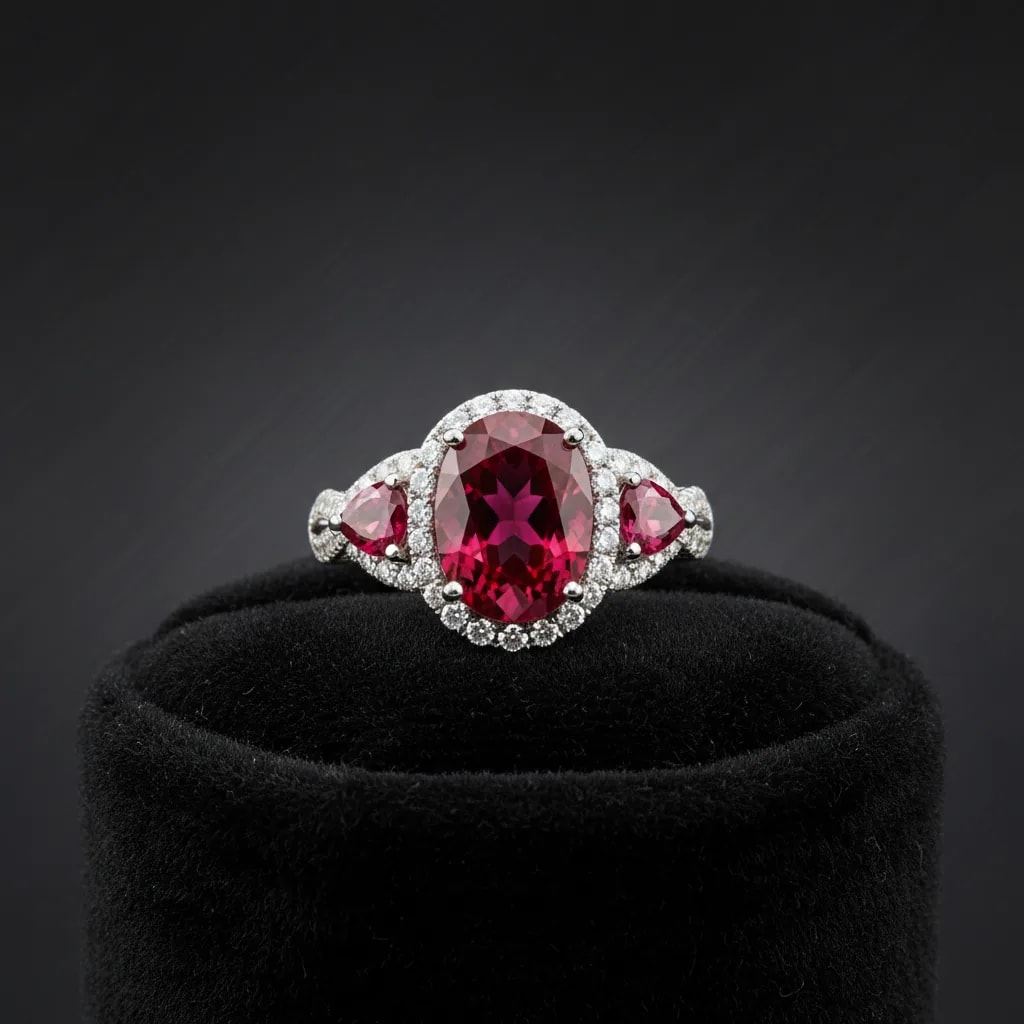
You've decided you want a ruby. Maybe it's for an engagement ring, maybe it's a 40th anniversary gift, or maybe you just fell in love with that deep red glow and can't shake it. We get it. We’ve been sourcing ruby gemstones from Sri Lanka, Myanmar, and East Africa, and that first spark of red still hits different every single time.
Here's the thing: buying a ruby is not like buying a diamond. There's no universal grading report that gives you a neat little score. Color matters more than anything else. And the price gap between a good ruby and a great one can be staggering. A fine 1-carat unheated Burmese ruby can sell for $35,000 per carat. A heated African stone of similar size? Closer to $4,000. That's a 775% difference for what looks almost identical to an untrained eye.
This guide walks you through everything we've learned in 47 years of handling ruby gemstones, from grading and origin to pricing and red flags. Whether you're spending $500 or $50,000, you'll know exactly what to look for.
The Bottom Line on Ruby Gemstones
Ruby is the most valuable colored gemstone, graded on color, clarity, cut, and carat weight. Pigeon blood red from Myanmar commands the highest prices ($12,000-$100,000+/ct), but Mozambique and Sri Lankan rubies offer excellent value. Always ask for GIA or GRS certification, check for heat treatment disclosure, and avoid lead-glass-filled stones. The global ruby market hit $5 billion in 2026.
What Makes Ruby Gemstones So Special?
Ruby is a variety of the mineral corundum, the same species that gives us sapphires. The only difference is chromium. When trace amounts of chromium replace aluminum in the crystal lattice, you get red. More chromium means deeper red. It's that simple, and that rare.
Corundum scores 9 on the Mohs hardness scale. Only diamond sits above it. That makes ruby gemstones tough enough for daily wear, which is partly why they've been prized for thousands of years. Kings wore them into battle. The ancient Burmese believed rubies made warriors invincible. Even today, rubies outsell every other colored gemstone at major auction houses.
But here's what really sets rubies apart: fluorescence. Chromium doesn't just create the red color, it also causes the stone to glow under UV light. In natural sunlight (which contains UV), a fine ruby seems to radiate from within. Gemologists call this "fluorescent fire." No other red gemstone does this. Garnet doesn't. Red spinel doesn't. Only ruby.
According to the Gemological Institute of America (2025), ruby remains the single most sought-after colored gemstone globally, with auction prices consistently outperforming sapphire, emerald, and alexandrite per carat.
"Ruby is the only red gemstone that fluoresces under natural sunlight, creating a glow that no other stone can replicate." - GIA Gem Encyclopedia, 2025
How Are Ruby Gemstones Graded? The 4Cs Explained
Unlike diamonds, there's no universal grading system for ruby gemstones. GIA doesn't assign letter grades to colored stones. Instead, gemologists evaluate four factors, and color dominates everything.
Color (60% of Value)
Three components define ruby color: hue, saturation, and tone. The ideal hue is pure red with maybe a hint of purple. Too much orange? Value drops. Too much purple? It starts crossing into sapphire territory.
Saturation is the intensity of the color. You want vivid, not dull. Tone refers to how light or dark the stone appears. Medium to medium-dark is the sweet spot. A ruby that's too dark looks almost black in indoor lighting.
Clarity
Rubies are Type II gemstones, meaning inclusions are expected and normal. In fact, a completely inclusion-free ruby raises suspicion, it might be synthetic. The key is that inclusions shouldn't block light transmission or threaten the stone's structural integrity.
Tiny rutile needles (called "silk") are actually desirable in small amounts. They scatter light within the stone and give it that soft, velvety glow. Too much silk? The stone looks cloudy. Just enough? Magic.
Cut
Most rubies are cut as ovals or cushions to maximize carat retention. Round cuts waste more rough material, so they command a 15-25% premium. The cut should maximize the face-up color and minimize any dark or washed-out zones.
Carat Weight
Fine rubies over 2 carats are genuinely rare. Over 5 carats, you're in auction territory. The price-per-carat jumps dramatically at these thresholds, not linearly. A 3-carat ruby of identical quality to a 1-carat stone might cost 4-5x more per carat, not 3x.
"A fine ruby over 5 carats is rarer than a diamond of equivalent size, and auction prices reflect that scarcity." - Christie's Gemstone Report, 2025
What Does a Quality Ruby Look Like? A Color Deep Dive
Let's be honest: most "ruby red" you see in fashion or marketing bears little resemblance to actual ruby colors. Real rubies range from pinkish-red to deep purplish-red, and the market has very specific preferences.
Pigeon Blood Red
This is the holy grail. The term comes from Myanmar (formerly Burma) and describes a very specific shade: a vivid, slightly purplish red with medium tone and strong fluorescence. GRS (Gem Research Swisslab) is one of the few labs that officially assigns the "pigeon blood" designation on certificates.
Pigeon blood rubies from Myanmar can command $50,000-$100,000+ per carat at auction for stones over 3 carats. According to GRS (2025), only about 3% of submitted rubies receive this classification.
Pinkish Red (Sri Lankan Style)
Sri Lankan rubies tend toward lighter, pinker tones. They're not as saturated as Burmese stones but they have gorgeous fluorescence. In our experience sourcing from Ratnapura's gem market, the best Sri Lankan rubies offer 70-80% of the visual impact at 20-30% of the Burmese price.
Deep Purplish Red (Mozambique)
Mozambique has emerged as a powerhouse since major deposits were discovered around 2009. The best Mozambique rubies rival Burmese stones in saturation and command serious prices. At the Colombo gem auction in February 2026, a 4.2-carat unheated Mozambique ruby sold for $28,500 per carat.
Dark Red (Thai/Cambodian)
Thai rubies tend to be darker and more brownish. They're less valued in the market today, though they served as the primary source during the 1980s and 1990s when Burmese supply was restricted.
Where Do the Best Rubies Come From?
Origin matters in the ruby world. Sometimes it matters a lot. Here's how the major sources stack up in 2026.
Myanmar (Burma)
Still the benchmark. The Mogok Valley has produced the finest rubies for over a thousand years. Myanmar contributed roughly 9.5 million carats to global production in 2024, according to industry estimates. The combination of geological conditions, specifically marble-hosted deposits, creates rubies with low iron content, which means better fluorescence and that signature "glow."
The catch: geopolitical issues have made Burmese rubies increasingly controversial. Many dealers now avoid them entirely, which has actually pushed Mozambique and Sri Lankan stones higher.
Mozambique
The Montepuez deposit, operated partly by Gemfields, has changed the entire ruby market since commercial mining began around 2012. Production is transparent, ethically audited, and the quality can match Burma. We've personally inspected Mozambique parcels that made us forget we weren't looking at Burmese material.
Sri Lanka
Our home base. Sri Lankan rubies tend to be smaller and lighter in color, but what they lack in saturation they make up in brilliance. The alluvial mining around Ratnapura (literally "City of Gems" in Sinhalese) produces stones with exceptional transparency. We source directly from miners we've known since 1977.
Madagascar, Tanzania, and Others
Both countries produce commercial-grade rubies. Madagascar's Andilamena deposit has yielded some beautiful stones, though supply is inconsistent. Vietnamese rubies from Luc Yen can be exceptional but rare.
"Global ruby production reached 29.4 million carats in 2024, with Myanmar accounting for 9.5 million carats and Mozambique rapidly closing the gap." - Expert Market Research, 2025
How Much Do Ruby Gemstones Cost in 2026?
Ruby pricing is complicated. There's no Rapaport list like diamonds have. Prices depend on color, clarity, origin, treatment, and size, and they don't scale linearly. Here's a realistic breakdown based on current wholesale market data.
| Quality Tier | Price per Carat (1-2ct) | Notes |
|---|---|---|
| Commercial (heated, included) | $100 - $500 | Suitable for fashion jewelry |
| Good (heated, eye-clean) | $1,000 - $3,000 | Most retail purchases land here |
| Fine (heated, vivid color) | $5,000 - $12,000 | Investment-worthy with GIA cert |
| Exceptional (unheated, vivid) | $15,000 - $35,000 | Museum or collector grade |
| Pigeon blood (unheated, Burmese) | $50,000 - $100,000+ | Auction-level, extremely rare |
For context: the most expensive ruby ever sold at auction was the Estrela de Fura, a 55.22-carat Mozambique stone that fetched $34.8 million at Christie's in June 2023. That's roughly $630,000 per carat.
The global ruby market reached an estimated $5 billion in 2026, growing at a CAGR of 5.91% according to Industry Research (2026). Unheated stones from proven origins continue to appreciate at 6-8% annually, outpacing most traditional investments.
We personally prefer recommending the "fine heated" tier ($5,000-$12,000/ct) to most buyers. You get vivid color, GIA certification, and a stone that will genuinely take someone's breath away, without the six-figure commitment.
Natural vs. Lab-Grown Rubies: What's the Real Difference?
Lab-grown rubies are real rubies. Same chemical formula (Al2O3 + Cr). Same crystal structure. Same hardness. A lab-grown ruby will pass every basic gemological test because it IS corundum.
The difference is origin, time, and rarity.
A natural ruby took millions of years to form under extreme heat and pressure. A lab ruby takes a few weeks using the Verneuil (flame fusion) or Czochralski process. The visual result can be nearly identical, especially after cutting.
How to Tell Them Apart
Inclusions are the giveaway. Natural rubies contain silk (rutile needles), crystals, and fingerprint-like healing fractures. Lab-grown stones tend to have curved striae (growth lines) and gas bubbles, neither of which occur in nature.
A skilled gemologist with a loupe can usually tell in minutes. Under a microscope, it's even clearer. This is why we always recommend buying with a lab report from GIA, GRS, or SSEF.
The Price Gap
It's massive. A natural 1-carat ruby of decent quality sells for around $725. A lab-grown equivalent? About $68. That's a 90% discount. For larger sizes, the gap widens even further.
If you want ruby for its beauty and don't care about natural origin, lab-grown is a perfectly valid choice. But if value retention matters to you, natural rubies hold their price. Lab-grown stones depreciate the moment you buy them, similar to lab diamonds.
What Treatments Should You Know About?
Most rubies on the market have been treated in some way. Understanding treatments is probably the single most important skill for any ruby buyer. Here's what's out there.
Heat Treatment (Widely Accepted)
Roughly 90-95% of rubies sold today have been heated. The process involves heating rough stones to 1,600-1,800 degrees Celsius to improve color and reduce visible inclusions. GIA and the trade consider this a standard, acceptable enhancement. Heated rubies are significantly less expensive than unheated ones, but they're still natural stones.
Lead Glass Filling (Buyer Beware)
This is where it gets tricky. Low-quality rubies with heavy fractures are sometimes filled with lead glass to improve transparency. The result looks dramatically better, but the treatment is NOT durable. Exposure to lemon juice, household cleaners, or even hot water can damage the glass filling. GIA classifies these as "manufactured products" rather than natural gemstones.
Lead-glass-filled rubies sell for $10-$50 per carat. If someone offers you a "gorgeous" ruby at 90% below market price, this is almost certainly what you're getting.
Beryllium Diffusion
A newer treatment that uses beryllium to alter color. It penetrates deep into the stone, making detection harder. Reputable labs can identify it through advanced spectroscopy, but it's another reason why third-party certification is non-negotiable.
No Treatment (The Gold Standard)
Unheated, untreated rubies with strong color command the highest premiums. According to GIA (2025), unheated rubies typically sell for 50-200% more than comparable heated stones, depending on quality and origin.
"Approximately 90-95% of rubies in the commercial market have undergone heat treatment, making truly unheated specimens increasingly valuable to collectors." - GIA Research, 2025
How to Buy Ruby Gemstones Without Getting Burned
After decades in the gem trade, we've seen every scam, every misrepresentation, and every "too good to be true" deal. Here's our no-nonsense buying checklist.
1. Always Get a Lab Report
GIA, GRS, SSEF, or AGL. No exceptions above $500. The report should confirm: natural origin, any treatments detected, and ideally geographic origin. Budget $75-$200 for the report. It's the best insurance money can buy.
2. Prioritize Color Over Size
A stunning 0.8-carat ruby will always outperform a dull 1.5-carat stone in person. Color drives 60% of value. Don't chase carats at the expense of visual impact.
3. See the Stone in Multiple Lighting
Rubies can look dramatically different under LED, fluorescent, and natural light. A stone that glows in sunlight might look dark and lifeless under office lighting. If buying online, request videos in at least two lighting conditions.
4. Ask About Treatments Upfront
Any reputable dealer will disclose treatment without hesitation. If they get evasive or vague ("it's been enhanced" without specifics), walk away.
5. Understand the Return Policy
You should have enough time to have the stone independently appraised. If a seller won't allow this, that's a red flag.
6. Beware of "Burmese" Claims Without Proof
Origin commands premiums. Some sellers label stones "Burmese" without lab verification. A GRS or GIA origin determination is the only reliable confirmation.
7. Compare Prices Across Dealers
If one dealer's price is 50%+ below the market average for comparable quality, either the quality is lower than stated or the treatment disclosure is incomplete. Ruby pricing is driven by global supply and demand. Nobody has a secret source of cheap fine rubies.
Why Joalys Sources Rubies Differently
JOALYS Expert Insight: Mine-to-Customer Ruby Sourcing
Our founder spent two years in the trade on the ground in Ratnapura, Sri Lanka, buying parcels straight off dealers’ tables. We don’t buy from middlemen at trade shows. We buy rough rubies directly from miners, sort them ourselves, and send them to trusted cutters in Colombo.
What does this mean for you? Fewer hands touching the stone means better traceability and lower markups. A ruby that passes through 4-5 dealers between mine and retail typically carries a 300-400% cumulative markup. Our mine-to-customer model cuts that to under 100%.
Every ruby we sell comes with full documentation: GIA or GRS certification, origin disclosure, treatment status, and our own internal grading notes. We personally reject roughly 85% of the parcels we inspect because they don't meet our color or clarity thresholds.
We also work closely with small-scale miners in Sri Lanka who practice responsible extraction. No dynamite. No child labor. Alluvial mining with hand tools, the same way it's been done for centuries in the Ratnapura valley.
Are Ruby Gemstones a Good Investment?
Short answer: yes, if you buy right. Long answer: it depends entirely on what you buy and your time horizon.
The global ruby market is valued at approximately $5 billion in 2026, growing at 5.91% annually according to Industry Research. Fine natural rubies have appreciated steadily over the past two decades, with unheated Burmese stones showing 6-8% annual returns.
But not all rubies appreciate. Here's what we've seen perform well as investments:
- Unheated stones with GIA/GRS certification - treatment status is permanent and verifiable
- Stones over 2 carats with vivid color - scarcity drives long-term appreciation
- Documented origin (Burma, Mozambique, Sri Lanka) - provenance adds value
- Clean eye-visibility - no visible inclusions to the naked eye
What doesn't hold value: heated commercial stones under 1 carat, lead-glass-filled rubies (these actually degrade over time), and lab-grown stones.
The Estrela de Fura ($34.8 million for 55.22 carats in 2023) proved that exceptional rubies can rival diamonds at auction. For more modest budgets, we recommend the $5,000-$15,000 range per stone as a sweet spot for investment-grade ruby jewelry.
One word of caution: rubies are illiquid compared to stocks or bonds. Selling takes time and expertise. Treat ruby investment as a long-term portfolio diversifier (10+ year horizon), not a quick flip.
JOALYS
Everything Begins with the Stone
Colour first, everything else after. A ruby is judged on the red it holds.
Keep the ruby loose, or commission a ring made around it — made to order, never off the shelf.
Frequently Asked Questions
Ruby gemstones are not a casual purchase. They demand homework, patience, and ideally a relationship with a dealer who knows their origin chains inside out. But when you find the right stone, that deep red glow, that fluorescent fire under sunlight, there's genuinely nothing else like it in the gemstone world.
Start with color. Then certification. Then ask hard questions about treatment and origin. If the answers are clear and documented, you're on the right track. And if you want to see what mine-to-customer ruby sourcing actually looks like, come browse our collection. Every stone has a story, and we know each one personally.