Red Spinel Gemstone: Prices, Rarity, and the One Colour We Never Get
A buying guide from a sourcer in Ratnapura. Real price bands per carat, how to separate red spinel from ruby and from garnet, what Jedi actually means, and what 46 spinels in our own parcel say about red. Updated September 2026.
Red Spinel Gemstone: Quick Facts
| Property | Details |
|---|---|
| Mineral | Magnesium aluminium oxide (MgAl2O4) |
| Hardness (Mohs) | 8, with no cleavage plane. Fine for daily wear |
| Optics | Cubic, singly refractive, refractive index 1.718 |
| Specific gravity | 3.58 to 3.61 (garnet is heavier) |
| Colour cause | Chromium (Cr3+), the same element behind ruby red |
| Treatment | Almost never heated, never fracture filled |
| Price per carat | $200 to $1,500 commercial, $4,000 to $30,000+ fine vivid red |
| Top sources | Mogok and Man Sin (Myanmar), Mahenge (Tanzania), Luc Yen (Vietnam), Ratnapura (Sri Lanka) |
| Main look-alikes | Ruby (doubly refractive) and pyrope or almandine garnet (denser) |
| Birthstone | August, added by AGTA and Jewelers of America in 2016 |
| In our own parcel | 46 spinels, 0 pure red. Closest is a reddish orange at $1,136 per carat |
Introduction
Updated September 2026
For centuries the most famous "rubies" in European crown jewels were not rubies at all. The Black Prince's Ruby, set at the front of the Imperial State Crown, is a 170 carat red spinel. The Timur Ruby, 352 carats, is spinel too. Kings, court jewellers and the sharpest dealers of their day all got it wrong.
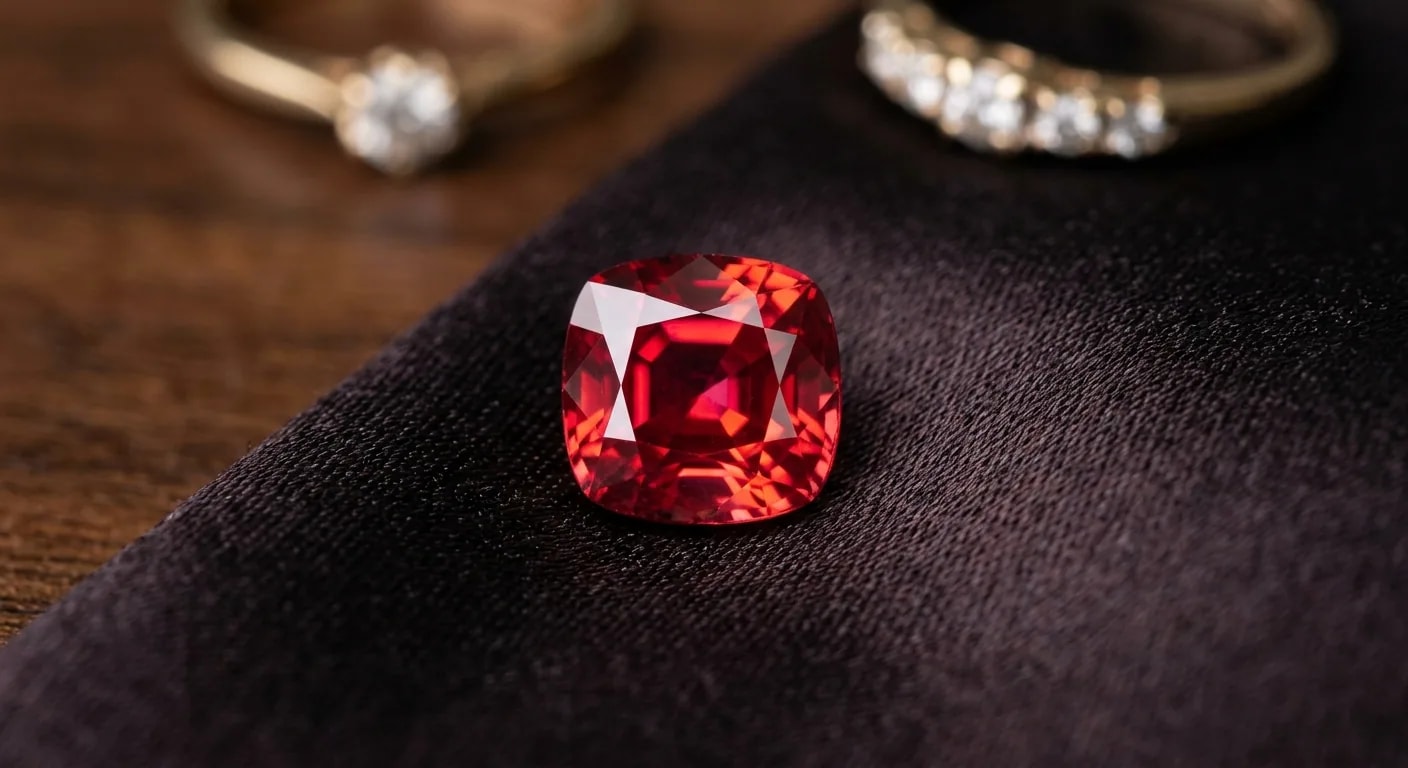
A red spinel gemstone is magnesium aluminium oxide (MgAl2O4), Mohs 8, coloured by chromium, the same trace element that makes ruby red. Unlike most ruby on the market, fine red spinel is almost never heated, and it is never fracture filled. What you see is what came out of the ground.
Red spinel is a natural gemstone at Mohs 8, refractive index 1.718, coloured by chromium and almost never heated. Commercial stones run $200 to $1,500 a carat. Fine vivid red runs $4,000 to $30,000 and up. Best material: Mogok and Man Sin in Myanmar, Mahenge in Tanzania, Luc Yen in Vietnam. August birthstone since 2016.
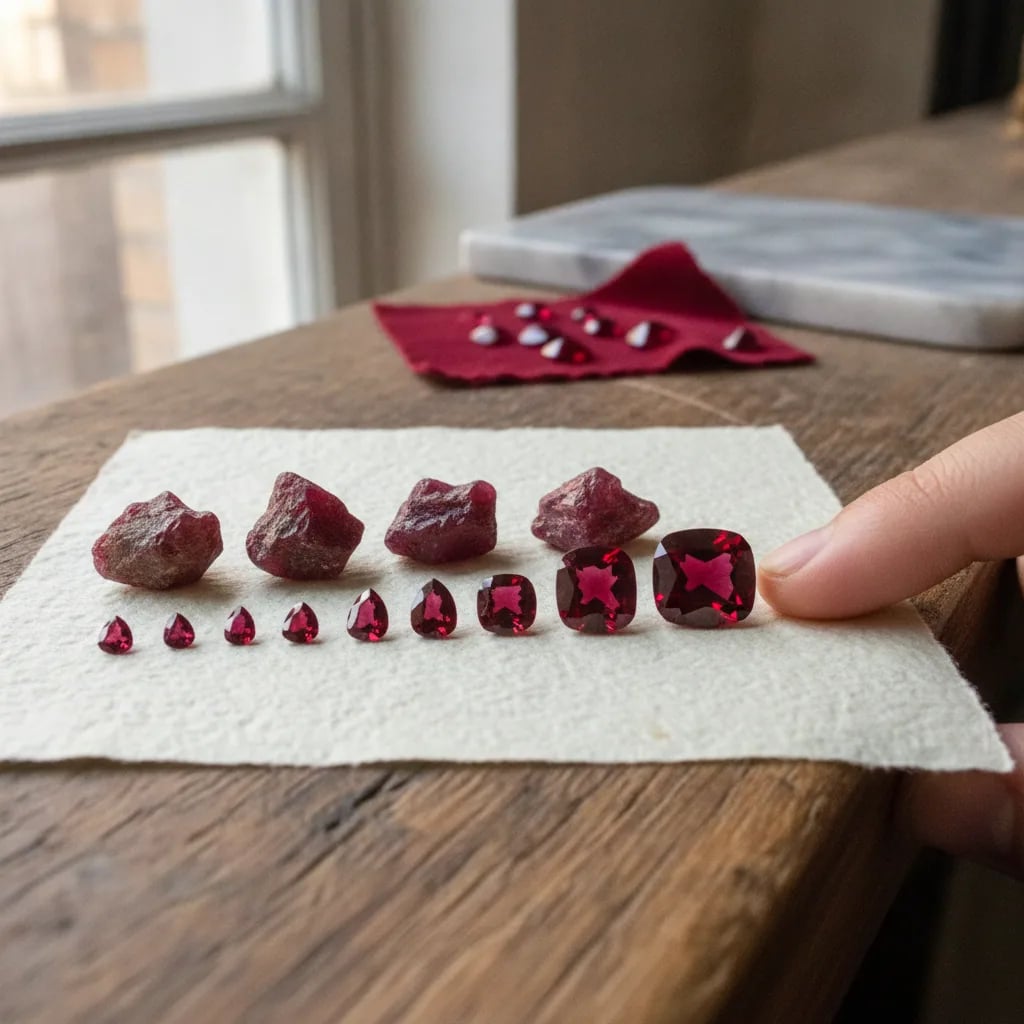
One number before you read on. We hold 46 spinels at the time of writing, 25 of them listed in our spinel collection as you read this. Not one is pure red. The closest is a 3.05 carat vibrant reddish orange at $1,136 a carat, about five times what our median purple spinel costs. That is not a stocking problem on our side. It is what red spinel actually is, and most of this guide is about why.
If you want the species overview across every colour rather than red specifically, start with our complete guide to spinel. For the blue end, we compared it head to head with sapphire in blue spinel vs blue sapphire.
What Is Red Spinel? History, Mineralogy, and the Royal Mix-Up
Red spinel spent centuries as the gem world's greatest case of mistaken identity, and the reason is chemical rather than careless. Modern gemmology recognises spinel as its own mineral species, completely separate from the corundum that makes ruby.
The mineralogy behind the brilliance
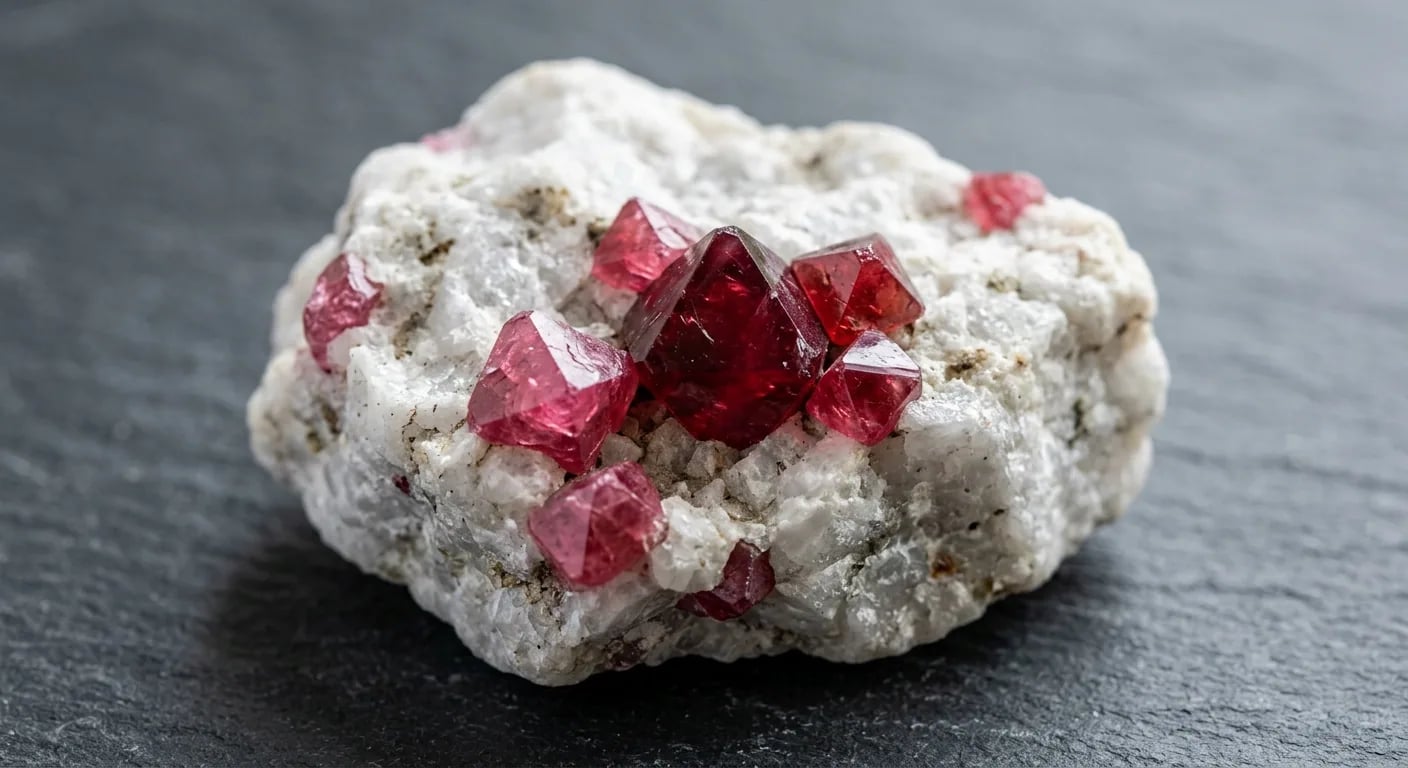
Spinel is a magnesium aluminium oxide that crystallises in the cubic system. It often comes out of the ground as a perfect octahedron. We still stop what we are doing when a clean one turns up in a parcel in Ratnapura.
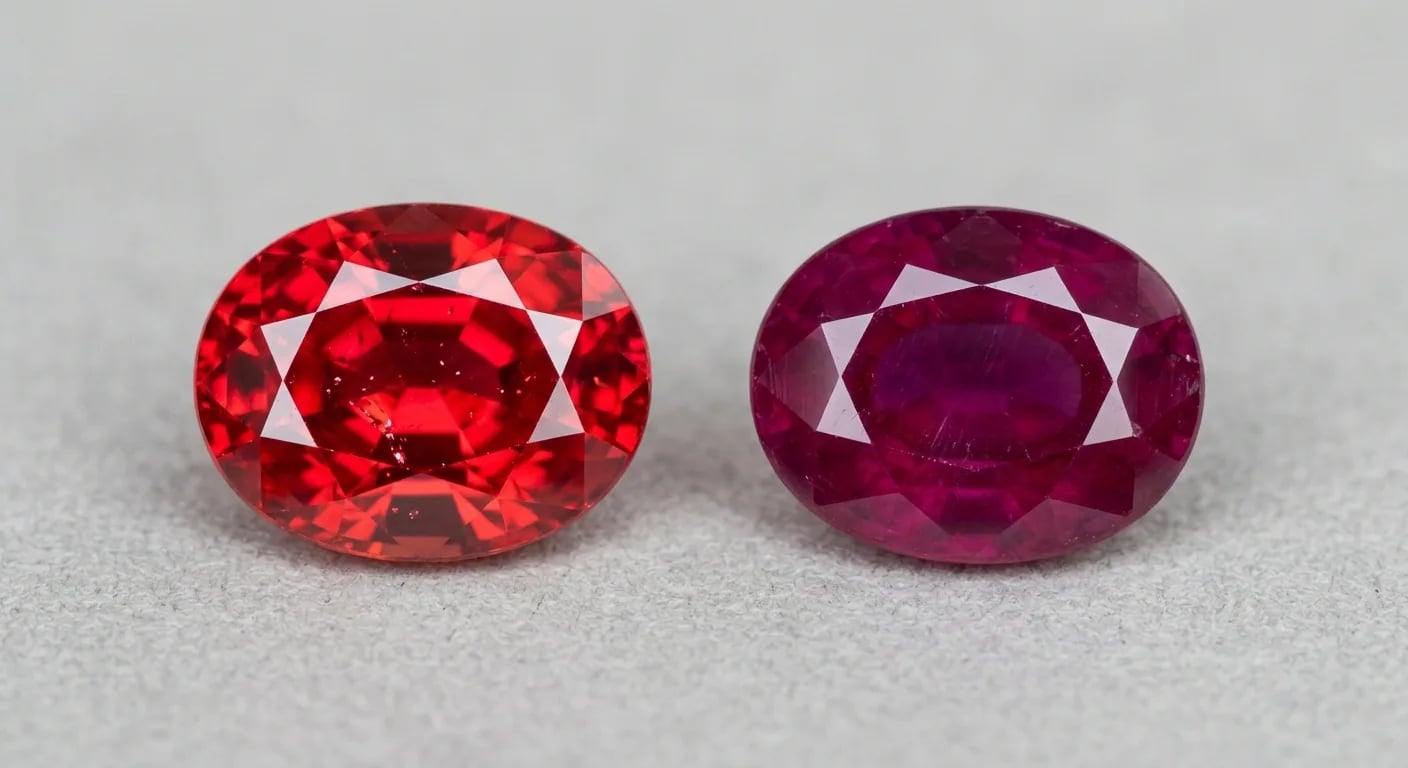
The key optical difference from ruby: spinel is singly refractive. Light goes in, light comes out, nothing splits. That gives a clean direct brilliance at a refractive index of 1.718. Ruby is doubly refractive, which creates a different kind of sparkle but also pleochroism, so the colour shifts between purplish red and orangey red depending on the angle. Single refraction is also the test that unmasks taaffeite, a stone that looks like spinel but is doubly refractive.
At Mohs 8, spinel sits just below sapphire and ruby. It is harder than emerald, harder than quartz, which is what household dust is made of and the thing that quietly abrades jewellery over a lifetime, and tough enough for engagement rings.
| Property | Red spinel |
|---|---|
| Chemical formula | MgAl2O4 |
| Crystal system | Cubic (isometric), octahedral habit |
| Hardness | 8 on the Mohs scale, no cleavage plane |
| Refractive index | 1.718, singly refractive |
| Specific gravity | 3.58 to 3.61 |
| Colour agent | Chromium (Cr3+) |
| Primary sources | Myanmar, Tanzania, Vietnam, Sri Lanka, Tajikistan |
Why "the great impostor" is the wrong label
When mineralogists finally drew the line in the late eighteenth century, spinel's reputation took the hit. "Not a real ruby" became the story and it stuck for two hundred years. Here is our honest opinion on that. The crown jewellers were not fooled into settling for something lesser. They were buying the best red they could find, they kept buying it, and the stone in the Imperial State Crown has not changed. Only its name did.
Red Spinel vs Ruby vs Garnet: How to Tell Them Apart
Shopping for a red gemstone means comparing three things, not two: spinel, ruby, and red garnet. They overlap in colour, they turn up in the same trays, and two of them have fooled experts.
Red spinel vs ruby: what actually differs
Ruby is corundum (Al2O3). Spinel is magnesium aluminium oxide (MgAl2O4). Different chemistry, different crystal structure, different optical behaviour.
Treatment is the first thing buyers notice. The GIA reports that the large majority of ruby on the market has been heat treated, and a meaningful share has been through more aggressive processes such as flux healing or lead glass filling. Spinel is different. When we source it from Sri Lankan dealers the treatment conversation lasts about four seconds. No heat. That is it.
A fine 3 carat Burmese ruby can pass $100,000 per carat. A comparable spinel might be $8,000 to $15,000. That is a fraction of the price for a stone that is arguably more brilliant and reliably untreated. We carry both, and the gap shows up on our own cards: compare the per carat line on our ruby stones against the spinel table further down this page.
| Feature | Red spinel | Ruby |
|---|---|---|
| Species | Spinel | Corundum |
| Hardness | 8 | 9 |
| Refraction | Single, 1.718 | Double, 1.762 to 1.770 |
| Treatment | Rarely treated | Usually heated |
| Pleochroism | None | Strong |
| Top price per carat | $10,000 to $30,000 | $100,000 and up |
The look-alike nobody warns you about: red garnet
Ruby gets all the attention here. In practice the stone most often sold as "red spinel" at a fair or on a marketplace is pyrope or almandine garnet, because garnet is cheap, abundant and the same colour family. This one you can settle without a lab.
Weight in the hand gives it away. Garnet is noticeably denser, which a gemmologist reads as specific gravity. Refractive index separates them too, and almandine sticks to a neodymium magnet while spinel ignores it completely.
| Red spinel | Pyrope garnet | Almandine garnet | |
|---|---|---|---|
| Refractive index | 1.718 | 1.730 to 1.760 | ~1.790 |
| Specific gravity | 3.58 to 3.61 | 3.65 to 3.80 | ~4.05 |
| Hardness | 8 | 7 to 7.5 | 7 to 7.5 |
| Magnet response | None | Weak to moderate | Strong |
| Typical price per carat | $200 to $30,000 | $20 to $150 | $10 to $80 |
The price gap is why this matters. A 3 carat "red spinel" offered at eighty dollars is garnet. Our garnet guide covers the species properly if that turns out to be what you are holding.
How Is Red Spinel Graded? The 4 Cs and the Jedi Phenomenon
Grading red spinel follows the usual four Cs, with two wrinkles that cost money if you miss them.
Colour: where roughly 70% of the value sits
- Hue. Pure vivid red is the most prized. Most spinels carry a secondary modifier, usually a touch of purple or pink. Orange modifiers give what the trade calls flame spinel, which has real fans but sells below pure red.
- Saturation. The finest stones are vivid, meaning the colour jumps at you. Low saturation reads grey, and grey kills value faster than any inclusion.
- Tone. Medium to medium dark is the target. Too light and the lab calls it pink spinel. Too dark and it goes blackish, throwing away the brilliance you were paying for.
What "Jedi" actually means
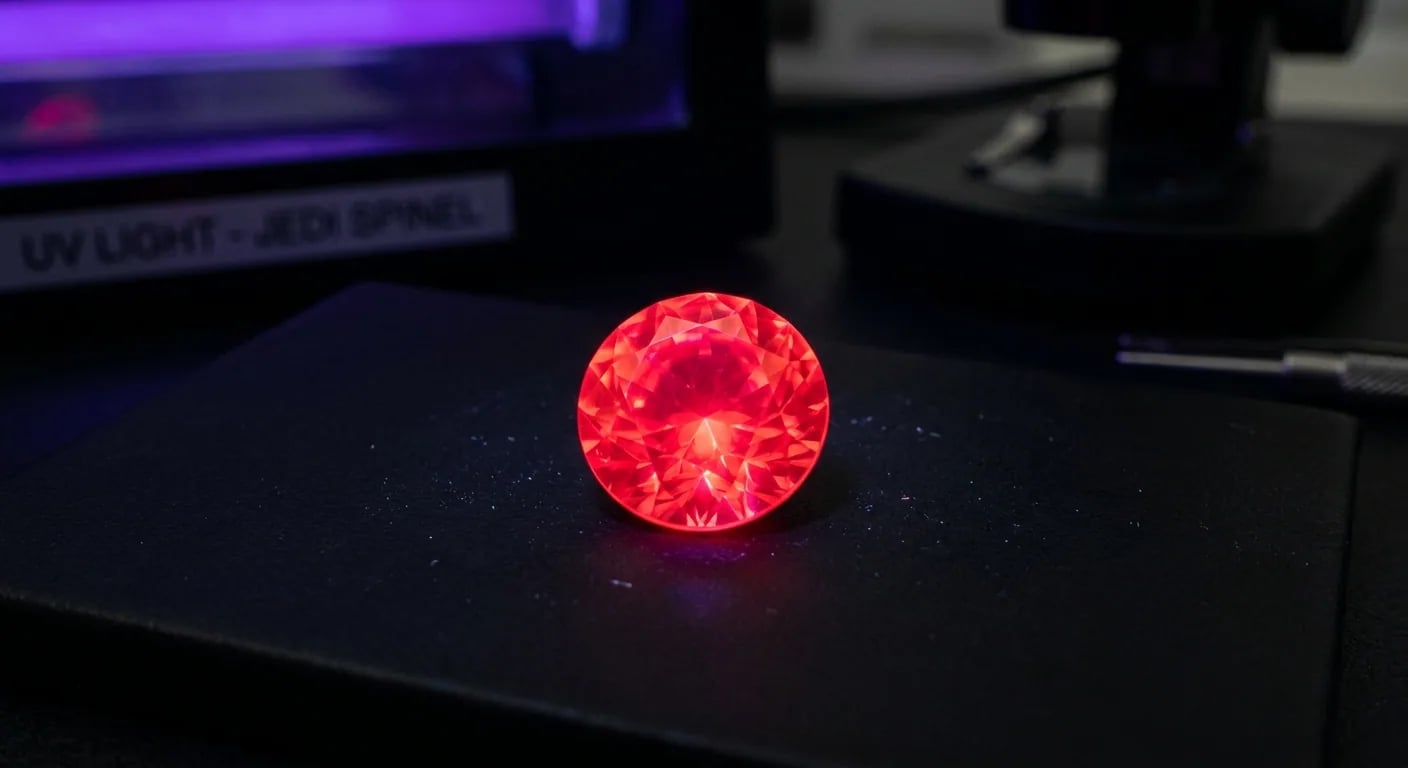
Jedi is a trade term, not a lab grade, and it will not appear on a GIA report. It describes ultra saturated neon spinel associated with the Man Sin (Mansin) workings in Myanmar, in the Mogok and Namya belt. Field gemmologist Vincent Pardieu documented the material for the GIA in Gems & Gemology, Spring 2014, in an article titled "Hunting for Jedi Spinels in Mogok".
The mechanism is simple once you know it. These stones carry unusually high chromium and almost no iron. Iron quenches fluorescence. Remove the iron and chromium fluorescence runs unchecked, so the stone glows in ordinary daylight instead of needing a UV lamp. Photographs never do it justice.
Real Jedi material is scarce. At the Colombo shows in early 2026 we saw two stones we would have called Jedi. Both under 2 carats, both priced above $20,000 per carat. We bought neither.
Clarity, cut and carat weight
- Clarity. Spinel is a GIA Type II gemstone, so some inclusions are normal. Fine stones should still be eye clean. Look for the characteristic octahedral spinel-in-spinel crystals. Anything that dulls transparency takes the price with it.
- Cut. A well cut spinel is electric, because a high refractive index plus single refraction rewards good proportions. Bad cutting gives extinction, those dead dark patches, and windowing. Judge cut on video or in person, never on a still photo.
- Carat weight. Price per carat steps up sharply past 2 carats and again past 5. Fine red above 5 carats is collector territory.
| Factor | What fine red spinel should show |
|---|---|
| Hue | Pure vivid red, minimal modifiers |
| Saturation | Vivid, no grey |
| Tone | Medium to medium dark |
| Fluorescence | Strong, visible in daylight on Jedi material |
| Clarity | Eye clean, Type II standard |
| Cut | Good symmetry, minimal extinction, no window |
What Does Red Spinel Cost per Carat?
Two things drive red spinel pricing: how close the hue gets to pure red, and how far past 2 carats the stone goes. Treatment barely exists in this species, so it drops out of the equation entirely.
Price per carat: realistic 2026 bands
| Quality | 1 to 1.99 ct | 2 to 2.99 ct | 3 to 4.99 ct | 5 ct and up |
|---|---|---|---|---|
| Commercial | $200 to $800 | $400 to $1,200 | $800 to $2,500 | $1,500 to $4,000+ |
| Fine (vivid, eye clean) | $1,000 to $3,500 | $2,500 to $6,000 | $5,000 to $12,000 | $10,000 to $20,000+ |
| Extra fine | $4,000 to $10,000+ | $8,000 to $18,000+ | $15,000 to $30,000+ | $25,000 to $50,000+ |
| Jedi | $8,000 to $25,000+ | $15,000 to $40,000+ | $30,000 to $70,000+ | Auction only |
Bands compiled from dealer asking prices at the Colombo and Bangkok fairs through 2025 and 2026, cross checked against published retail listings. Use them as a sanity check on a quote, not as a valuation.
What our own parcel says about red
Price charts have a blind spot. They price the stone you asked about, not the stone you can actually buy. So here is our inventory instead, priced by us, in full.
Forty six spinels. Sixteen in the pink family, fourteen purple or violet, twelve blue, teal or green, and two still waiting on a colour grade. Two carry a red modifier. None is pure red.
| Colour in our parcel | Stones | Median price per carat |
|---|---|---|
| Purple and violet | 14 | $230 |
| Blue, teal and green | 12 | $263 |
| Pink | 16 | $404 |
| Reddish pink | 1 | $871 |
| Vibrant reddish orange | 1 | $1,136 |
| Pure red | 0 | not available to us |
Read that column downward. The median across the whole parcel is $270 a carat. Every step toward red multiplies it, and the line stops before it arrives: median purple $230, the single reddish orange $1,136, a factor of five on hue alone across the same buying trips.
One stone breaks the pattern and it is worth saying out loud. The most expensive piece per carat we own is not the reddish one. It is a 3.16 carat vibrant neon pink from Mahenge at $2,161 a carat. Saturation gets paid before hue does, which is exactly why a dull "red" spinel at $600 is not the bargain it looks like.
That is the most useful thing we can tell you about red spinel scarcity, and it is the one thing a price chart cannot. We buy spinel in volume, at source, and red still does not reach us. The same method applied to corundum is in sapphire price per carat.
Where the best red comes from
- Myanmar, Mogok and Man Sin. The reference source, and the only reliable origin for Jedi material. Burmese origin carries a premium of its own.
- Tanzania, Mahenge. On the market since 2007, known for neon pinkish reds and flame spinel. Most of our Tanzanian material sits here.
- Vietnam, Luc Yen. Excellent clarity across reds and pinks.
- Sri Lanka. One of the oldest sources. Plenty comes through Ratnapura, though pure vivid red is rarer here than in Myanmar.
- Tajikistan, the Pamirs. Ancient workings, larger pinkish red stones with real provenance.
We buy spinel directly from cutting and mining families in Sri Lanka, and Tanzanian material through dealers we have worked with for years. One margin, no intermediate resellers, which is why our per carat numbers sit where they do. What we cannot do is conjure red spinel that is not in the ground. Tell us the size and the budget and we will look, or we will tell you it is not findable at that number.
Is Red Spinel Good for an Engagement Ring?
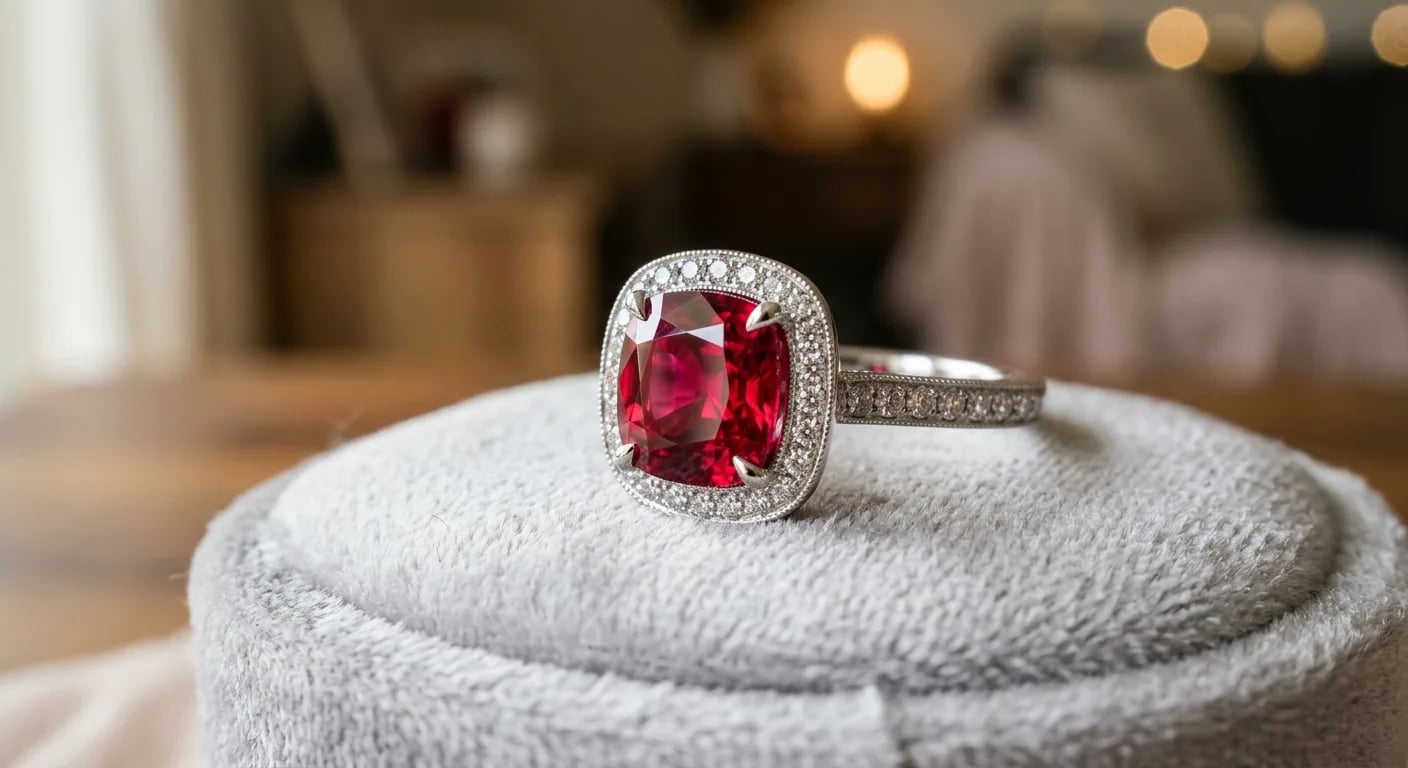
Red spinel makes a very good engagement ring stone. It clears every practical test, and it gives you a red no diamond can.
Durability for daily wear
An engagement ring gets knocked against door handles, keyboards and car doors for decades. At Mohs 8 spinel outranks quartz at 7, which is what airborne dust is made of and what abrades softer stones over years. It is harder than emerald and considerably tougher in practice, because it lacks the internal fractures that make most emeralds fragile.
Spinel also has no cleavage plane, no internal direction along which the crystal splits cleanly. Diamond, at Mohs 10, has perfect cleavage in four directions. Hit one at the wrong angle and it chips. Against impact, spinel is the more forgiving stone.
| Stone | Hardness | Toughness | Daily wear |
|---|---|---|---|
| Red spinel | 8 | Good, no cleavage | Excellent |
| Diamond | 10 | Good, has cleavage | Excellent |
| Ruby and sapphire | 9 | Excellent | Excellent |
| Emerald | 7.5 to 8 | Poor, usually fractured | Moderate |
Setting the stone
A bezel gives maximum protection and is the right answer for hands that work. A halo adds scale and shields the girdle. Four or six prongs let in the most light, which is the classic choice when the stone deserves the spotlight. Platinum and white gold give clean contrast, yellow gold warms the red, and rose gold suits stones with a pinkish modifier, which in practice is most of what is available.
Our advice runs opposite to how most people shop: choose the loose gemstone first, then design the setting around that specific stone. A setting can be remade. The stone cannot.
JOALYS
Everything Begins with the Stone
For centuries spinel was mistaken for ruby. It was never the lesser stone.
Keep the spinel loose, or commission a ring made around it — made to order, never off the shelf.
How to Buy Red Spinel Safely: Synthetics, Certification and Care
Spinel has one identification trap that ruby does not, and it is not the one most guides warn about.
The synthetic problem, stated honestly
Synthetic spinel has been produced industrially since the early twentieth century by the Verneuil flame fusion process, making it one of the oldest man made gemstones in circulation. It hides in vintage jewellery, in class rings, in inherited costume pieces, and it is often sold in complete good faith.
Flame fusion material is easy to catch. Growing crack free boules needs roughly twice the normal alumina, which pushes the refractive index to about 1.727 instead of 1.718 and creates a banded strain pattern under a polariscope that the trade calls tabby extinction. Any competent gemmologist reads it in a minute.
Now the part most articles skip. Red is the colour flame fusion struggles with, because red boules crack at the usual ratio, so red Verneuil stones are uncommon and generally under 2 carats. Larger synthetic reds are grown by the flux method instead, and flux grown synthetic spinel reads 1.716 to 1.719, squarely inside natural spinel's range. The quick refractometer check that catches blue synthetics does not catch these. They are separated on their inclusion scene, in a laboratory. Above a few thousand dollars, a report stops being optional.
Reading the report
- Species. It must read "natural spinel". Synthetic spinel is a legitimate product at a fraction of the price, and there is nothing wrong with owning one as long as you paid synthetic money.
- Treatment. The wording you want is "no indications of heating". The LMHC treatment codes you may have seen elsewhere (TE, NTE, F1 to F3) are defined for ruby, sapphire and emerald, not for spinel, so do not go looking for them on a spinel report.
- Origin. GIA offers a geographic origin opinion for spinel within its identification and origin report. Note the word opinion. It is a conclusion drawn from trace element chemistry and inclusions, not a measurement, and a Mogok or Mahenge call does move the price.
| Report field | What you want to see | Why it matters |
|---|---|---|
| Species | Natural spinel | Rules out flame fusion and flux grown synthetics |
| Treatment | No indications of heating | Untreated is the norm here, so a heated stone should be priced below one |
| Origin | Myanmar or Tanzania | Premium origins, stated as an opinion |
| Comments | Inclusion description | The only reliable separation for flux grown red |
We wrote a longer piece on what a gemstone certificate actually proves, including what it does not. On our side: every stone we sell ships with a free report from Lanka Gem Laboratory in Galle, run by a GIA graduate gemmologist. Our certification policy states plainly that LGL is not internationally accredited and does not issue origin determinations. Where origin or a five figure price is in play we arrange a report from an internationally accredited lab instead, GIA or IGI. Anyone claiming their house certificate is equivalent to GIA is telling you something else as well.
Caring for spinel
Warm water, mild soap, soft brush. Rinse, pat dry on a lint free cloth. That is the whole routine.
Ultrasonic and steam cleaners are usually fine on untreated spinel, though keep a stone with a reaching fracture away from both. Store it apart from sapphire and diamond, which will scratch it given the chance. Our full jewellery care guide covers the rest.
Frequently Asked Questions
Conclusion
Red spinel is not a ruby substitute and it never was. It is a separate mineral that happens to be Mohs 8, singly refractive, almost always untreated, and genuinely scarce in fine red. The crown jewellers who picked it were not settling.
The honest summary of this guide is the number we opened with. Forty six spinels in our parcel, zero pure red, and a price gradient that multiplies by five as the hue creeps toward it. If you are hunting a pure red, expect to wait and expect to pay. If what you actually want is that saturated glow at a price that makes sense, the pinks and reddish oranges sitting one step down the scale are the better buy, and we have those.
Either way, see the stone in daylight before you commit. Red is the colour photographs lie about most.