Ring Size Chart: US, UK, EU, AU and mm Converter (Free Printable)
Convert any ring size between US, UK, EU, AU and mm. Free printable PDF, mm-to-size converter and 3 at-home measuring methods.
Ring Size Chart, Quick Reference
| Property | Details |
|---|---|
| Measurement Basis | Inside diameter and inside circumference in millimeters |
| Standard Systems | US/Canada (numerical), UK/Australia (alphabetical), Europe (numerical, mm) |
| Average Woman's Size | US 6 (16.5mm diameter, 51.9mm circumference) |
| Average Man's Size | US 10 (19.8mm diameter, 62.1mm circumference) |
| mm to US Formula | US Size = (Diameter mm − 11.63) ÷ 0.8128 |
| Printable Chart Calibration | Verify calibration line measures exactly 50mm or 2 inches |
| Wide Band Sizing Rule | Order a half size larger for bands wider than 6mm |
| Ideal Measurement Conditions | Room temperature, end of day, repeated 3 times |
| Non-Resizable Styles | Full eternity bands, tungsten, titanium, intricate engravings |
| Between Two Sizes Rule | Always go up, half size larger is safer than too tight |
Introduction
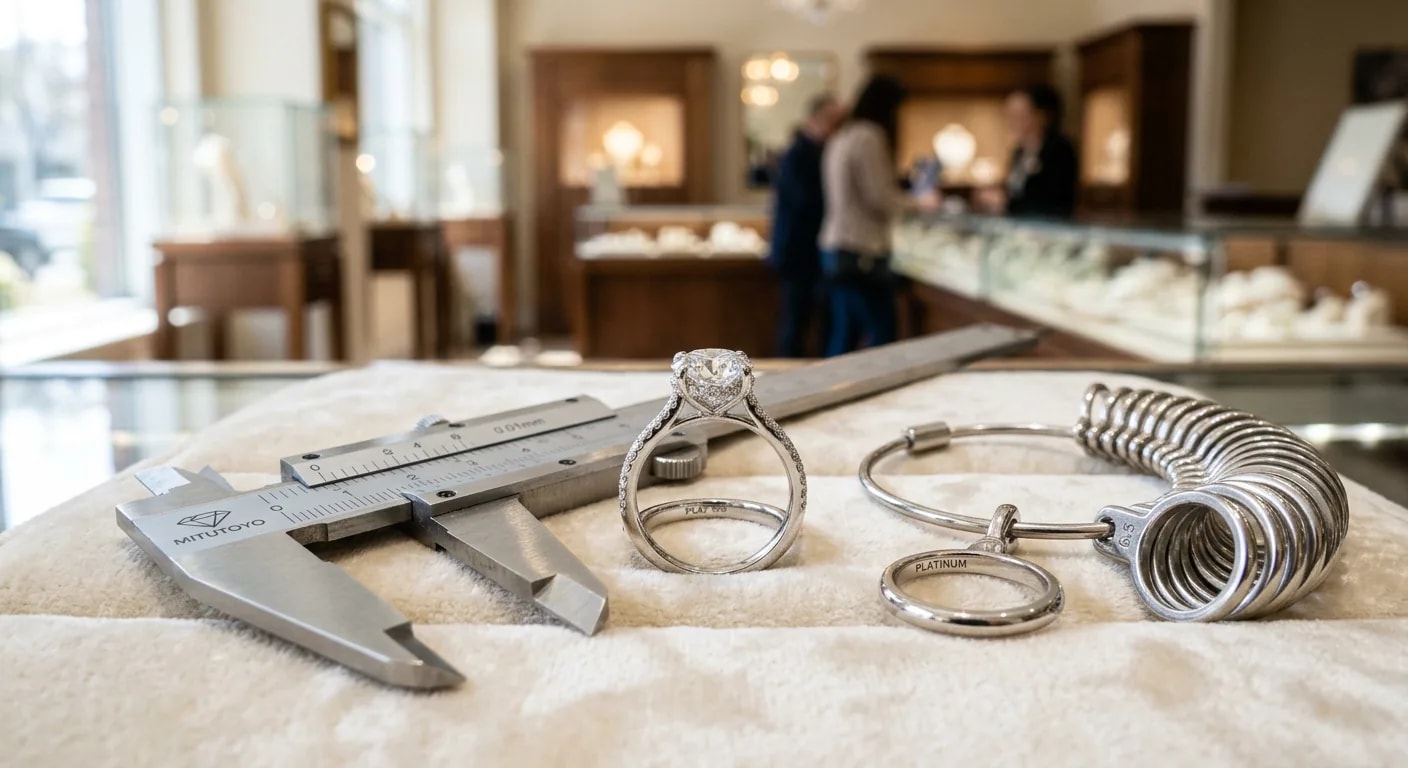
Here's the answer up front: a ring size chart converts your finger's inner diameter or circumference, in millimeters, into a standardized US, UK, EU or Australian size. Common conversions: 15.7mm = US 5, 16.5mm = US 6, 17.3mm = US 7, 18.1mm = US 8, 18.9mm = US 9, 19.8mm = US 10. Between two sizes? Go up half a size. That's the short version.
The longer version is that nearly 30% of online jewelry returns happen because of poor fit, not a change of heart about the design. Finger size shifts throughout the day, with temperature, and even after a salty meal. We've measured thousands of fingers at Joalys, and trust us, timing and technique matter more than most people think.
This free printable ring size chart guide, written and verified by a GIA gemologist (last updated June 2026), covers everything: the full US to UK to EU to AU conversion table, three measurement methods ranked by accuracy, a quick mm-to-size converter, wide band adjustments, and the knuckle problem. Jump to the printable chart, the measuring methods or the FAQ.
The Joalys Free Printable Ring Size Chart (US, UK, EU, AU)
Measure your finger's inner circumference in mm, then match it to the table below. Average woman: US 6 (16.5mm diameter). Average man: US 10 (19.8mm). Always measure at the end of the day, at room temperature. If between two sizes, go up.
Choosing fine jewelry, especially a engagement ring or a wedding band you'll wear every day, makes accurate sizing non-negotiable. Digital tools are convenient, but a physical, calibrated chart remains the most reliable method for at-home use. Skip this step and you're gambling on a resize that may not even be possible, depending on the setting.
Video: How to Measure your Ring Size at Home.
How to Calibrate Your Printout, Don't Skip This
Every printable ring size chart has one critical flaw: printers lie. Most default settings scale the document slightly, which throws off every measurement. Before you do anything else, print the chart and check the calibration line with a physical ruler. It should measure exactly 50mm (or 2 inches, depending on the chart). If it doesn't, go back to print settings, select "Print at 100%" or disable "Scale to Fit", and reprint. A 2mm error at this stage translates directly into a wrong ring size.
US, UK, EU and AU Ring Size Conversion Chart
A US size 6 is a UK L½, a European 52, and an Australian L½. The numbers look different, but they all describe the same finger, a 16.5mm inner diameter. When in doubt, always go back to the millimeter measurement. It's the universal reference that removes all ambiguity.
| US/Canada | Diameter (mm) | Circumference (mm) | UK/Australia | Europe |
|---|---|---|---|---|
| 3 | 14.1 | 44.2 | F | 44 |
| 3.5 | 14.5 | 45.5 | G | 46 |
| 4 | 14.9 | 46.8 | H 1/2 | 47 |
| 4.5 | 15.3 | 48.0 | I 1/2 | 48 |
| 5 | 15.7 | 49.3 | J 1/2 | 49 |
| 5.5 | 16.1 | 50.6 | K 1/2 | 51 |
| 6 | 16.5 | 51.9 | L 1/2 | 52 |
| 6.5 | 16.9 | 53.1 | M 1/2 | 53 |
| 7 | 17.3 | 54.4 | N 1/2 | 54 |
| 7.5 | 17.7 | 55.7 | O 1/2 | 56 |
| 8 | 18.1 | 57.0 | P 1/2 | 57 |
| 8.5 | 18.5 | 58.3 | Q 1/2 | 58 |
| 9 | 19.0 | 59.5 | R 1/2 | 59 |
| 9.5 | 19.4 | 60.8 | S 1/2 | 61 |
| 10 | 19.8 | 62.1 | T 1/2 | 62 |
| 10.5 | 20.2 | 63.4 | U 1/2 | 63 |
| 11 | 20.6 | 64.6 | V 1/2 | 65 |
| 11.5 | 21.0 | 65.9 | W 1/2 | 66 |
| 12 | 21.4 | 67.2 | X 1/2 | 67 |
| 12.5 | 21.8 | 68.5 | Y 1/2 | 68 |
| 13 | 22.2 | 69.7 | Z | 70 |
Got your size? Double-check it with one of the three measuring methods below, then read our guides on engagement rings and wedding bands for women before you order.
| US size | Inside diameter (mm) | EU / FR (circumference, mm) | UK / AU |
|---|---|---|---|
| 3 | 14.1 | 44.3 | F |
| 3.5 | 14.5 | 45.6 | G |
| 4 | 14.9 | 46.8 | H½ |
| 4.5 | 15.3 | 48.1 | I½ |
| 5 | 15.7 | 49.3 | J½ |
| 5.5 | 16.1 | 50.6 | K½ |
| 6 | 16.5 | 51.8 | L½ |
| 6.5 | 16.9 | 53.1 | M½ |
| 7 | 17.3 | 54.4 | N½ |
| 7.5 | 17.7 | 55.6 | O½ |
| 8 | 18.1 | 56.9 | P½ |
| 8.5 | 18.5 | 58.1 | Q½ |
| 9 | 19.0 | 59.7 | R½ |
| 9.5 | 19.4 | 60.9 | S½ |
| 10 | 19.8 | 62.2 | T½ |
| 10.5 | 20.2 | 63.5 | U½ |
| 11 | 20.6 | 64.7 | V½ |
| 11.5 | 21.0 | 66.0 | W½ |
| 12 | 21.4 | 67.2 | X½ |
| 12.5 | 21.8 | 68.5 | n/a |
| 13 | 22.2 | 69.7 | n/a |
EU and French sizes are the ring's inner circumference in millimetres. UK and Australian letter sizes above US 12 are not standardised, so they are left out rather than guessed.
Ring Size Calculator: Convert Any Measurement to a Size
If you measured your finger but the chart doesn't match exactly, you can convert any millimeter measurement into a US, UK or EU size with two simple formulas. The math is always the same, the chart is just a lookup table.
The Two Core Formulas
Every ring size system in the world traces back to one of two physical measurements: the inner diameter (the width across the inside of the band) or the inner circumference (the distance around the inside of the band). They relate through one constant:
| From | Formula | Example |
|---|---|---|
| Circumference to Diameter | Diameter = Circumference ÷ 3.1416 (π) | 51.9mm ÷ 3.1416 = 16.5mm |
| Diameter to Circumference | Circumference = Diameter × 3.1416 (π) | 16.5mm × 3.1416 = 51.9mm |
Convert Millimeters to US Ring Size
Once you know the inner diameter in mm, finding your US size is a single calculation:
| From mm Diameter | To US Size | Worked Example |
|---|---|---|
| Use this formula | US Size = (Diameter − 11.63) ÷ 0.8128 | (17.3 − 11.63) ÷ 0.8128 = 6.97 → US 7 |
Round to the nearest half size, and if you land exactly between two sizes, round up. This formula is derived from the official US ring size standard (each whole size = 0.8128mm increment, starting at size 0 = 11.63mm diameter) and matches the conversion table above to within 0.05mm.
Convert Millimeters to EU Ring Size
The European system is the cleanest of the four, because the size number is literally the circumference in millimeters. If your inner circumference is 54mm, your EU size is 54. If it's 56mm, your EU size is 56. No formula needed, just measure and read.
mm to Ring Size: Quick Reference Table
No chart to hand? Use this mm to ring size reference: match your inner diameter in millimeters straight to a US and EU size.
| Inner Diameter (mm) | US Size | EU Size |
|---|---|---|
| 15.7 | 5 | 49 |
| 16.5 | 6 | 52 |
| 17.3 | 7 | 54 |
| 18.1 | 8 | 57 |
| 19.0 | 9 | 59 |
| 19.8 | 10 | 62 |
| 20.6 | 11 | 65 |
Ring Size by Country: International Conversion Made Simple
If you bought a ring in Paris, Tokyo or Sydney, the size stamped inside it won't match what an American jeweler reads. Each region runs a different ring size system, but all of them ultimately describe the same physical measurement: the ring's inner diameter in millimeters. That's your anchor when you're converting across borders.
The Four Main Ring Size Systems
- United States and Canada, numerical sizes from 3 to 13.5 in quarter and half increments. A US 6 = 16.5mm diameter.
- United Kingdom, Australia, Ireland, New Zealand and South Africa, alphabetical sizes from A to Z with half steps. A UK L½ = 16.5mm diameter = US 6.
- Europe (France, Italy, Germany, Spain, Switzerland), numerical, based directly on circumference in millimeters. EU 52 = 51.9mm circumference = US 6.
- Japan and East Asia, numerical from 1 to 27, based on a different scale. Japanese 12 = 16.5mm diameter = US 6.
How to Convert Between Systems Without Guessing
Forget the regional code on a borrowed ring. Measure its inner diameter with a caliper or ruler in millimeters, then read across the conversion chart in section above. A 17.3mm diameter is a US 7, a UK N½, an EU 54 and a Japanese 14, no matter what's engraved inside. The millimeter measurement is the only truly international ring size standard, which is why every certified jeweler ultimately works from it.
Average Ring Sizes for Women and Men
Before you measure, it helps to know where you likely land. Most people fall within a predictable range, and knowing the average means you're already working with fewer unknowns. These figures come from GIA jewelry education data and retail sizing reports (2025).
- Size range: 3 to 9
- Most common: 5 to 7
- Most popular: US 6 (16.5mm)
- Size range: 6 to 13
- Most common: 8 to 10.5
- Most popular: US 9 (19.0mm)
These averages are useful as a starting point, especially when buying a surprise gift and you have zero information to work from. A US 6 for women and US 9 for men are the safest blind guesses if you truly have no reference. That said, finger size varies significantly with age, weight, and dominant hand, so treat these numbers as a starting point, not a substitute for measuring.
One thing we see consistently at Joalys: customers from warmer climates tend to run slightly larger than the average, since fingers stay expanded more of the year. Worth keeping in mind if you're ordering for someone based in a hot region.
How to Measure Ring Size at Home: 3 Methods Ranked by Accuracy
Let's be honest: most people eyeball this and end up with a ring that's slightly off. Professional sizing by a jeweler is always the gold standard, but if you're buying online, here are the three methods we actually recommend, ranked by how accurate they are in real conditions. One rule applies to all of them: measure at the end of the day, at room temperature. Fingers are measurably smaller in the morning and when cold.
Method 1: The Paper Sizer (Best At-Home Accuracy)
This is the closest you'll get to a professional sizing gauge without visiting a jeweler. Many printable ring size charts include a paper belt sizer you can cut out. It works like this:
- Print and calibrate first, verify the 50mm calibration line before anything else.
- Cut out the sizer and make the small slit at the indicated mark.
- Wrap it around the base of your finger and thread the pointed end through the slit.
- Pull snug, not tight. The number at the slit edge is your size.
One thing people get wrong: they pull too loosely because paper feels tight. Paper has give; metal doesn't. Pull it firmly, almost uncomfortably, to get the number that will translate to a well-fitting metal ring.
Method 2: Measuring an Existing Ring (Best for Surprise Gifts)
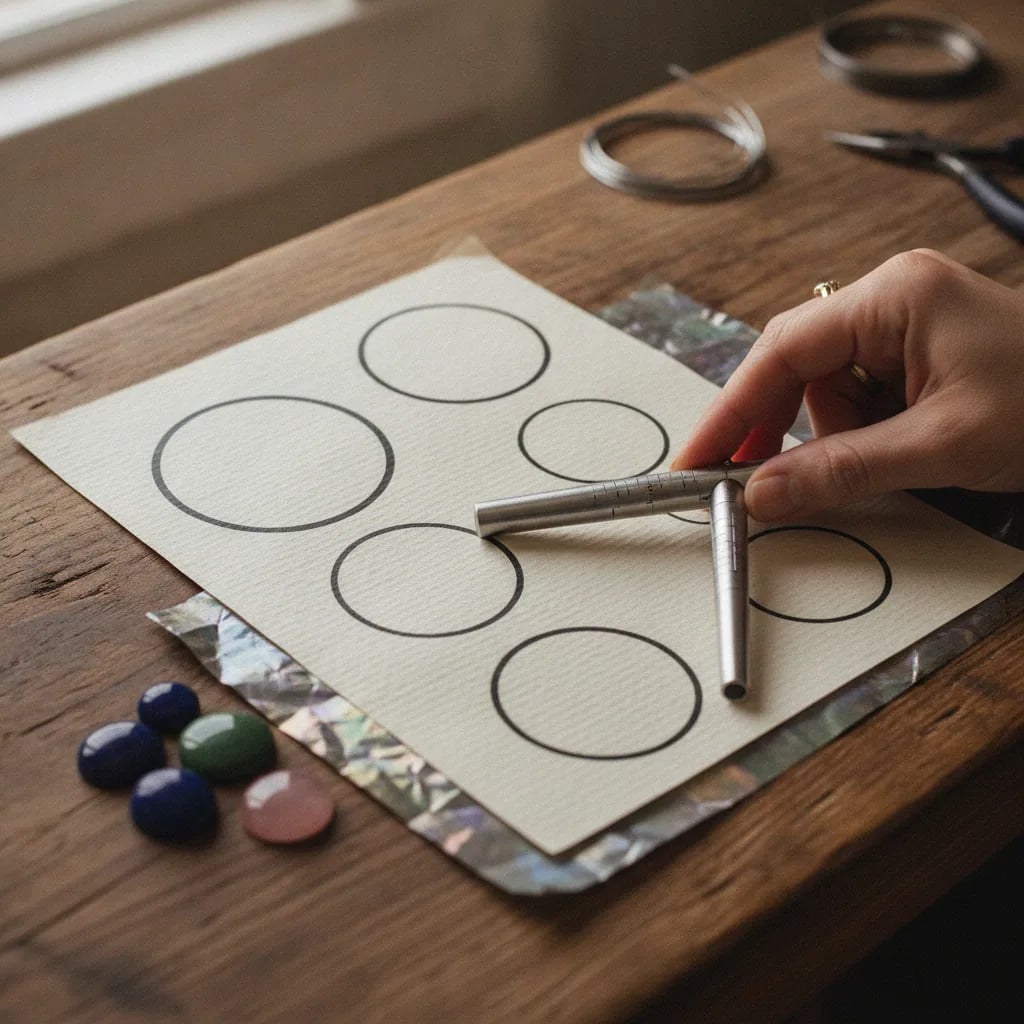
Got a ring the recipient wears on that exact finger? This works surprisingly well. Use the circle chart on a printable guide and match the ring's inner diameter to the circles, you want the inner edge of the ring to align with the outer edge of the circle. Between two sizes? Always go up. Two things to verify first: the ring must be round (not bent), and it must be worn on the specific finger and hand you're buying for. Dominant-hand fingers run slightly larger.
This technique is reliable for engagement ring surprises, one borrowed ring, two minutes, accurate result.
Method 3: The Paper Strip (Fair, But Never Use String)
When you have nothing else available, a strip of non-stretchy paper works. Cut it about 12mm wide, wrap it snugly around the finger base, mark the overlap point, then measure that length in millimeters with a ruler. That's your circumference, match it to the table in Section 1.
The one thing Joalys always warns against: string. String stretches, even slightly, and that stretch turns a size 6.5 into a size 7. We've seen it cause problems more times than we can count. Use paper.
For best results, repeat three times and average the measurements.
| Method | Accuracy | Best For | Key Watch-Out |
|---|---|---|---|
| Paper Sizer | ⭐⭐⭐ Highest | Self-measurement | Calibrate the printout first |
| Existing Ring | ⭐⭐ Good | Surprise gifts | Correct finger, perfectly round ring |
| Paper Strip | ⭐ Fair | Quick check | Never string, always non-stretch paper |
Accurate measurement matters most with rings set with delicate stones like emeralds, they don't respond well to resizing pressure. Get it right the first time.
The 7 Most Common Ring Size Mistakes (and How to Avoid Them)
After thousands of measurements, we see the same handful of mistakes again and again. Each one of these will cost you a half-size to a full-size of accuracy, which is exactly enough to need a resize you might not be able to do.
| # | Mistake | What Happens | The Fix |
|---|---|---|---|
| 1 | Measuring in the morning | Reads up to a half size smaller than the true size | Measure at the end of the day, at room temperature |
| 2 | Skipping the printer calibration check | 2mm scale error = wrong size, every time | Verify the 50mm line with a real ruler before measuring |
| 3 | Using string instead of paper | String stretches and adds a quarter to half size | Use a non-stretch paper strip, about 12mm wide |
| 4 | Measuring after exercise or a salty meal | Temporary swelling reads a full size larger | Wait at least an hour, hydrate normally first |
| 5 | Ignoring band width | A 6mm+ band feels tight at your measured size | Add a half size for any band 6mm or wider |
| 6 | Using the wrong hand | Dominant hand is 0.25 to 0.5 size larger | Always measure the exact finger and hand the ring is for |
| 7 | Measuring once and trusting it | Single readings catch random swelling or shrinkage | Measure three times on different days, take the average |
The "Between Sizes" Mistake
If you land between a US 6 and US 6.5, do not split the difference and pick "size 6.25" from a chart that doesn't include it. Quarter sizes exist in custom work, but most online retailers stock only half sizes. Choose the larger of the two, then ask your jeweler to add a sizing bead inside the shank if it ends up a hair loose. It's a 15-minute adjustment that costs almost nothing.
The "I'll Get It Resized Later" Mistake
This works only for resizable styles. Full diamond eternity bands, tungsten, titanium and cobalt rings simply cannot be resized in the conventional sense. If you bought one of these and the size is off, you're looking at a replacement, not a repair. Save yourself the frustration: for non-resizable styles, use a plastic ring sizer set (around $10 online) and confirm the size before placing the order. Same goes for surprise engagement ring purchases, where you can't simply hand the ring back and ask for an adjustment without ruining the moment.
The Wide Band Rule and Other Product Considerations
Here's something most ring size guides won't tell you upfront: your measured size and your ordered size aren't always the same. Band width changes the equation, and ignoring it is one of the most common reasons rings feel too tight even when the measurement was correct.
Why a Wider Band Fits Tighter
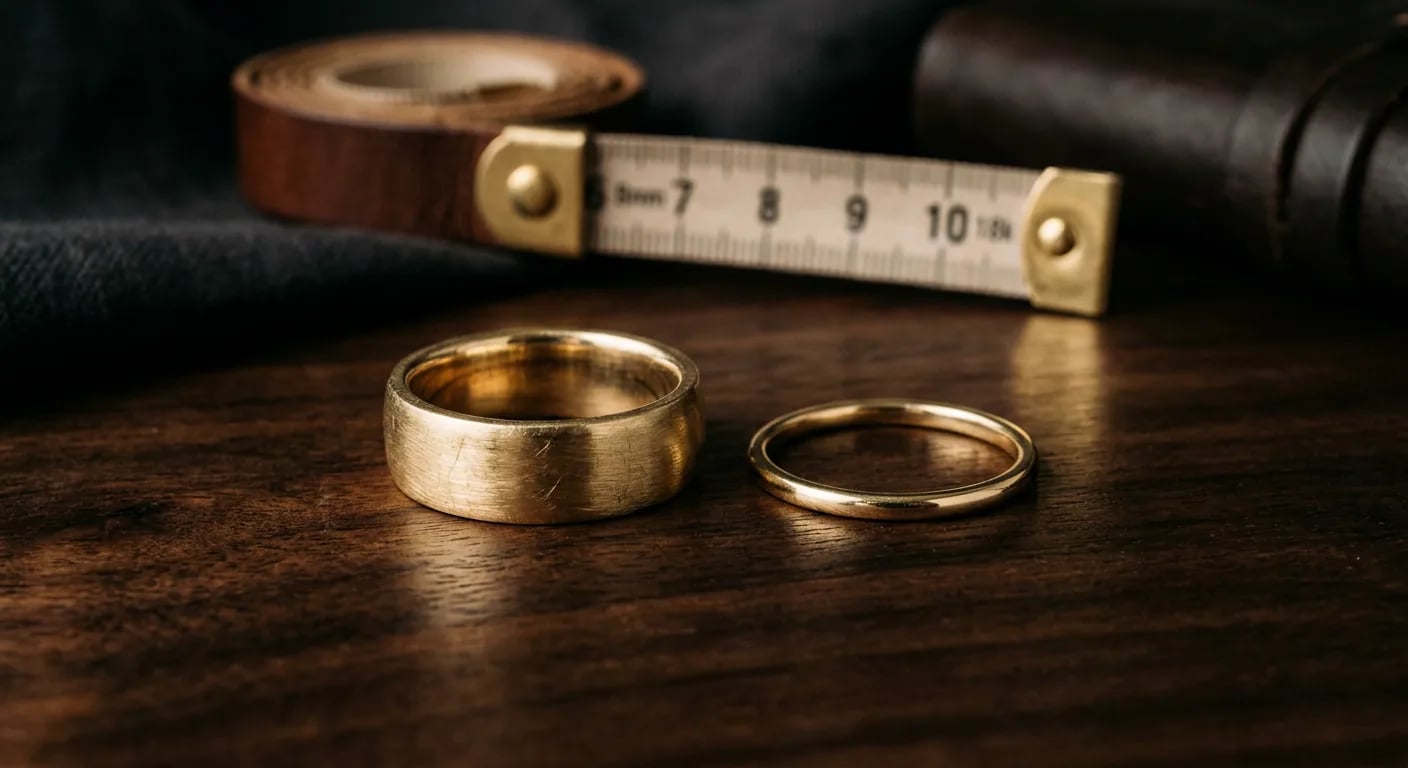
A wider band covers more surface area on your finger, compresses more tissue, and creates more friction when passing over the knuckle. A 10mm band and a 2mm band with identical inner diameters will feel completely different on the same finger. The wider one will always feel tighter. According to GIA gem education guidelines (2024), the industry standard recommendation for bands 6mm or wider is to order a half size up.
| Band Width | Sizing Adjustment | Common Examples |
|---|---|---|
| Standard (1.5 to 4mm) | Order your measured size | Delicate solitaires, thin wedding bands |
| Medium (4 to 6mm) | Consider +¼ size | Classic wedding bands, fashion rings |
| Wide (6mm+) | Order +½ size | Statement rings, men's gold wedding bands |
Practical example: you measure as a US 9. You want an 8mm band. Order a 9.5. That half-size accounts for the compression and prevents the "muffin top" effect where skin bulges at the band edges.
Eternity Bands and Non-Resizable Metals
Two situations where you absolutely cannot afford to get sizing wrong at purchase:
- Full eternity bands, stones set all the way around the shank cannot be resized without disrupting the setting. This applies to diamond and sapphire eternity styles alike. No resizing, full stop.
- Alternative metals, tungsten carbide, titanium, and cobalt cannot be cut and rejoined like gold or platinum. A wrong size in these materials means a full replacement.
For both cases, we personally recommend ordering a plastic ring sizer set (under $10 online) before placing the order. For a ring you can't resize, that's a smart $10 to spend.
Got Unusual Fingers or Buying a Surprise? How to Handle Tricky Sizing
Standard sizing charts assume a fairly uniform finger shape, but fingers aren't standard. Large knuckles, in-between measurements, dominant-hand differences, these are the real-world situations that trip people up. Here's how we handle each one.
Large Knuckles: The Two-Measurement Rule
This is the most common complaint we hear. The ring slides over the knuckle fine but spins at the base, or fits the base but won't go past the knuckle at all. The fix: measure both. Take the knuckle circumference, take the base circumference, then choose a size between the two. You want the ring to require a firm push over the knuckle, and to sit snugly (not loosely) at the base.
If the gap between the two measurements is large (more than one full size), ask a jeweler about sizing beads, small metal balls added inside the shank that create friction against the base while still allowing the ring to pass over the knuckle. For engagement ring styles with thinner bands, this works particularly well.
Between Sizes? Always Go Up
Fingers land between standard sizes more often than not. The rule is simple: go up. A slightly loose ring is safer and more comfortable than one that cuts circulation. That said, ring design matters here. A very slender 1.5mm band can wear smaller, so you might take the smaller size. A wide band? Always take the larger. If you end up with a ring that's just a touch too loose, a jeweler can add a sizing insert, a quick, inexpensive fix that leaves no visible mark on the ring.
This is especially worth keeping in mind for rings with emeralds or other sensitive stones, minimizing resize interventions protects the setting long-term.
Buying a Surprise Gift? Three Ways to Get the Size
You'd be surprised how often this comes up. Here are the three tactics we actually recommend, in order of reliability:
- Borrow a ring she or he wears on that specific finger, use the circle chart method. Takes two minutes, very accurate.
- Ask someone close to them, a friend or sibling may know, or can find out naturally without blowing the surprise.
- Trace the inner circle, if you can't borrow it, place the ring on paper and trace the inside edge with a sharp pencil. Compare to a physical size chart.
And a practical tip: when the ring is for a surprise, always prioritize resizable styles and metals. For complex designs like diamond eternity bands, where resizing isn't an option, nailing the size upfront isn't optional, it's the whole game.

When and How to Measure for the Most Accurate Result
Measuring once and trusting that number isn't always enough. Fingers shift throughout the day and across seasons, sometimes by a half size or more. The best approach: measure the same finger at least three times over a couple of days, at different times, and average the results. It sounds tedious, but for a ring you'll wear for years, it's worth it.
What Actually Affects Your Finger Size
Temperature is the biggest factor most people overlook. Fingers are measurably smaller when cold and expand in warmth. So if you measured right after a cold commute, your size could read a full half-size smaller than your true size. Beyond temperature, exercise causes temporary swelling, and high-sodium meals cause water retention that shows up in your fingers within hours. According to standard gemmological sizing protocols referenced by the American Gem Society (2025), the most reliable measurements come from fingers at rest, at room temperature, at the end of the day.
| Factor | Effect | Best Time to Measure |
|---|---|---|
| Cold temperature | Fingers shrink | Wait until hands are at room temperature |
| Warm temperature | Fingers expand | Measure at comfortable room temp |
| Exercise | Temporary swelling | Wait 30 to 60 minutes after activity |
| Time of day | Larger in evening | End of day = most accurate reading |
| Salty food | Water retention | Avoid measuring right after a big meal |
Dominant Hand vs. Non-Dominant Hand
This trips up a lot of people. Your dominant hand is typically 0.25 to 0.5 sizes larger due to more developed musculature. A size 6 on your left hand may not be a size 6 on your right. Always measure the specific finger on the specific hand where the ring will be worn. If you're unsure which hand, check, don't assume symmetry that isn't there.
This precision matters most for rings with delicate settings, where a stone sits flush against the band and even a quarter size of play can stress a prong over months of wear. Measure the exact finger, on the exact hand, and you protect the setting for years.
Ready to find your stone? Browse our certified collection of hand-selected gemstones.
Made to Your Size, Not Resized After
Here is where we work differently from most of the names that outrank this page. They hold rings in stock sizes and correct the fit afterwards. Joalys holds no finished rings at all. We sell loose stones. If you want the stone set, the atelier builds the setting around the measurement you give us.
The order of operations is reversed
Your size is not a correction applied after delivery. It is an input, taken before anyone touches metal, alongside the metal choice and the 3D sketch. That is the whole point of made to order.
So measure carefully. A made to order shank gets built once. Reworking a finished bespoke setting later is real bench work, not a two day turnaround, and on some designs it is not sensible at all: full eternity bands, tension settings, anything with stones running round the shank.
The honest trade-off
Let us be straight about it. You get a ring built to your finger instead of to the nearest half size. In exchange, the measurement matters more, not less. If you are unsure, say so before the sketch stage rather than after. Five minutes talking about knuckle gap and band width at the start costs nothing. The same conversation once the ring exists costs a rebuild.
And to be clear about what Joalys is and is not: we publish no resizing or exchange policy, because we do not sell finished stock rings that would need one. What we do publish is our certification policy on the stone itself, including your right to have it checked by an accredited lab and returned if the report does not match.
JOALYS
Everything Begins with the Stone
One stone, chosen by hand at the source. The piece comes afterwards.
Keep the gemstone loose, or commission a piece made around it — made to order, never off the shelf.
Create Your Perfect Ring
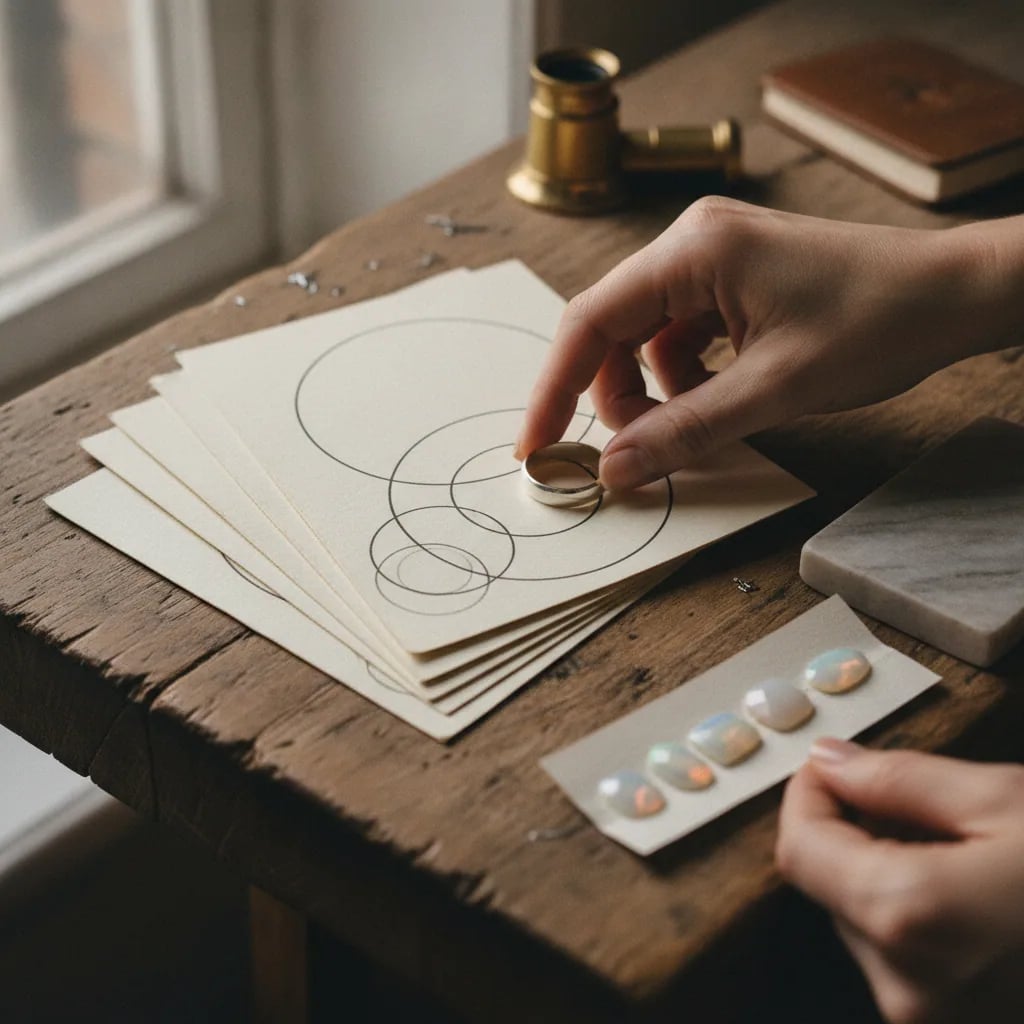
Your ring starts with the right size and the right stone. Once you have confirmed your measurement with the chart above, the Joalys process is short: pick the stone, then have the setting built around your size instead of the other way round.
- Pick your stone, browse the certified collection. Most of what we carry comes from Sri Lanka, where I spent two years buying at the source in Ratnapura and Beruwala. Every stone ships with a documented origin.
- Check it yourself, each stone arrives in a collector's case with its certificate of authenticity and a loupe. Every stone is examined by a GIA Graduate Gemologist who does not work for Joalys, which is the point: the person grading it has nothing to gain from the sale.
- Have the setting made, work with the atelier to build the ring to the size you measured, not to a stock size.
Start a custom project or look through the stones first. The size can wait until you have found one you actually want to wear.
Frequently Asked Questions
Conclusion
Getting an accurate ring measurement at home is doable. Download and calibrate the printable ring size chart, check the 50mm line with a ruler before you trust a single number, then measure three times at the end of the day. Account for band width and knuckle, and you will avoid the resize that a made to order setting cannot always absorb.
Then the part that actually matters: the stone. A size is just a number on a shank, and it is the easy half of the decision. Start with the stones we carry, or read how a coloured stone behaves in a ring setting before you commit to one. When you are ready, tell us what you have in mind.