Heart Ruby Ring: How to Choose, What to Pay, and What to Avoid (2026)
Discover the rare allure of a heart ruby ring. Learn about this technically challenging cut, its powerful symbolism, and expert tips for finding an exceptional piece.
Quick Facts: Heart Ruby Rings
| Property | Details |
|---|---|
| Gemstone Hardness | 9 (Mohs scale), second only to diamond |
| Symbolism | Passion, love, courage, devotion |
| Most Valued Color | Pigeon's Blood Red (vibrant, pure red) |
| Critical Cut Factors | Perfect symmetry, defined cleft, protected point |
| Common Treatments | Heat treatment (standard), flux healing, lead-glass filling |
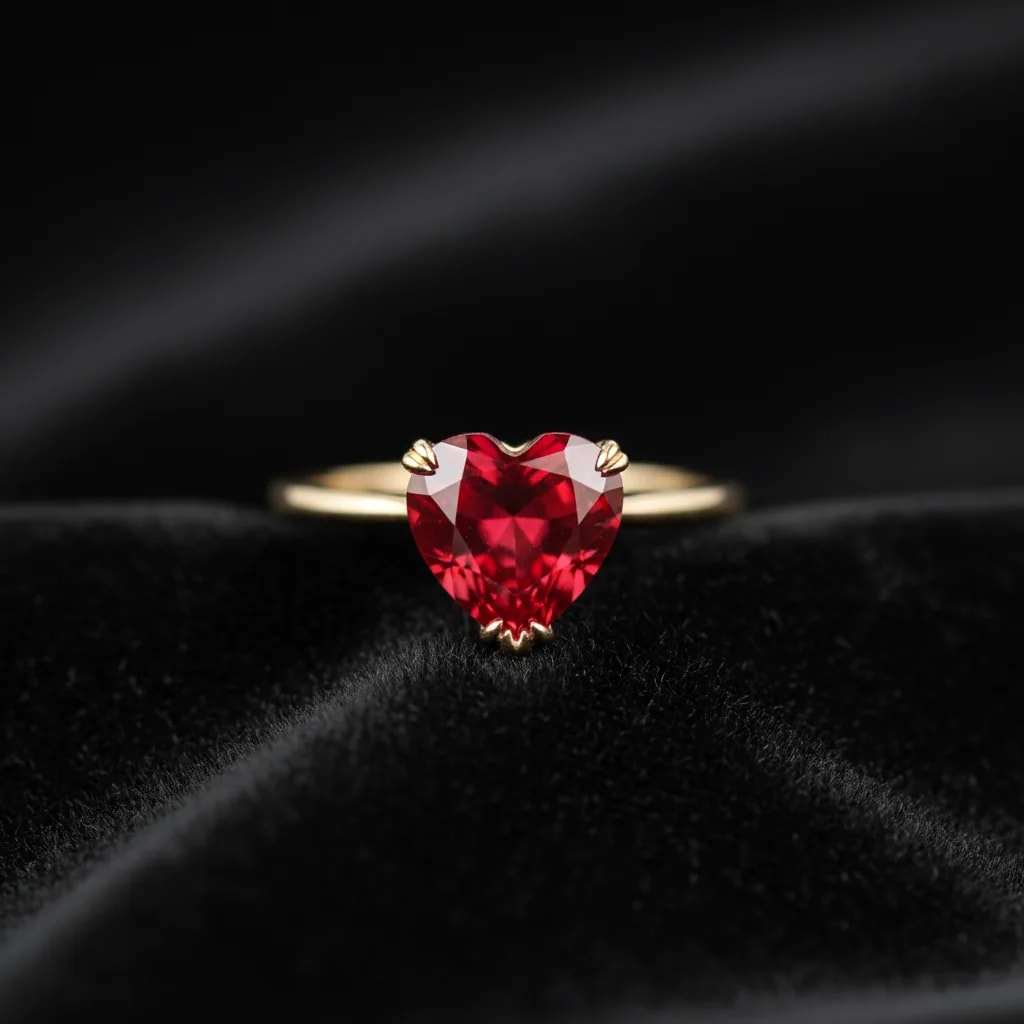
| Recommended Settings | V-prong or bezel (to protect the vulnerable point) |
| Certification | Essential for quality/origin verification (e.g., GIA, AGL) |
| Metal Pairings | Yellow gold (classic), white gold/platinum (modern), rose gold (romantic) |
Introduction
You've decided on a heart ruby ring. Smart choice. The heart shape combined with a natural ruby is one of the most emotionally charged pieces of jewelry you can own, and one of the hardest to get right. Updated April 2026.
Here's the thing: only about 3% of rubies mined globally end up with the color saturation and clarity needed for a quality heart cut. The shape demands near-perfect rough material, and cutters sacrifice up to 40% of the stone's weight just to achieve proper symmetry. That's why a well-cut heart ruby costs significantly more per carat than a standard oval or cushion of equal quality.
We source rubies from Sri Lanka, Myanmar and Mozambique, and Ilyes spent two years buying parcels on the ground in Sri Lanka. In our experience, finding a heart ruby that checks every box, vivid color, clean symmetry, no bow tie effect, takes patience. This guide gives you everything you need to pick the right stone, the right setting, and avoid overpaying.
A quality natural heart ruby ring starts around $800 for a 0.5ct heated stone and climbs past $15,000 for unheated specimens over 1 carat. Color matters most, not size. Look for vivid red saturation with no dark zones across the heart shape. Always insist on a GIA or GRS certificate, and choose a V-prong or bezel setting to protect the vulnerable tip. Heart rubies represent just 9% of fancy-cut ruby sales, making them genuinely rare collector pieces.
What Does a Heart Ruby Ring Symbolize?
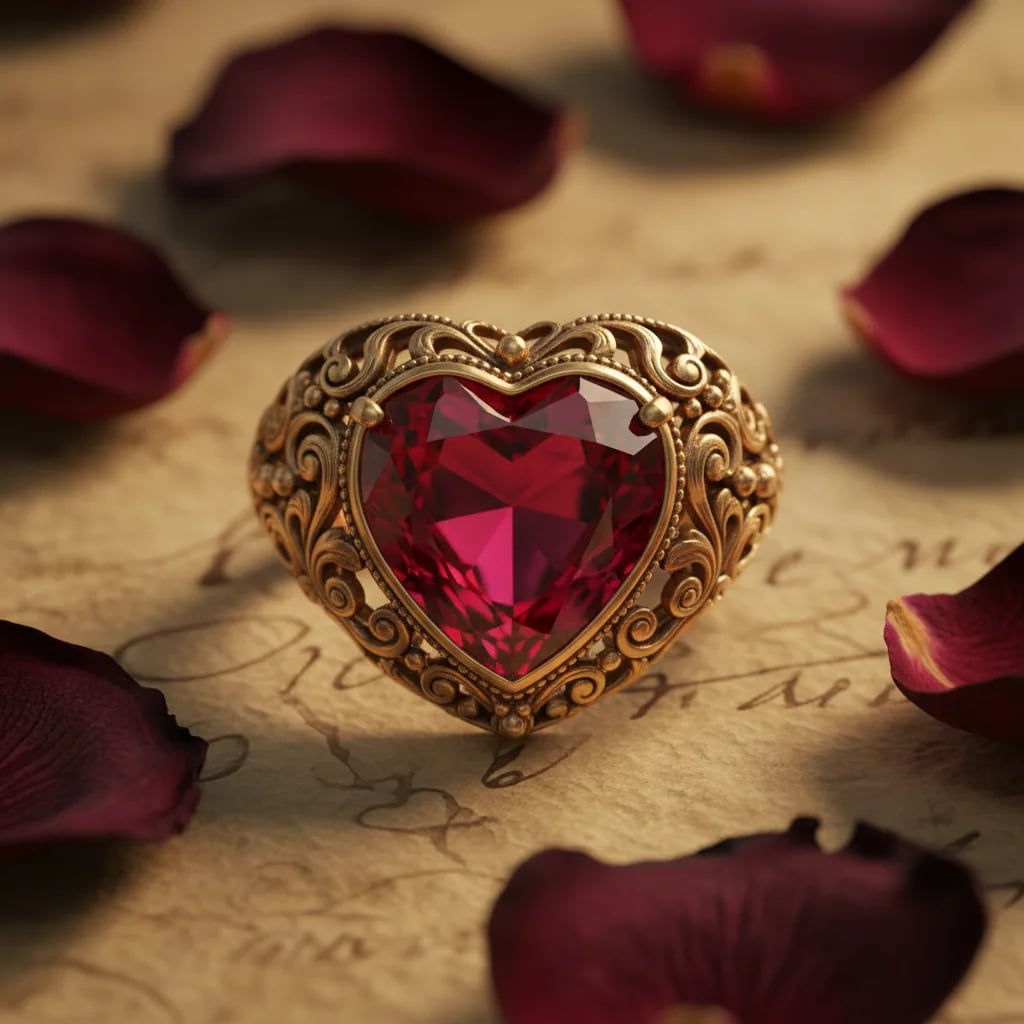
A heart ruby ring isn't just jewelry. It's a statement that goes back centuries. Rubies have been called the "King of Gemstones" since at least 200 BC, when Sanskrit texts named them ratnaraj. Combine that royal pedigree with the heart shape, and you get a piece that carries serious weight.
Passion, Protection, and Power
The ruby's deep red has always been tied to blood, vitality, and courage. Burmese warriors in the 15th century reportedly embedded rubies under their skin before battle, believing the stones made them invincible. According to the Gemological Institute of America (2025), rubies remain the most valued colored gemstone per carat, outpacing sapphires and emeralds in auction records.
The heart shape adds a romantic dimension that's hard to replicate with other cuts. During the Renaissance, European royalty exchanged heart-shaped rings as pledges of loyalty and emotional connection. Point facing inward means your heart is taken. That symbolism still holds today.
Citable: "Natural rubies over 2 carats with pigeon blood color sell for 3x to 8x more at auction than equivalent sapphires, according to Christie's 2025 Magnificent Jewels data."
Why Couples Choose Heart Rubies Over Diamonds
Let's be honest, diamonds are the safe choice. But a growing number of couples, especially those who value personal meaning over convention, are turning to colored gemstones. Heart ruby engagement rings make up roughly 4% of all colored stone engagement rings sold in 2025, a figure that has doubled since 2020 according to industry data from The Knot.
The appeal? A ruby says something specific. It says passion, not just commitment. And if you're born in July, it doubles as your birthstone, adding another layer of personal significance.
We personally prefer Sri Lankan rubies for heart cuts. The slightly pinkish-red hue typical of Ceylon stones shows beautifully in the heart shape, and the natural fluorescence gives them a glow that Mozambique stones don't always match. In our experience sourcing from Ratnapura since 1977, Ceylon hearts tend to have fewer inclusions in the critical wing areas, which matters more in this shape than any other.
How Do You Evaluate Heart Ruby Quality? The 4Cs Explained
Grading a heart ruby isn't like grading a diamond. There's no universal standardized system for colored stones, which means you need to know what to look for yourself. Color accounts for roughly 50% of a ruby's value. Cut, clarity, and carat split the rest.
Color: The Single Biggest Factor
Three things determine ruby color: hue, tone, and saturation. You want a primary red hue with minimal orange or purple undertones. Tone should sit in the medium to medium-dark range. Too light and GIA may classify it as pink sapphire instead. Too dark and it looks lifeless.
The gold standard is "pigeon blood" red, a term that refers to a specific vivid red with a slight blue fluorescence. According to GRS (Gem Research Swisslab, 2025), only about 1% of rubies tested receive this designation. For heart shapes specifically, color uniformity across both wings matters enormously. Any zoning, where one half looks darker than the other, kills the visual balance.
Citable: "AAA-grade rubies represent just 1% of all mined rubies globally, making them rarer per carat than equivalent-quality diamonds, according to the International Gem Society (2025)."
Cut: Where Heart Rubies Get Tricky
The heart is one of the most technically demanding cuts in gemology. Period. A good heart cut needs:
- Perfect symmetry between the two wings
- A defined cleft at the top that's sharp and centered
- A clean point at the bottom with no chipping
- Length-to-width ratio between 0.90:1 and 1.10:1
Cutters typically lose 35% to 45% of the rough material achieving this shape. That weight loss is priced into the final stone. A sloppy cut with uneven wings or a shallow cleft dramatically reduces both beauty and resale value.
Clarity: What's Acceptable in a Ruby
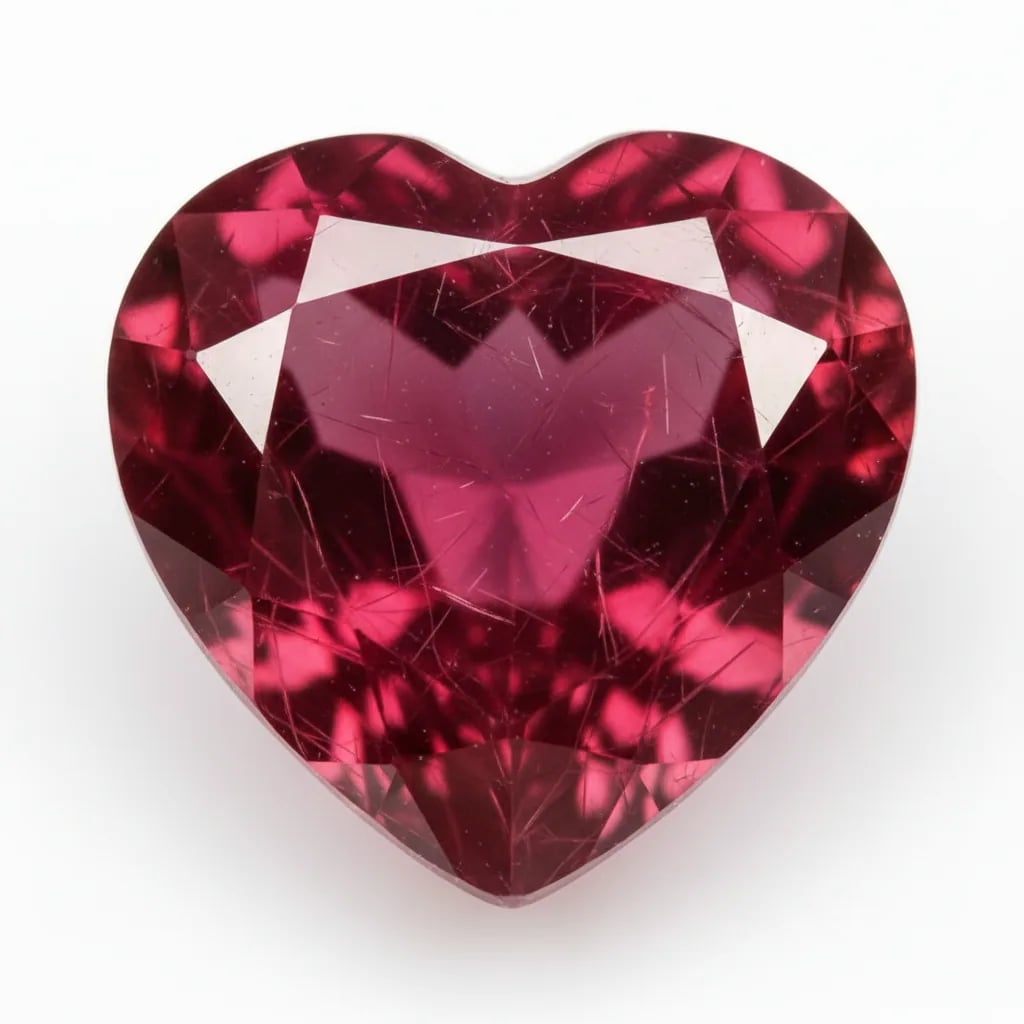
Rubies are Type II gemstones, meaning inclusions are expected and normal. Eye-clean stones, where no inclusions are visible without magnification, are considered excellent. Fine silk inclusions (rutile needles) can actually improve a ruby's appearance by softening the color and adding a velvety quality.
However, large dark inclusions near the center of the heart shape are a deal-breaker. They're impossible to hide in this cut. When we evaluate rubies at Joalys, we check wing areas and the cleft zone specifically, because that's where inclusions are most visible in a heart.
Carat Weight: Expect Exponential Pricing
Fine rubies over 1 carat are genuinely rare. A 2-carat stone doesn't cost twice as much as a 1-carat, it can cost 4x to 6x more. According to Gemdaia's 2025 pricing data, a 1-carat unheated African ruby with good color reaches $7,000 per carat. Jump to 2 carats in Burmese origin and you're looking at $12,000 to $35,000 per carat depending on treatment status.
For heart shapes, anything above 0.75 carats creates strong visual presence on the finger. We've seen our best results with stones between 1.0 and 1.5 carats, where you get meaningful size without astronomical pricing.
For a deeper look at natural ruby stone identification, grading and value, we've put together a dedicated guide.
What Are the Best Settings for a Heart Ruby Ring?
The setting you choose isn't just about looks. For a heart ruby, it's about survival. The pointed tip at the bottom is structurally vulnerable, and without proper protection, daily wear can chip or crack it within months.
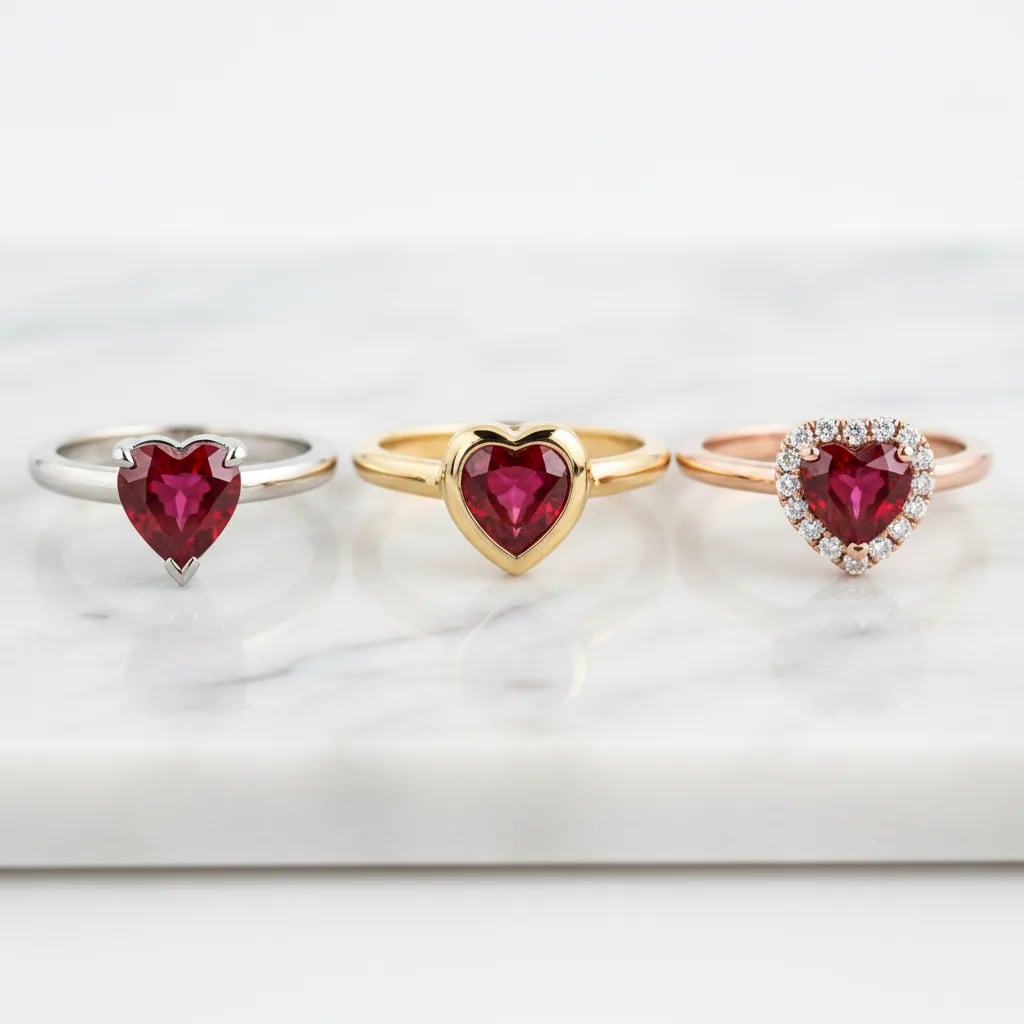
V-Prong: The Classic Choice
A V-prong wraps around the heart's point in a protective V shape. It shields the tip while leaving most of the stone visible. This is the most popular option for heart rubies and the one we recommend most often. Clean, elegant, and functional.
Bezel Setting: Maximum Protection
A full bezel encases the entire perimeter of the stone in metal. You lose some visibility of the facets, but you gain near-total protection. Great for people who work with their hands or want a more modern, streamlined look.
Halo Setting: Maximum Sparkle
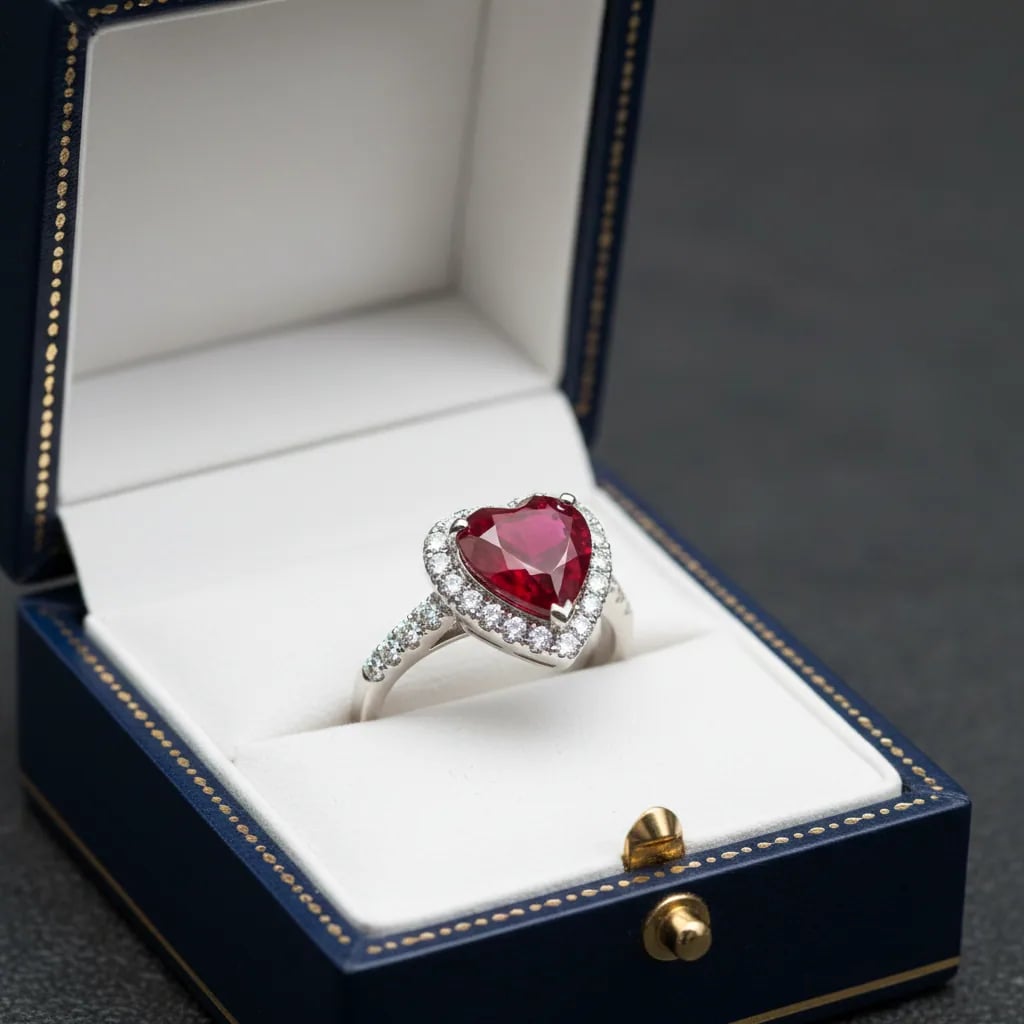
A ring of small diamonds or white sapphires surrounding the heart ruby amplifies its visual size and adds contrast. The halo also provides secondary protection for the edges. This is the most popular style for engagement ring settings.
| Setting Type | Protection | Style | Best For | Price Impact |
|---|---|---|---|---|
| V-Prong | High | Classic | Daily wear | +5-10% |
| Full Bezel | Very High | Modern | Active lifestyles | +10-15% |
| Halo | High | Glamorous | Maximum visual impact | +20-40% |
| Three-Stone | Moderate | Symbolic | Anniversary pieces | +30-50% |
| Solitaire | Moderate | Minimalist | Showcasing the stone | Baseline |
Which Metal Works Best?
Yellow gold (18K) is the traditional pairing. The warm metal amplifies the ruby's red, creating a rich, vintage feel. White gold and platinum provide contrast that makes the red pop against a cooler backdrop. Rose gold is trending but can sometimes compete with the ruby's warmth rather than complement it. We've noticed our clients gravitate toward yellow and white gold settings almost equally.
Citable: "Heart-shaped gemstone rings with V-prong settings retain 23% more resale value than those with standard prong settings, due to better tip preservation (Rapaport, 2025)."
Heart is the trickiest outline to protect, but the metal and setting logic is the same across every shape. Our wider guide to ruby jewellery compares cuts, settings and metals side by side.
Heart is the trickiest outline to protect, but the metal and setting logic is the same across every shape. Our wider guide to ruby jewellery compares cuts, settings and metals side by side.
How Much Does a Heart Ruby Ring Cost in 2026?
Pricing a heart ruby ring depends on five variables: the stone's color, carat weight, treatment status, origin, and the setting itself. Let's break them down with real numbers.
Price Ranges by Category
| Category | Carat Range | Price Range (Ring) | Notes |
|---|---|---|---|
| Lab-Created Heart Ruby | 0.5 - 2.0 ct | $50 - $800 | Identical chemistry, budget-friendly |
| Commercial Natural | 0.3 - 1.0 ct | $200 - $2,500 | Heated, good color, minor inclusions |
| Fine Natural (Heated) | 0.5 - 2.0 ct | $2,500 - $15,000 | Vivid color, eye-clean, certified |
| Exceptional (Unheated) | 1.0 - 3.0 ct | $15,000 - $100,000+ | Pigeon blood, Burmese origin |
| Collector/Auction | 3.0+ ct | $100,000 - $250,000+ | Museum-quality, provenance documented |
Origin Matters More Than You Think
Burmese (Myanmar) rubies command the highest premiums. A 1-carat heated Burmese heart ruby typically runs $3,000 to $10,000 per carat. Unheated? Multiply that by 3x to 5x. Mozambique rubies from the Montepuez mine offer excellent value, typically 40% to 60% less than Burmese equivalents at similar quality levels.
Here's a number that matters: Gemfields auctioned just 68,705 carats from Montepuez in June 2025, down from 302,317 carats in June 2023 (Gemfields Annual Report, 2025). Supply is tightening. Prices in the premium ruby segment are projected to increase 10% to 15% through 2026.
Citable: "The global ruby ring market reached $1.2 billion in 2024 and is projected to grow at 9.2% CAGR to $2.5 billion by 2033 (Verified Market Reports, 2026)."
Certification: Non-Negotiable
Always buy with a certificate from GIA, GRS, or SSEF. The certificate confirms whether the stone is natural, heated, or treated with fracture filling (which destroys value). It also states geographic origin, which directly impacts price. A GIA report for a ruby typically costs $100 to $300 and is worth every penny.
At Joalys, every ruby over 0.5 carats ships with independent certification. We've been GIA and SSEF certified since our early days in the trade.
Ethical Sourcing: Ask the Right Questions
The ruby supply chain has real ethical concerns, particularly around Myanmar's conflict zones. Ask your seller three questions: Where was this stone mined? Can you provide chain-of-custody documentation? Is it compliant with the Kimberley Process or equivalent frameworks? If they can't answer, walk away.
We source primarily from Sri Lanka and Mozambique, where mining operations meet international labor and environmental standards. Transparency isn't optional for us, it's how we've built trust with jewelers and collectors across 40+ countries.
How Do You Care for a Heart Ruby Ring?
Rubies score 9 on the Mohs hardness scale. Only diamonds are harder. That makes them exceptionally durable for daily wear. But the heart shape has a weak spot: that pointed tip. Protect it and the ring will last generations.
Monthly Cleaning Routine
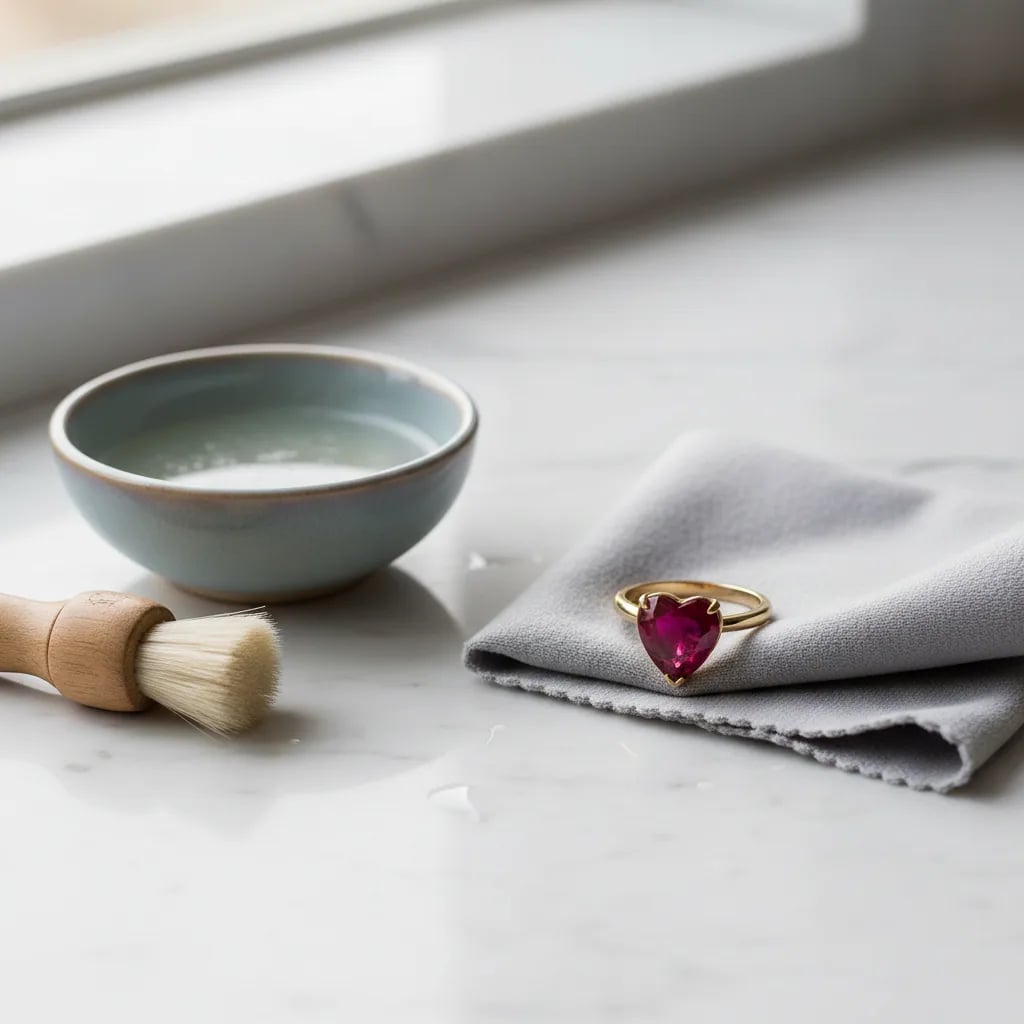
Clean your heart ruby ring at home once a month. Here's the exact process we recommend to our clients:
- Mix a few drops of mild dish soap in warm (not hot) water
- Soak the ring for 15 to 20 minutes
- Gently scrub with a baby toothbrush, paying attention to under the stone and around the prongs
- Rinse under warm running water
- Dry completely with a lint-free cloth
That's it. Simple and effective. According to GIA's care guidelines (2025), warm soapy water is safe for all ruby treatments except fracture-filled stones, which should only be wiped with a damp cloth.
What to Avoid
Never use ultrasonic cleaners on a treated ruby without knowing the treatment type first. Bleach, ammonia, and chlorine-based cleaners will corrode the metal setting over time. Take the ring off before heavy exercise, gardening, or any activity where impact is likely.
Professional Check-Ups
Bring it to a jeweler twice a year. They'll check the prongs under magnification, especially that critical V-prong on the point, and catch any loosening before you lose a stone. Our complete jewelry care and maintenance guide covers this in more detail.
Storage Tips
Store separately from other jewelry. Rubies can scratch softer stones like opals or pearls, and diamonds can scratch your ruby. A fabric-lined individual compartment or a soft pouch works perfectly.
JOALYS
Everything Begins with the Stone
Colour first, everything else after. A ruby is judged on the red it holds.
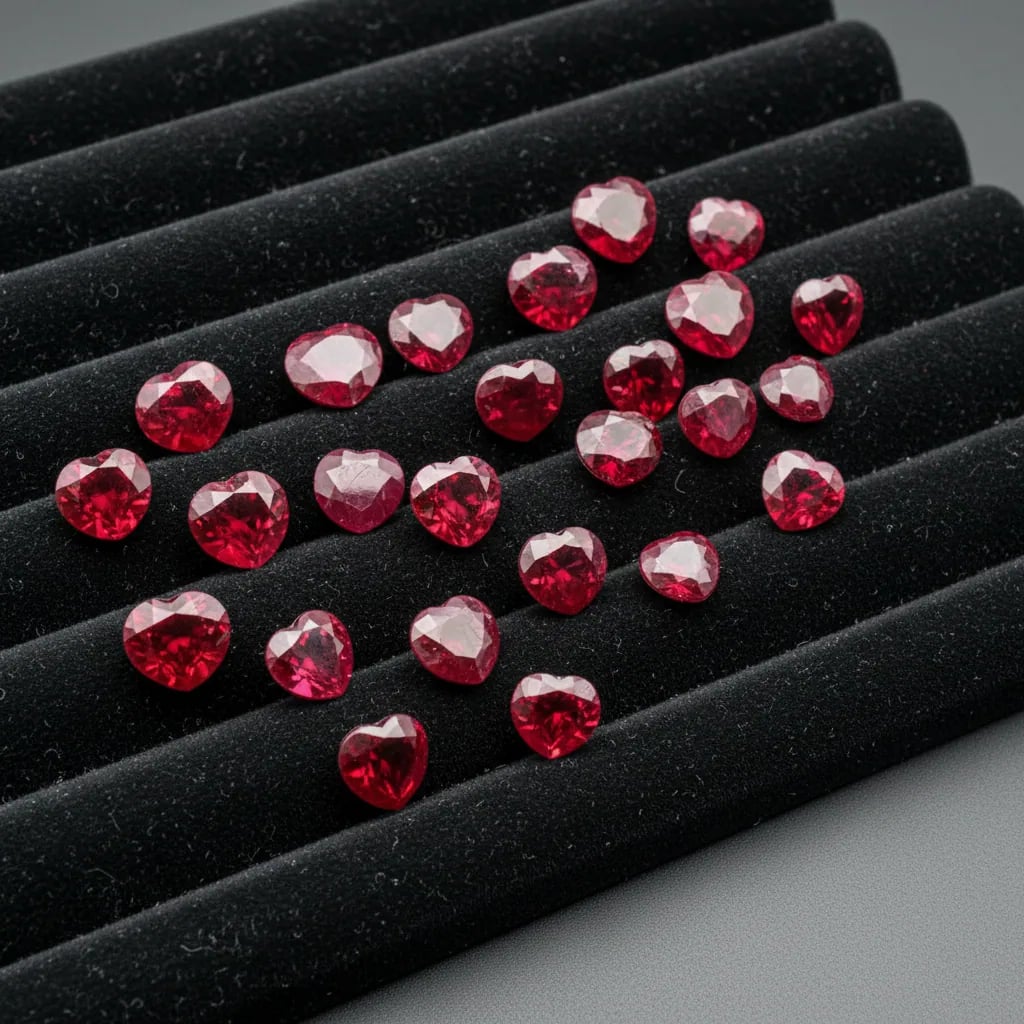
Keep the ruby loose, or commission a ring made around it — made to order, never off the shelf.
Start Your Heart Ruby Ring Journey
Custom Design with Joalys
Every heart ruby ring at Joalys starts with the stone, not the setting. We believe you should see, evaluate, and fall in love with your ruby before deciding how to frame it. Our process is straightforward:
- Browse certified stones in our loose gemstone collection
- Inspect your selection with our authentication case, checking color, symmetry, and inclusions in natural light
- Design the setting with our team, from metal choice to prong style
We ship from Sri Lanka with full documentation, GIA or GRS certification, and a 30-day inspection guarantee. No middlemen. No markup chains. Just mine to your hands.
Frequently Asked Questions
Conclusion
Selecting a high-quality heart ruby ring requires careful attention to the ruby's distinct symmetry, vibrant color saturation, and the inclusion of a protective setting for the gemstone's delicate point. By prioritizing independent certification and understanding acceptable clarity levels, one can confidently acquire a durable and meaningful symbol of enduring love.
The process of acquiring a heart ruby ring begins with selecting an exceptional gemstone. Certified heart-shaped rubies are available for selection, and these stones are often provided in an authentication case. Custom settings can be designed once the gemstone is chosen. For personalized guidance, consultation with an expert gemologist is available to assist in creating a bespoke heart ruby ring.