Vintage Engagement Rings: How to Choose the Perfect One (2026 Guide)
From Victorian filigree to Art Deco geometry, your complete buying guide with certified gemstones
Quick Facts: Vintage Engagement Rings
| Property | Details |
|---|---|
| Definition | Rings 20-100+ years old, from a distinct design era |
| Major Eras | Victorian (1837-1901), Edwardian (1901-1920), Art Deco (1920-1940), Retro (1940-1960) |
| Popular Stones | Old mine cut diamonds, sapphires, emeralds, rubies |
| Signature Details | Filigree, milgrain, hand engraving, cluster settings |
| Best Metals | Platinum (Edwardian/Deco), Yellow gold (Victorian), Rose gold (Retro) |
| Price Range | $1,500–$50,000+ depending on era, stones, condition |
| Key Check | Always verify with independent gemological certification |
| Vintage vs Inspired | Authentic = aged patina, hand-cut stones; Inspired = modern precision, new materials |
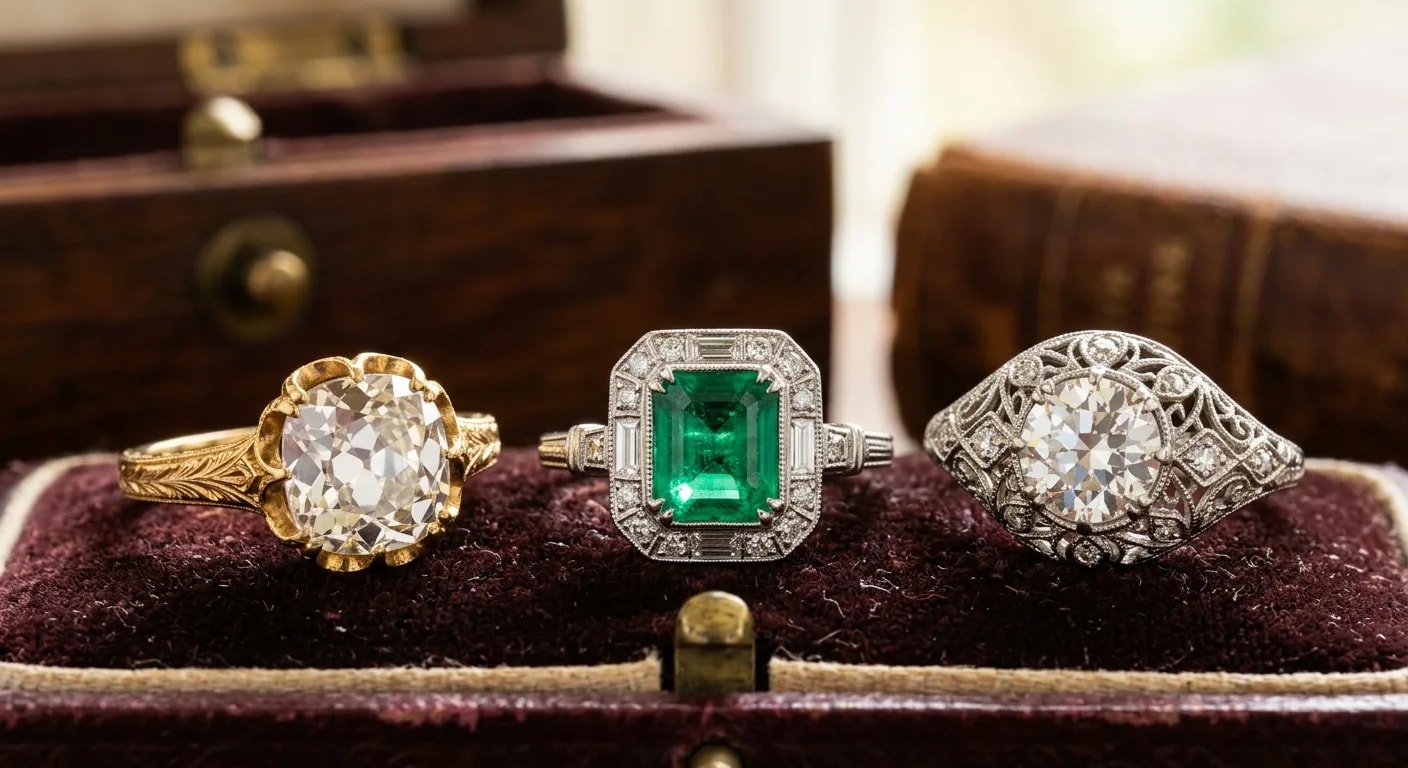
What Makes a Ring Truly Vintage?
A vintage engagement ring is at least 20 years old. An antique engagement ring is 100 years or older. That distinction matters when you're shopping, because "vintage-style" or "vintage-inspired" rings are brand-new pieces designed to look old. They borrow the aesthetic without the history.
Here's the thing: a genuine vintage ring carries the fingerprints of its era. The metalwork, the stone cuts, the proportions all reflect the tools and tastes of a specific decade. According to the Gemological Institute of America (2024), old mine cut and old European cut diamonds were hand-cut with 58 facets, but their proportions differ sharply from modern brilliants. The tables are smaller, the culets are larger, and the sparkle is softer, more like candlelight than a laser show.
We've handled hundreds of vintage pieces at Joalys, and no two are alike. A 1920s Art Deco ring from Paris feels completely different from a 1940s Retro piece from New York. The weight, the warmth, the way light plays through the stones, it all tells a story that a factory-made ring simply can't replicate.
The vintage ring market was valued at $370.25 million in 2024 (Market Reports World), projected to reach $538.49 million by 2033 at a CAGR of 4.25%. That growth is driven by couples who want something with soul. Etsy reported a 30% increase in vintage and antique-inspired engagement ring sales in 2024 alone, and North America holds approximately 39% of the global market share.
Vintage vs. Antique vs. Estate: Quick Definitions
| Term | Age | What It Means |
|---|---|---|
| Antique | 100+ years | Pre-1926 pieces. Victorian, Edwardian, early Art Deco. Often hand-fabricated entirely. |
| Vintage | 20-99 years | Roughly 1926-2006. Includes Art Deco, Retro, Mid-Century, and early modern designs. |
| Estate | Any age | Any previously owned ring, regardless of age. A 5-year-old ring sold secondhand is "estate." |
| Vintage-Inspired | Brand new | Modern ring using historical design elements like filigree, milgrain, or antique cuts. |
When dealers say "vintage," they sometimes mean 50+ years. The jewelry industry has no single standard. Always ask for the approximate date of manufacture and demand documentation when possible. A seller who can't provide at least a decade estimate should raise questions.
Why 40% of Millennials Choose Vintage
According to industry surveys (2024), 40% of millennials prefer vintage or vintage-inspired engagement rings over modern designs. The reasons go beyond aesthetics. Younger buyers cite sustainability (no new mining), uniqueness (impossible to replicate in a factory), and value (vintage rings often cost 20-40% less than comparable new rings because there's no manufacturing or retail markup). There's also an emotional component. A ring with history feels heavier with meaning, even if it weighs exactly the same on a scale.

The Four Great Eras of Vintage Engagement Rings
Vintage engagement rings fall into four major design periods, each with a distinct personality. Knowing these eras helps you identify what you're looking at, spot fakes, and find the style that actually fits your taste. Let's walk through them chronologically.
Victorian Era (1837-1901): Romance in Gold
Queen Victoria's engagement in 1840, when Prince Albert gave her a serpent ring symbolizing eternal love, launched the modern engagement ring tradition. Victorian rings favor yellow gold and rose gold. Platinum was rare and extremely difficult to work. Stones were typically rose-cut or old mine cut diamonds set in clusters, sometimes paired with colored gems like garnets, turquoise, and seed pearls.
Design motifs lean sentimental: flowers, hearts, snakes, and celestial symbols. The metalwork uses repoussé (hammered relief) and hand engraving. These rings feel warm and personal. If you see a ring with a snake motif and a garnet eye, you're almost certainly looking at a Victorian piece.
The Victorian era also gave us "acrostic" rings, where the first letter of each gemstone spelled a word. A ring set with Diamond, Emerald, Amethyst, Ruby would spell "DEAR." These are rare and highly collectible today.
- Metals: Yellow gold (10K-18K), rose gold, occasional silver
- Stone cuts: Old mine cut, rose cut, cabochon
- Signature details: Snake motifs, cluster settings, acrostic gem spelling, repoussé
- Price range: $1,500-$15,000 for most pieces; exceptional examples reach $50,000+
Edwardian Era (1901-1920): Platinum and Lace
The Edwardian era changed everything. Jewelers learned to work platinum, and suddenly rings could be impossibly delicate. Platinum's strength allowed intricate openwork, filigree, and milgrain borders that yellow gold couldn't support. The result is rings that look like frozen lace.
Old European cut diamonds dominate this period, often set in elaborate engagement ring settings with garland motifs and bow designs. The "daisy cluster" became iconic: a center diamond surrounded by a halo of smaller stones, decades before the modern halo trend became mainstream. According to 1stDibs research (2024), genuine Edwardian rings are among the most sought-after by collectors, with prices climbing 5-8% annually for well-preserved examples.
Edwardian rings are sometimes called "garland era" pieces because of the flowing, nature-inspired patterns. If you hold one up to the light, the openwork in the gallery (the underside of the setting) is as detailed as the top. That level of craftsmanship is extraordinarily difficult to replicate today, even with modern tools.
- Metals: Platinum with yellow gold backs, white gold (late period)
- Stone cuts: Old European cut, single cut, rose cut
- Signature details: Milgrain edges, filigree, garland motifs, bow designs, openwork galleries
- Price range: $3,000-$25,000; museum-quality pieces exceed $100,000
Art Deco Era (1920-1940): Geometry and Glamour
Art Deco is the era most people think of when they hear "vintage engagement ring," and for good reason. These rings are bold, architectural, and unapologetically glamorous. The roaring twenties brought geometric shapes, clean lines, and a love of contrast. Art Nouveau's flowing curves gave way to sharp angles and symmetry.
According to Market Reports World (2024), Art Deco-style engagement rings lead demand in 2026. The toi et moi ring (two stones set side by side, French for "you and me") surged in popularity after high-profile celebrity engagements. Step-cut stones like emerald cuts and Asscher cuts became fashionable, complemented by calibré-cut sapphires, emeralds, and rubies as accent stones.
One feature that separates genuine Art Deco from reproductions is the use of onyx, black enamel, or dark gemstones for contrast. The interplay between white platinum and dark accents creates a visual punch that's distinctly Deco. Signed pieces from Cartier, Van Cleef & Arpels, or Tiffany & Co. from this period are among the most valuable engagement rings in existence.
- Metals: Platinum, white gold
- Stone cuts: Old European cut, emerald cut, Asscher cut, baguette, single cut
- Signature details: Geometric patterns, step-cut accents, onyx contrast, milgrain, pierced metalwork
- Price range: $2,500-$30,000; exceptional signed pieces reach six figures
Retro Era (1940-1960): Bold, Colorful, Oversized
World War II restricted platinum (reserved for military use), so jewelers turned to yellow and rose gold. Retro rings are big, bold, and theatrical. Think oversized cocktail-style settings, large aquamarines, citrines, and synthetic rubies. The designs reflect Hollywood glamour and post-war optimism.
The Retro period also saw the standardization of the modern round brilliant cut. Marcel Tolkowsky published his ideal proportions in 1919, but it took decades for the industry to adopt them widely. By the 1950s, the round brilliant had become the dominant diamond shape, which is still true today.
These rings polarize people. You either love the drama or find it too much for daily wear. We personally think Retro pieces make incredible statement rings, even if they're not everyone's first choice for an engagement ring. They're also currently undervalued compared to Edwardian and Art Deco pieces, which makes them interesting for collectors.
- Metals: Yellow gold, rose gold (14K-18K), occasionally sterling silver
- Stone cuts: Round brilliant (newly standardized), emerald cut, cushion cut
- Signature details: Oversized designs, scrollwork, ribbon motifs, tank-track bracelets, colorful stones
- Price range: $1,200-$12,000; more accessible than Edwardian or Art Deco
Era Comparison at a Glance
| Era | Years | Primary Metal | Typical Cut | Design DNA | Entry Price |
|---|---|---|---|---|---|
| Victorian | 1837-1901 | Yellow gold | Old mine cut | Romantic, sentimental | $1,500 |
| Edwardian | 1901-1920 | Platinum | Old European cut | Delicate, lace-like | $3,000 |
| Art Deco | 1920-1940 | Platinum | Emerald/Asscher | Geometric, bold | $2,500 |
| Retro | 1940-1960 | Yellow/rose gold | Round brilliant | Oversized, dramatic | $1,200 |

What Gemstones Belong in Vintage Engagement Rings?
Diamonds dominate modern engagement rings, but vintage pieces tell a different story. Before the De Beers marketing campaigns of the mid-20th century, colored gemstones were just as popular for engagements, sometimes more so. Understanding which stones belong in which era helps you authenticate rings and choose the right gem for your own piece.
Diamonds: Old Cuts vs. Modern Brilliants
Every era had its own diamond cut. The progression from rose cut to old mine cut to old European cut to modern round brilliant reflects advances in cutting technology, not improvements in beauty. Many collectors actually prefer the softer sparkle of antique cuts. The broad, chunky facets of an old mine cut produce a warm glow under candlelight that modern precision cuts simply don't.
| Cut | Era | Facets | Key Feature |
|---|---|---|---|
| Rose Cut | 1500s-1900 | 3-24 | Flat bottom, dome top, subtle shimmer |
| Old Mine Cut | 1700s-1890s | 58 | Squarish shape, large culet, chunky facets |
| Old European Cut | 1890s-1930s | 58 | Round, small table, high crown, fiery sparkle |
| Transitional Cut | 1920s-1940s | 58 | Bridge between OEC and modern brilliant |
| Modern Brilliant | 1950s-present | 57-58 | Mathematically precise angles for maximum brilliance |
According to GIA (2024), old mine cut diamonds were hand-cut using rudimentary tools, which means each stone has a unique personality. No two are identical. That's part of their appeal for couples who want something that feels genuinely one-of-a-kind. On 1stDibs, old mine cut diamond engagement rings sell for an average of $9,750, ranging from $685 to over $400,000 for exceptional pieces.
Colored Gemstones in Vintage Rings
Sapphires have been engagement favorites since the Middle Ages. The famous sapphire engagement ring that Princess Diana received in 1981 (now worn by Catherine, Princess of Wales) sparked a revival that continues today. In our experience sourcing from Sri Lanka's Ratnapura mines, we've seen demand for untreated Ceylon sapphires in vintage-style settings increase by roughly 35% since 2022.
Rubies were prized in Victorian and Edwardian pieces for their symbolic association with passion and devotion. A genuine Burmese ruby in an Edwardian platinum setting is one of the most valuable combinations in the vintage market, with prices starting around $8,000 for smaller stones and climbing rapidly for anything above 2 carats. Read our detailed natural ruby identification guide for grading specifics.
Emeralds became especially popular during the Art Deco period, when their green hue contrasted beautifully with platinum and white gold settings. The geometric shapes of Art Deco design suit emerald-cut emeralds perfectly. Colombian emeralds commanded the highest premiums then and still do now.
Other Stones Found in Vintage Rings
- Garnets: Common in Georgian and early Victorian rings. Deep red varieties like pyrope and almandine were affordable alternatives to rubies. A garnet set in a Victorian cluster ring is a beautiful and budget-friendly entry into vintage jewelry.
- Opals: Popular in mid-to-late Victorian pieces. Queen Victoria herself loved opals and helped reverse superstitions about them. See our October birthstone guide for more on opal quality.
- Turquoise: Found in Victorian "forget-me-not" rings, often paired with seed pearls.
- Aquamarine: A Retro era favorite, often set in oversized yellow gold designs. The March birthstone was especially popular in cocktail rings.
- Seed Pearls: Used as accent stones in Victorian and Edwardian rings. Beautiful but fragile for daily wear.
Hardness Matters for Daily Wear
Let's be honest: if you're choosing a loose gemstone for a vintage-style ring, hardness is the most practical consideration after beauty. The Mohs scale tells you how well a stone resists scratching.
| Stone | Mohs Hardness | Daily Wear? | Care Level |
|---|---|---|---|
| Diamond | 10 | Excellent | Low maintenance |
| Sapphire/Ruby | 9 | Excellent | Low maintenance |
| Emerald | 7.5-8 | Good with protective setting | Moderate |
| Garnet | 6.5-7.5 | Good for occasional wear | Moderate |
| Opal | 5.5-6.5 | Fragile | High maintenance |
| Pearl | 2.5-4.5 | Not recommended | Very high |
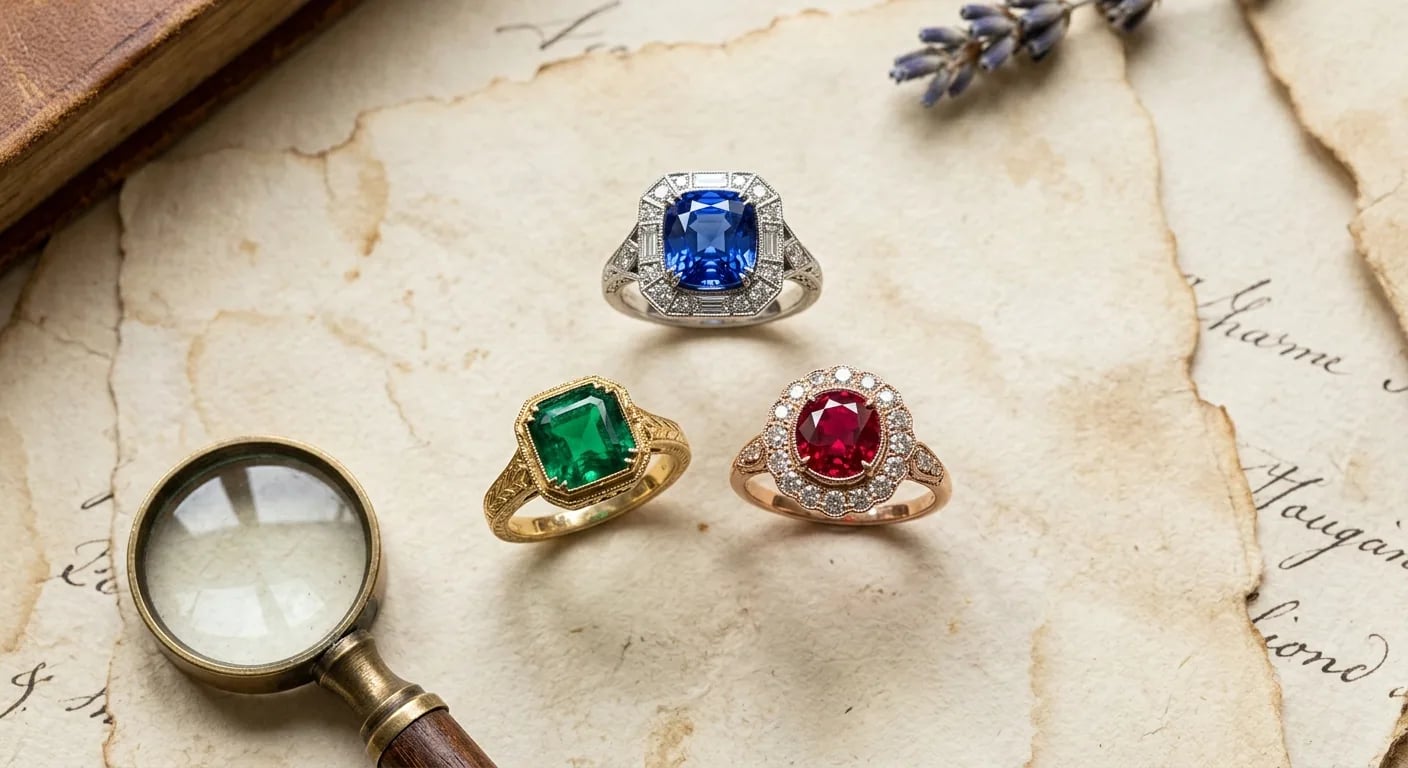
How Do You Choose the Right Vintage Engagement Ring?
Choosing a vintage engagement ring is different from buying a new one. You're evaluating history, condition, and authenticity on top of the usual considerations like size, style, and budget. Here's the framework we recommend after years of sourcing vintage and bespoke pieces.
Step 1: Pick Your Era (Not Just Your Style)
Start with the era that resonates with you emotionally. Each period has a distinct personality. Victorian is romantic and warm. Edwardian is delicate and refined. Art Deco is bold and architectural. Retro is dramatic and colorful. Browse rings from each era before committing to a style. Many people think they want Art Deco until they try on an Edwardian piece and fall in love with the delicacy.
Visit our engagement ring styles guide to understand how different settings work with different eras.
Step 2: Set a Realistic Budget
Vintage ring prices vary enormously. A simple Victorian gold band with a small rose-cut diamond might cost $1,500. A signed Art Deco platinum ring from Cartier could run $150,000. Most buyers find quality vintage engagement rings between $3,000 and $12,000.
The vintage ring market was valued at $370.25 million in 2024, according to Market Reports World, and prices have been climbing steadily. That said, vintage rings often offer better value than comparable new rings because you're not paying for new manufacturing, marketing, or retail markup. A 1-carat old European cut diamond in an original Edwardian setting frequently costs less than a comparable modern brilliant in a new setting.
Step 3: Assess Condition Honestly
Every vintage ring shows some age. That's normal and expected. But there's a difference between charming patina and structural compromise. Here's what to check:
- Prong integrity: Are the prongs holding the stone securely? Worn prongs are the most common issue and usually fixable ($50-$200 at a qualified jeweler).
- Metal thickness: Has the band worn thin? Thin bands can crack. Check the bottom of the shank (the part that contacts surfaces most). If you can see light through it, that's too thin.
- Stone security: Gently tap the ring near your ear. Any rattling means a loose stone that needs immediate attention.
- Solder marks: Previous repairs aren't necessarily bad, but heavy repair work can affect value and structural integrity. Look for color differences in the metal that indicate solder.
- Hallmarks: Look inside the band for maker's marks, purity stamps (750 for 18K gold, 950 for platinum), or date letters. British hallmarks are particularly reliable for dating.
Step 4: Verify the Stones
Synthetic gems existed as early as the 1900s. Flame-fusion synthetic rubies were common in Art Deco and Retro pieces. GIA (2023) notes that many "ruby" rings from the 1930s-1950s actually contain synthetic corundum. This doesn't make them worthless, but it dramatically affects value.
For diamonds, request certification. GIA grading requires unmounting the stone, which reputable sellers should accommodate for any purchase over $3,000. For colored stones, a gemological laboratory report from GIA, SSEF, or Gubelin confirms origin and treatment status. In our experience, about 15% of "natural" colored stones in vintage rings turn out to be synthetic or heavily treated upon laboratory examination.
Step 5: Check Sizing Limitations
Not every vintage ring can be resized. Plain bands typically resize up or down by 2 sizes without issue. But rings with intricate filigree, engraving around the entire band, or channel-set stones may crack or distort during resizing. Always ask the seller before assuming. Check our ring size chart to know your exact measurement before shopping.
Some Edwardian filigree rings cannot be resized at all without risking damage to the openwork. If you find a ring you love but it's the wrong size, ask if sizing beads (small metal beads soldered inside the band) could work as an alternative.
Step 6: Buy From Specialists
Vintage jewelry requires specialized knowledge. Buy from dealers who can document provenance, identify the era correctly, and provide condition reports. Estate auction houses (Christie's, Sotheby's, Bonhams) are reliable for high-end pieces. Specialist dealers like Lang Antiques, Erstwhile Jewelry, and Trumpet & Horn focus exclusively on vintage and antique jewelry.
For bespoke vintage-inspired pieces with certified gemstones, we source directly from Sri Lanka's Ratnapura mines. Every stone comes with full gemological certification and documented origin from mine to finished piece.

Vintage vs. Vintage-Inspired: Which Should You Buy?
This is the fork in the road every buyer faces. A genuine vintage ring gives you history and one-of-a-kind character. A vintage-inspired ring gives you the aesthetic with modern engineering. Neither choice is wrong, but the tradeoffs are real.
The Case for Authentic Vintage
- Unique character: Hand-cut stones, hand-fabricated settings, tooling marks that tell a story. No factory on earth can replicate the irregularities of a hand-made Edwardian piece.
- Environmental impact: No new mining, no new manufacturing. The most sustainable engagement ring is one that already exists.
- Investment potential: Genuine Art Deco and Edwardian pieces have appreciated 4-6% annually over the past decade, according to estate jewelry market data (2024). That outpaces inflation.
- Conversation piece: Every authentic vintage ring has a history. Some come with provenance documents tracing them back a century or more.
- Quality of materials: Pre-war platinum is often purer (95% vs. modern 90%). Old mine cut diamonds frequently have higher clarity than their grades suggest because the grading system was designed for modern cuts.
The Case for Vintage-Inspired
- Perfect sizing: Made to your exact finger measurement. No resizing risks or compromises.
- Stone choice: Pick the exact gemstone you want, with full certification. A Ceylon sapphire in a Deco-inspired setting, a Mozambique ruby in an Edwardian-style mounting, the combinations are endless.
- Structural reliability: Modern CAD design and casting produce stronger, more consistent settings. The prongs are engineered, not hand-bent.
- Matching bands: Vintage rings rarely came with matching wedding bands. A vintage-inspired ring can be designed with a perfectly fitting band from the start. See our guide to gemstone wedding rings for inspiration.
- Ethical sourcing: Choose recycled metals, conflict-free diamonds, or responsibly sourced colored gems. You control the entire supply chain.
- Warranty and service: New rings come with manufacturer warranties. Vintage pieces rarely do.
Side-by-Side Comparison
| Factor | Authentic Vintage | Vintage-Inspired |
|---|---|---|
| Age | 20-100+ years | Brand new |
| Uniqueness | One of a kind | Can be replicated |
| Sizing | Limited (risk of damage) | Made to measure |
| Stone certification | May need unmounting | Certified before setting |
| Durability | Varies (check condition) | Modern engineering |
| Price (comparable quality) | $3,000-$30,000 | $2,000-$15,000 |
| Resale/Investment | Strong for rare pieces | Depreciates like new jewelry |
| Environmental impact | Zero new resources | Low with recycled materials |
| Wedding band match | Difficult to find | Designed as a set |
| Warranty | Usually none | Manufacturer warranty |
The Hybrid Approach
JOALYS Expert Insight: We work both sides. Some clients bring us a vintage setting and ask us to source a new certified gemstone for it. Others want a completely new ring in Art Deco style with a stone we source from Ratnapura. The hybrid approach, pairing a certified unheated sapphire with a period-correct design, gives you the best of both worlds. We've seen gemstone wedding rings designed this way become family heirlooms in their own right. Every stone we source comes with full gemological certification from GIA or SSEF, and we document the complete journey from mine to ring.
JOALYS
Everything Begins with the Stone
Two sapphires can share the same grade and nothing else. Yours is chosen in hand.
Keep the sapphire loose, or commission a ring made around it — made to order, never off the shelf.

The Pre-Purchase Checklist: 7 Things to Verify Before You Buy
Before you hand over your credit card, run through this checklist. We've seen too many buyers skip these steps and regret it later. Take this list with you when shopping.
- Confirm the era. Ask the seller for a specific date range, not just "vintage." Request any documentation, hallmarks, or provenance records. Cross-reference the design elements with the era characteristics listed above. If a seller calls something "Art Deco inspired," that usually means it's a reproduction.
- Get an independent appraisal. Never rely solely on the seller's valuation. An independent appraiser certified by the American Gem Society (AGS) or a GIA Graduate Gemologist can verify authenticity, stone quality, and fair market value. Budget $75-$150 for a professional appraisal. This small investment can save you thousands.
- Check stone authenticity. Synthetic stones have been around since 1902. Lab reports from GIA, SSEF, or Gubelin confirm whether stones are natural, treated, or synthetic. For purchases over $2,000, this documentation is non-negotiable. We've seen "antique ruby" rings with synthetic corundum listed at natural ruby prices.
- Inspect structural integrity. Examine prongs under magnification (a 10x loupe is sufficient). Check the band thickness at its thinnest point. Test for loose stones by tapping gently near your ear. Ask if any repairs or modifications have been made and when.
- Verify sizing options. Ask the seller directly: "Can this ring be resized, and by how much?" Get this in writing. Some intricate vintage rings can only be sized half a size in either direction without risk of cracking the filigree or distorting the setting.
- Understand the return policy. Reputable vintage dealers offer at least a 7-day inspection period. Online sellers should provide 14-30 days. If there's no return policy, walk away. No exceptions.
- Document everything. Before purchasing, photograph the ring from multiple angles under different lighting. Note any existing scratches, wear marks, or repairs. This protects both you and the seller, and serves as a baseline for insurance documentation.
After Purchase: Caring for Your Vintage Ring
Taking proper care of your jewelry is just as important after purchase. Vintage rings need gentler cleaning methods than modern pieces. Avoid ultrasonic cleaners for antique settings with fragile stones or delicate filigree work. Warm water with mild soap and a soft brush is the safest approach. Have your ring professionally inspected every 12 months to catch worn prongs or loosening stones early.
Store vintage rings separately from other jewelry. The harder stones can scratch softer ones, and intricate metalwork can catch on chains or other rings. A soft pouch or individual compartment in a jewelry box works well.