Color Change Sapphire: One Stone, Two Lights
What the change looks like, why it happens, how it differs from alexandrite, and how to judge one.

A color change sapphire is a natural sapphire that shows one color in daylight and another under a warm incandescent bulb. Most go from blue or violet by day to purple or reddish purple by lamplight. A trace of vanadium causes it, and the stronger the change, the more the stone is worth.
- What it is
- A natural sapphire (corundum) whose color changes with the light
- Cause
- Vanadium
- Typical change
- Blue or violet in daylight, purple to reddish purple under incandescent light
- Rare change
- Green in daylight, reddish brown under incandescent light
- First value factor
- Strength of the change, then body color
- Hardness
- 9 on the Mohs scale
- Often confused with
- Alexandrite, synthetic color change sapphire, color change garnet
What does a color change sapphire look like?
One sapphire, two lights
A 1.51 carat sapphire we sell as blue changing to violet. View this stone
Some sapphires change color with the light. Typically they run from blue to violet in daylight, and from violetish purple to reddish purple under an incandescent lamp. They are very rare.
Two photographs of the same stone, nothing retouched. A screen is not a stone: before you choose a violet or color change stone, ask to see it in daylight and under a warm lamp.
Blue by day, violet to purple under the lamp: that is the pair you will see most. Rarer stones travel elsewhere: green in daylight to reddish brown by lamplight, or greenish blue that softens into pale browns and soft pinks. Plenty of natural stones are less clean than the textbook pair. Under the lamp they show pink-brown, brownish pink or purple; by day, yellowish brown, grayish violet or grayish blue.
What moves is the hue. Tone and saturation usually stay close, which is why a good one feels like one stone wearing two colors, not two different stones.
Both of the color change sapphires we hold today, 1.51 and 2.04 carats, are listed as blue changing to violet.
Why does a sapphire change color?
Vanadium. Sapphire is corundum, and corundum takes its colors from traces of other elements (the full range is in our guide to sapphire colors). In the color change variety, the trace that matters is vanadium.
Such a stone lets red light and green light through in almost equal amounts. Which one wins depends on the light you bring. An incandescent bulb or a candle flame is rich in red, so the stone leans purple. Daylight is richer in blue and green, so it leans blue.
The stone never changes. The light does. And because corundum rarely forms with enough vanadium to do this, these sapphires are very rare.
Color change, color shift or pleochroism?
Three words get mixed up in listings. One test separates them: hold the stone still and change the lamp, then keep the lamp and turn the stone.
- Color change. Same stone, same angle, different light, different color. Its strength is described as weak, moderate or strong.
- Color shift. A trade word, not a grade. Some sellers keep it for a milder change; others list the very same stone under both names. Read which two colors are described, not the label.
- Pleochroism. Same light, different angle. A sapphire can look pure blue in one direction and greenish blue in another. It comes from the crystal, not from the lamp.
Color change sapphire vs alexandrite
Alexandrite gave the phenomenon its name: color change is often called the alexandrite effect. It is another mineral, chrysoberyl, colored by chromium.
| Color change sapphire | Alexandrite | |
|---|---|---|
| Mineral | Corundum | Chrysoberyl |
| Cause | Vanadium | Chromium |
| In daylight | Blue to violet | Yellowish, grayish or bluish green |
| Under a warm bulb | Violetish purple to reddish purple | Orangy or brownish red to purplish red |
| Hardness | 9 on the Mohs scale | 8.5 on the Mohs scale |
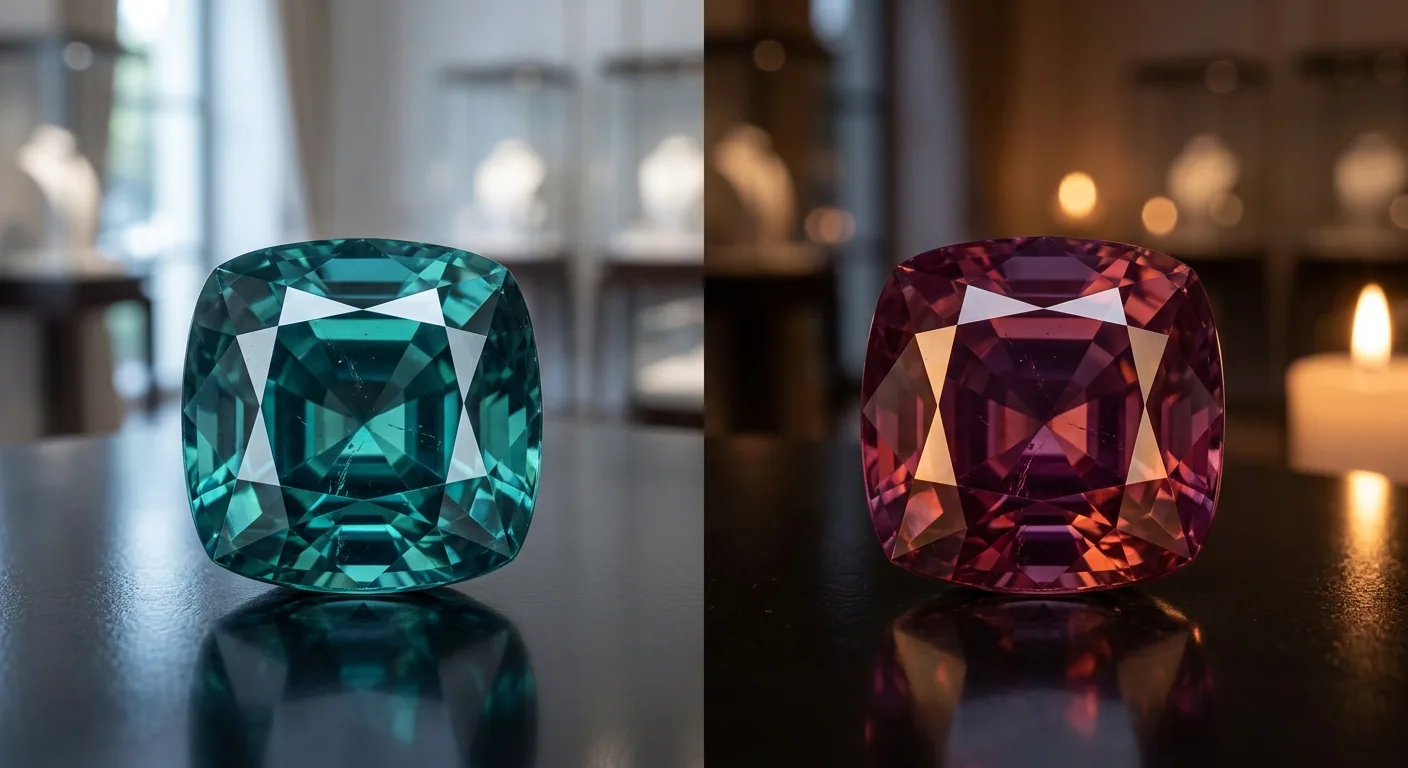
One alexandrite, two lights
Only the hue changes. The light changes, the stone does not.
Two separate photographs of the same stone, cut out on the same grey ground and set to the same size.
Sapphires that change color are sometimes called alexandrite-like, yet the two markets sit far apart: the sapphire costs much less per carat. Neither usually reaches a pure red and green: the sapphire almost always falls short of that ideal, and under a lamp alexandrite itself can turn brownish rather than red. Look at ours above. My view: if you want the phenomenon on a hand you use every day, the harder stone is the sapphire. If you want the name, start with our alexandrite guide.
How to judge a color change sapphire
- Strength first. How strongly the color changes is the first value factor, ahead of the body color. A clear switch between two colors beats a pretty stone that barely moves. Percentages in listings ("100% change") are an eye estimate, not a grade.
- Both lights, in that order. Look under daylight-equivalent light first, then switch to a warm incandescent bulb. From a distance, ask for the same stone, at the same angle, under both lights.
- Natural sapphire, really? Synthetic color change sapphire is the most common imitation of alexandrite: grayish blue by day, purplish under the lamp. Color change garnet can look close too. Magnification separates natural from synthetic, and an independent laboratory report names the stone.
- Heat. Heating is by far the most common sapphire treatment (our colored gemstone statistics give the share). Both of ours are heated, and their listings say so.
What that report can and cannot tell you is in what a gemstone certificate proves.
Quick answers
Are color change sapphires rare?
Can a color change sapphire be lab grown?
Where do color change sapphires come from?
Does a color change sapphire glow under UV light?
Is a color change sapphire good for an engagement ring?
The bottom line
Judge a color change sapphire by how far it moves, not by what it is called. Hold it still, change the light, and ask for the report. A strong change in a natural sapphire is rare. The words "color shift" prove nothing.