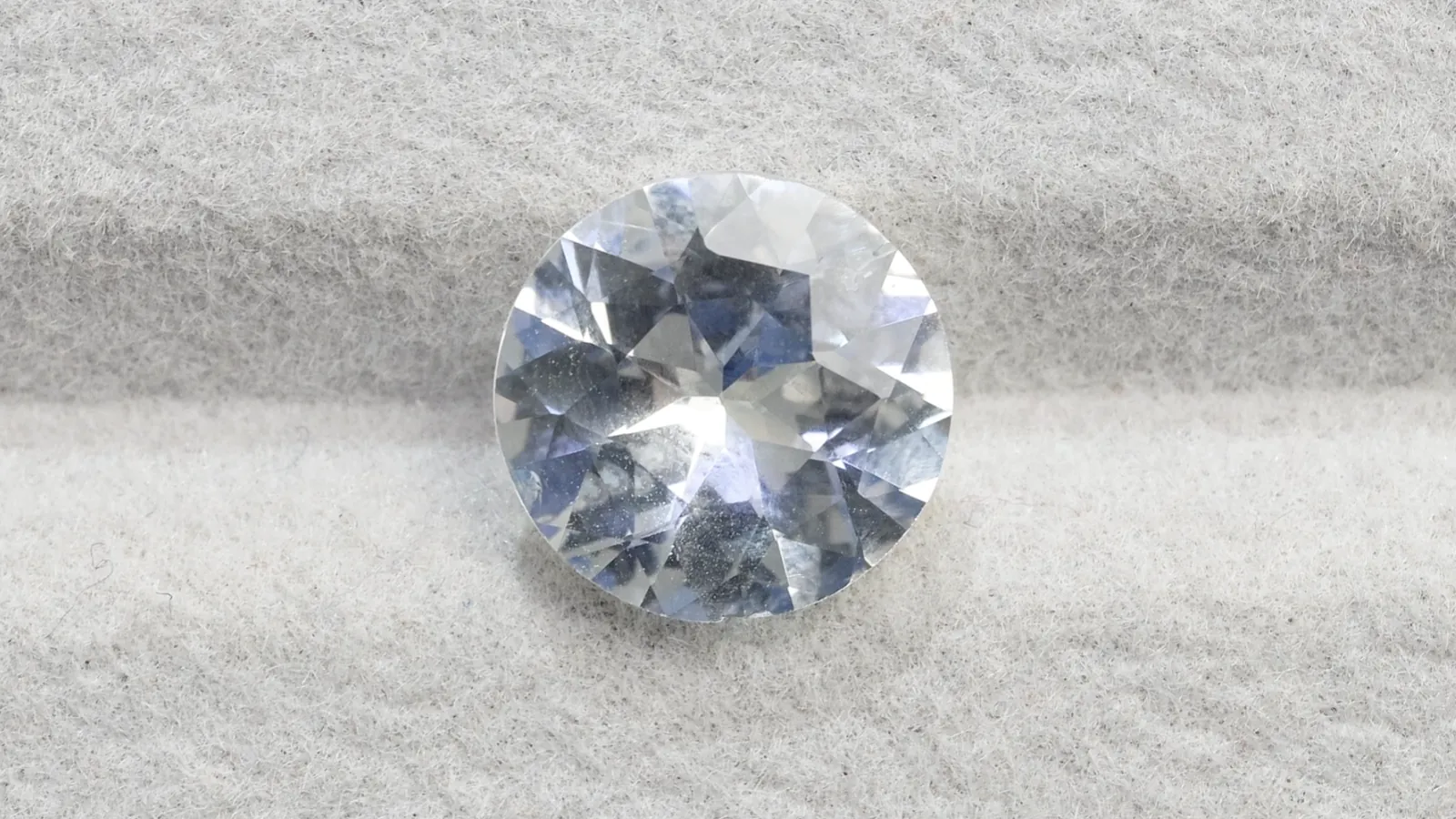
White Sapphire vs Diamond: What Your Eye Will See
Fire, wear, the dirt myth and the diamond tester: where a white sapphire holds its own against a diamond, where it doesn't, and how moissanite and cubic zirconia fit in.

A diamond is harder and much brighter, with more than twice the fire. A white sapphire is corundum, tough enough for a ring worn every day, and long offered as the more accessible alternative. Side by side, the diamond is the brighter stone. Choose the sapphire for its quieter, glassier glow, not in the hope that nobody notices.
| White sapphire | Diamond | |
|---|---|---|
| Hardness (Mohs) | 9 | 10 |
| Toughness | Usually excellent | Good to excellent |
| Fire (dispersion) | 0.018, weak | 0.044, moderate |
| Brilliance | Much lower, glassy luster | High |
| Standard diamond tester | Not diamond | Diamond |
| Cost | Lower | Higher |
Can You Tell a White Sapphire From a Diamond?
Yes, side by side, and light gives it away. Fire is the flash of color you see when white light splits into spectral colors, and a diamond's dispersion is more than twice a sapphire's: 0.044 against 0.018. A white sapphire is also much less brilliant, with a glassier luster.
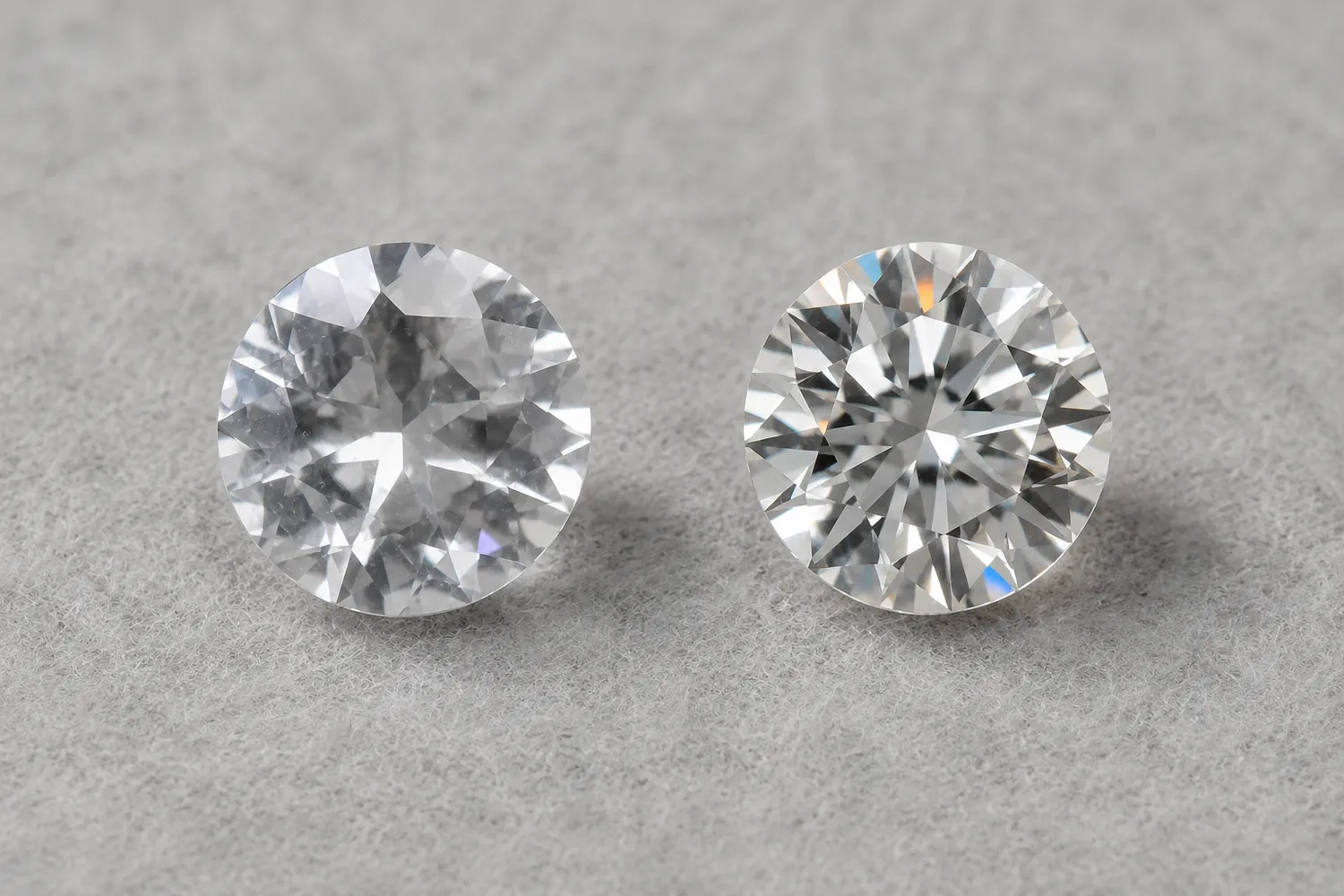
A white sapphire reads calm and clear; a diamond throws light and color back at you. Neither look is a lesser one. They are two different stones, and your eye will see it.
Which One Lasts Longer in a Ring?
Both take daily wear. Sapphire rates 9, diamond 10, and no natural gem other than diamond can scratch a sapphire.
Nine even steps, then diamond
The Mohs scale is a ranking: each mineral scratches the ones below it. Steps 1 to 9 are drawn equal. The step up to diamond is much wider.
SofterMohs rankHarder
How much wider depends on the test. In scratch tests done with a weighted diamond point, diamond came out 140 times harder than corundum. Tests that press a dent into the stone use another scale.
Who scratches whom?
Pick two.
Colorless gems
Everyday things
White sapphire (9) and diamond (10)
Harder: Diamond. It scratches the other and is not scratched back.
On a ring
It can mark a white sapphire. Keep the two from rubbing together, on the hand or in the box.
Every material against white sapphire
| Material | Mohs hardness | Against white sapphire | On a ring |
|---|---|---|---|
| Diamond | 10 | Scratches white sapphire | It can mark a white sapphire. Keep the two from rubbing together, on the hand or in the box. |
| Moissanite (synthetic) | 9.25 | Scratches white sapphire | Synthetic moissanite is listed at 9.25, just above sapphire. Keep the two from rubbing together, on the hand or in the box. |
| White topaz | 8 | White sapphire scratches it | The white sapphire is the one that marks the other. Keep it apart from softer gems in the jewelry box. |
| Rock crystal | 7 | White sapphire scratches it | The white sapphire is the one that marks the other. Keep it apart from softer gems in the jewelry box. |
| Colorless zircon | 6 to 7.5 | White sapphire scratches it | The white sapphire is the one that marks the other. Keep it apart from softer gems in the jewelry box. |
| Dust and sand | about 7 | White sapphire scratches it | Dust and sand are mostly quartz, at about 7. A gem ranked below topaz can pick up scratches over time. Sapphire sits two ranks above quartz. |
| Steel nail | about 6.5 | White sapphire scratches it | A steel nail sits at about 6.5, below sapphire. The precious metal of a setting is softer than the stone: have the prongs checked. |
| Glass | about 5.5 | White sapphire scratches it | A glass plate sits at about 5.5, well below sapphire. The stone can scratch glass, not the other way round. |
| Fingernail | about 2.5 | White sapphire scratches it | A fingernail sits at about 2.5, far below sapphire. |
The ten reference minerals
| 1 | Talc |
|---|---|
| 2 | Gypsum |
| 3 | Calcite |
| 4 | Fluorite |
| 5 | Apatite |
| 6 | Orthoclase |
| 7 | Quartz |
| 8 | Topaz |
| 9 | Corundum |
| 10 | Diamond |
Everyday values are approximate. The rule: a material scratches anything ranked the same or lower.
What dulls a ring stone is dust, mostly quartz at 7, and both sit well above it. Toughness, the resistance to chips and breaks, tilts the other way. Corundum's is usually excellent, diamond's good to excellent, and a diamond has perfect cleavage in four directions: struck just right, it can split cleanly.
Does a White Sapphire Get Dirty Faster Than a Diamond?
No, and this is the myth most comparisons repeat. Diamond has a remarkable affinity for grease: miners even use it, catching rough diamonds on greased belts. Colored stones don't attract grease as strongly.
On any ring, soap, hand lotion and skin oil build a film, and the film steals light. On a diamond, the grease layer lets light leak out through the back of the stone, dimming even a well-cut one. Clean, both get their brightness back, and warm, soapy water is safe for a sapphire. If the haze sits inside the stone, in its inclusions, no cleaning will change it.
White Sapphire, Moissanite or Cubic Zirconia?
- Moissanite, the kind set in jewelry, is man-made. Hardness 9¼, dispersion 0.104: much more fire than a diamond. It passes a standard diamond tester, and it is lighter than a diamond of the same size.
- Cubic zirconia is man-made too, and the most common diamond simulant. It is almost as brilliant as diamond, with slightly more fire, hardness 8¼, and much heavier in the hand.
- White sapphire is the natural one of the three, at 9, with the least fire. Synthetic white sapphire exists as well, made quickly and inexpensively; magnification is what separates it from natural, and for a stone that matters, an independent laboratory makes the call (what a lab report proves). More on the stone itself: our white sapphire guide.
Fire and brightness: four colorless stones
Dispersion is the splitting of white light into colors: the flashes called fire. Pick a stone.
The figures in a table
| Stone | Dispersion | Refractive index |
|---|---|---|
| White sapphire | 0.018, weak | 1.762 to 1.770 |
| Diamond | 0.044, moderate | 2.417 |
| Cubic zirconia (synthetic) | 0.060, strong | 2.150 |
| Moissanite (synthetic) | 0.104, strong | 2.648 to 2.691 |
White Sapphire for an Engagement Ring: Five Settings
For a ring worn every day, yes: white sapphire rates 9 on the Mohs scale and its toughness is usually excellent. Here are five classic settings, in white sapphire alone, from the solitaire to the toi et moi.
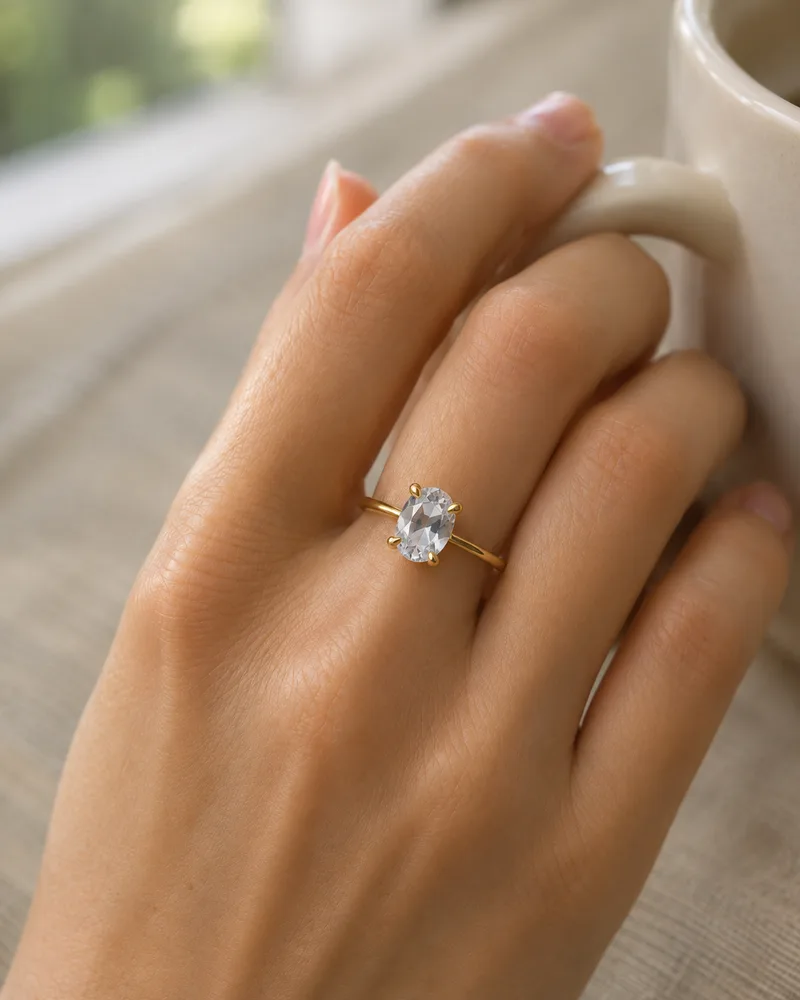
1 / 5Solitaire
An oval white sapphire alone in four claws, on a thin yellow gold band.
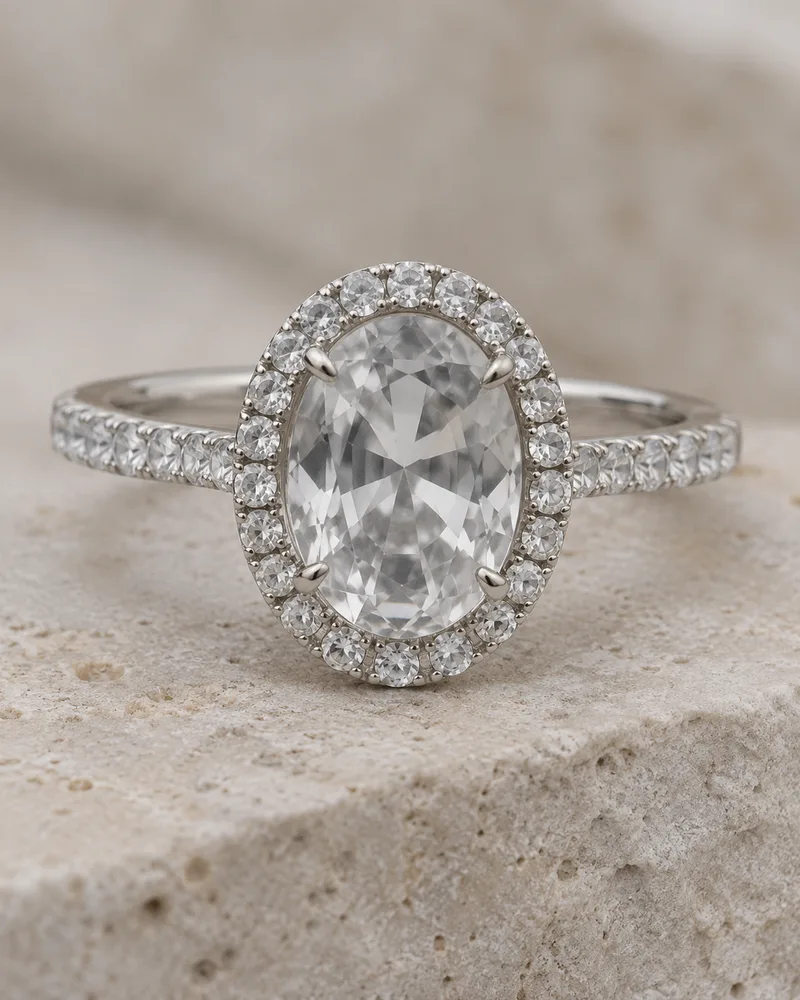
2 / 5Halo
An oval white sapphire inside a ring of small white sapphires, with more set along the band.
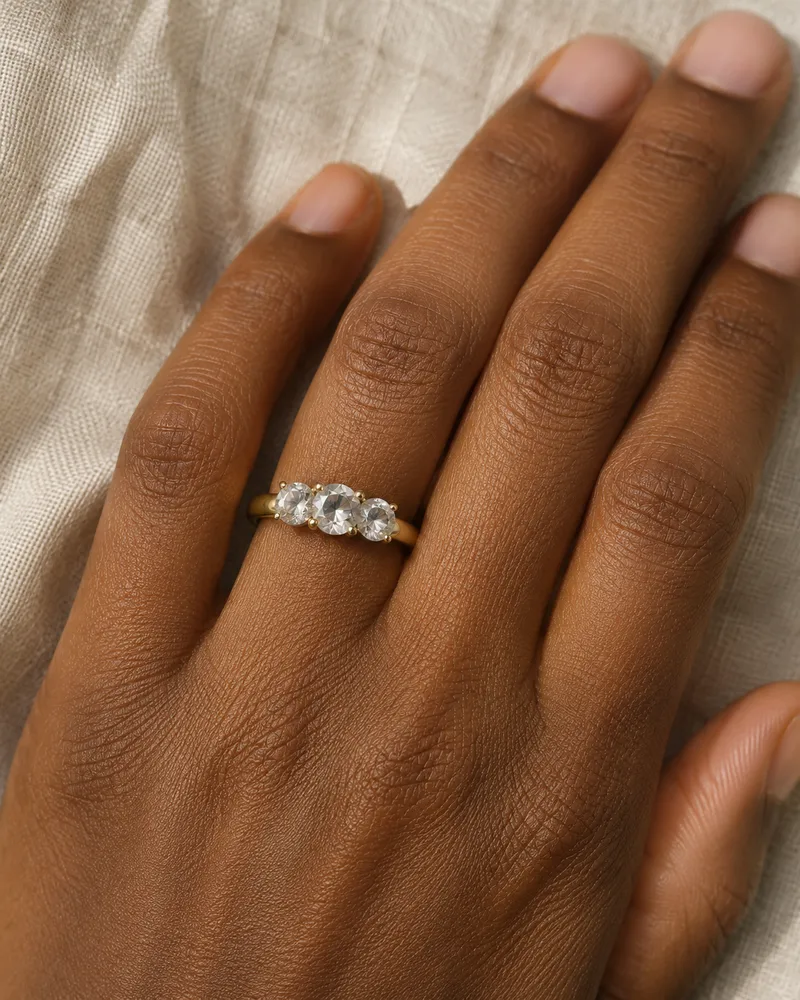
3 / 5Three stone
Three round white sapphires in a row, each held by claws, on a yellow gold band.
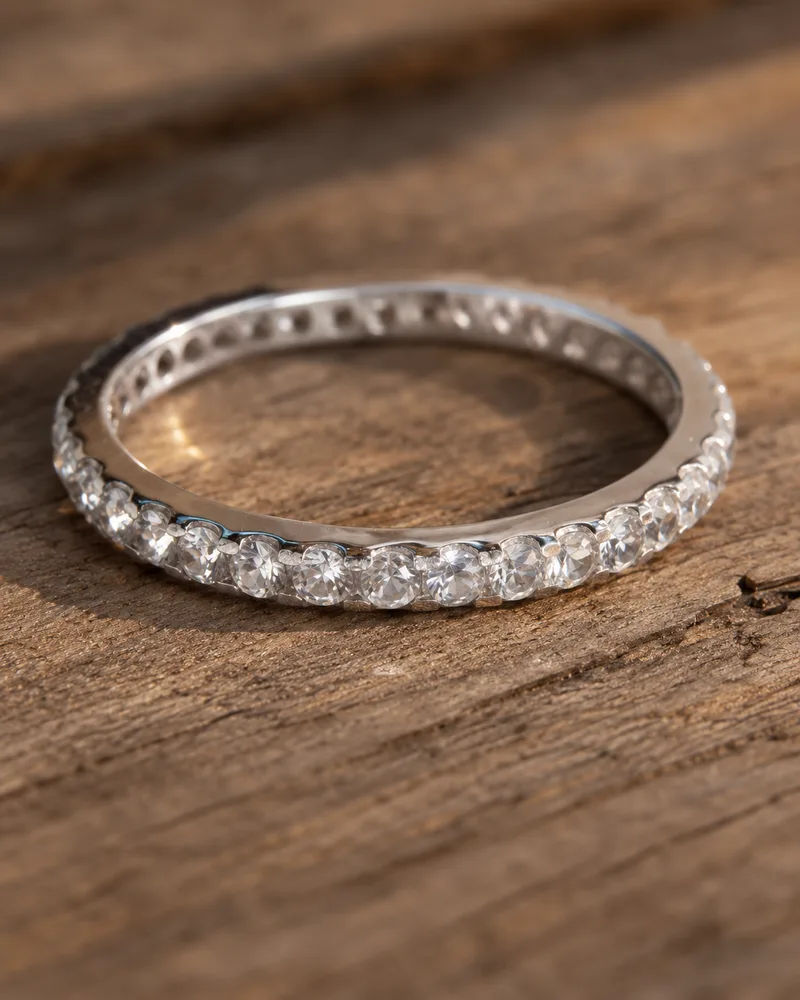
4 / 5Eternity band
Small round white sapphires set all the way around a white metal band.
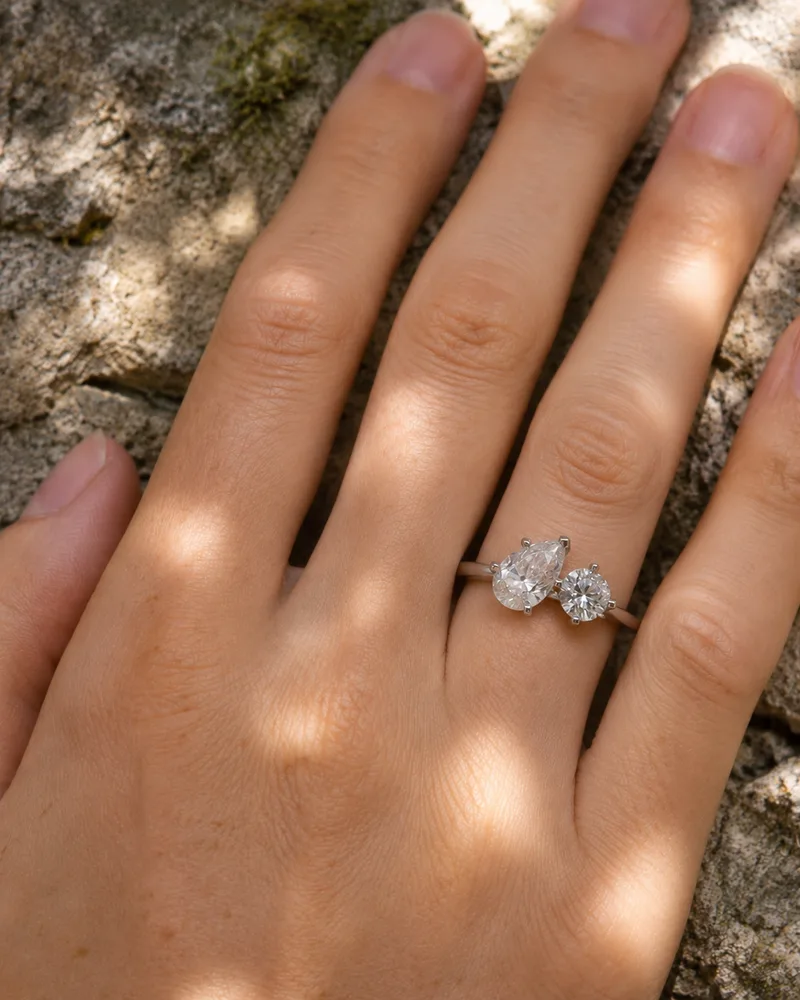
5 / 5Toi et moi
A pear and a round white sapphire side by side on a thin white metal band.
Quick answers
Can a white sapphire pass a diamond tester?
Is a white sapphire cheaper than a diamond?
White sapphire or lab-grown diamond?
Will a white sapphire scratch in a ring?
Light or calm: choose what you will look at every day
A diamond gives more light, more fire and the top of the hardness scale. A white sapphire gives a quieter, glassier glow, takes daily wear too, and costs less. Both dim under a film of skin oil and both come back once cleaned. Choose the look you want on your hand, then judge the stone itself.