Natural Alexandrite vs Lab-Grown: How to Tell the Difference (and What It Really Costs)
The identification criteria, the prices that are not auction records, and the colour-change stone that costs a tenth as much.
| Property | Natural alexandrite | Lab-grown alexandrite |
|---|---|---|
| Species | Chrysoberyl | Synthetic chrysoberyl (same mineral) |
| Refractive index | 1.746 to 1.755 | 1.746 to 1.755 (identical) |
| Specific gravity | 3.73 | 3.73 (identical) |
| Absorption spectrum | Chromium spectrum | Identical to natural |
| UV fluorescence | Inert to moderate red | Moderate to strong red |
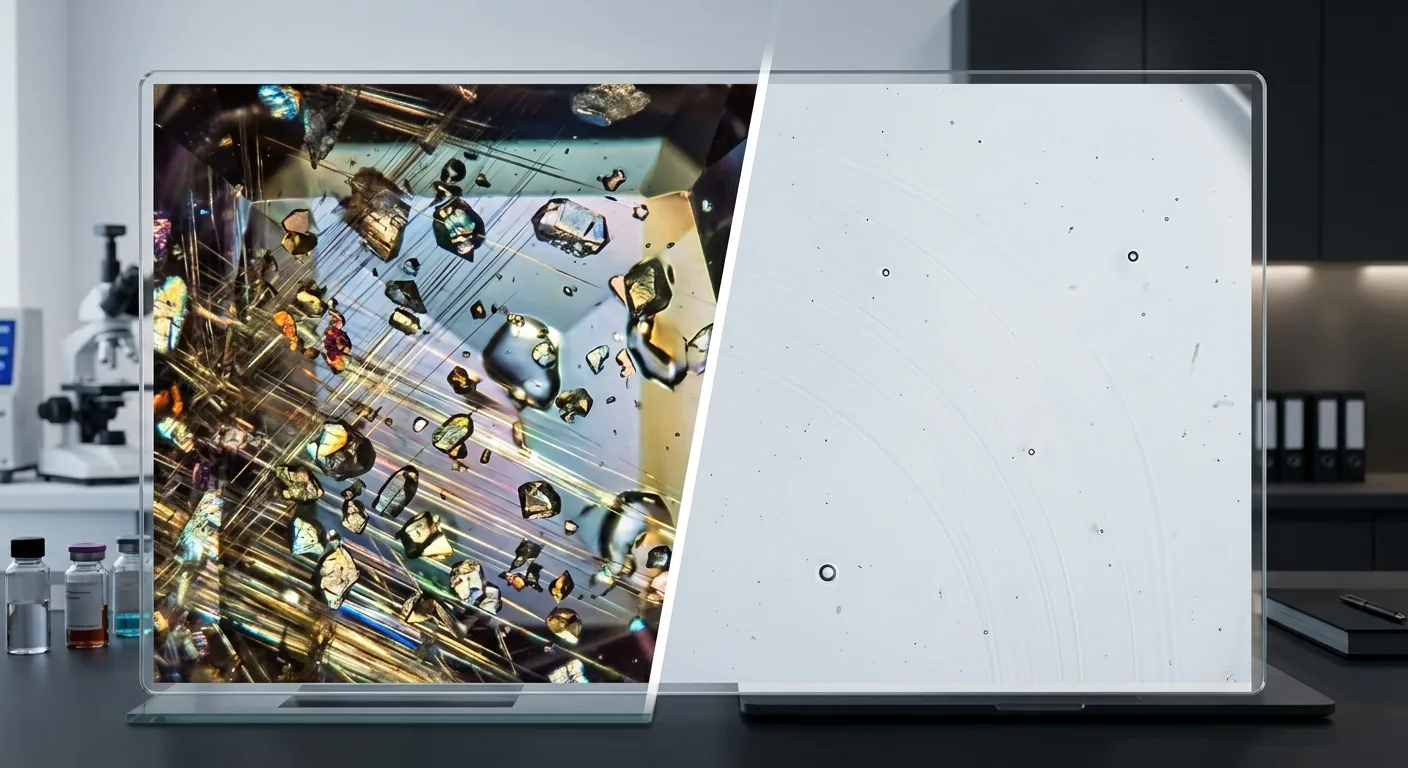
| Under magnification | Angular fluorite or apatite crystals, negative crystals, fingerprints | Curved striae and gas bubbles (pulled), or hexagonal platinum platelets (flux) |
| The deciding test | Magnification at 10x to 40x | Magnification at 10x to 40x |
| Typical price per carat | Roughly $900 to $20,000, auction stones far above | Roughly $50 to $500 |
Natural Alexandrite: What You Are Actually Buying
Someone sends me a photo of a stone that looks green in one shot and red in the next, and asks the same question every time. Is it real?
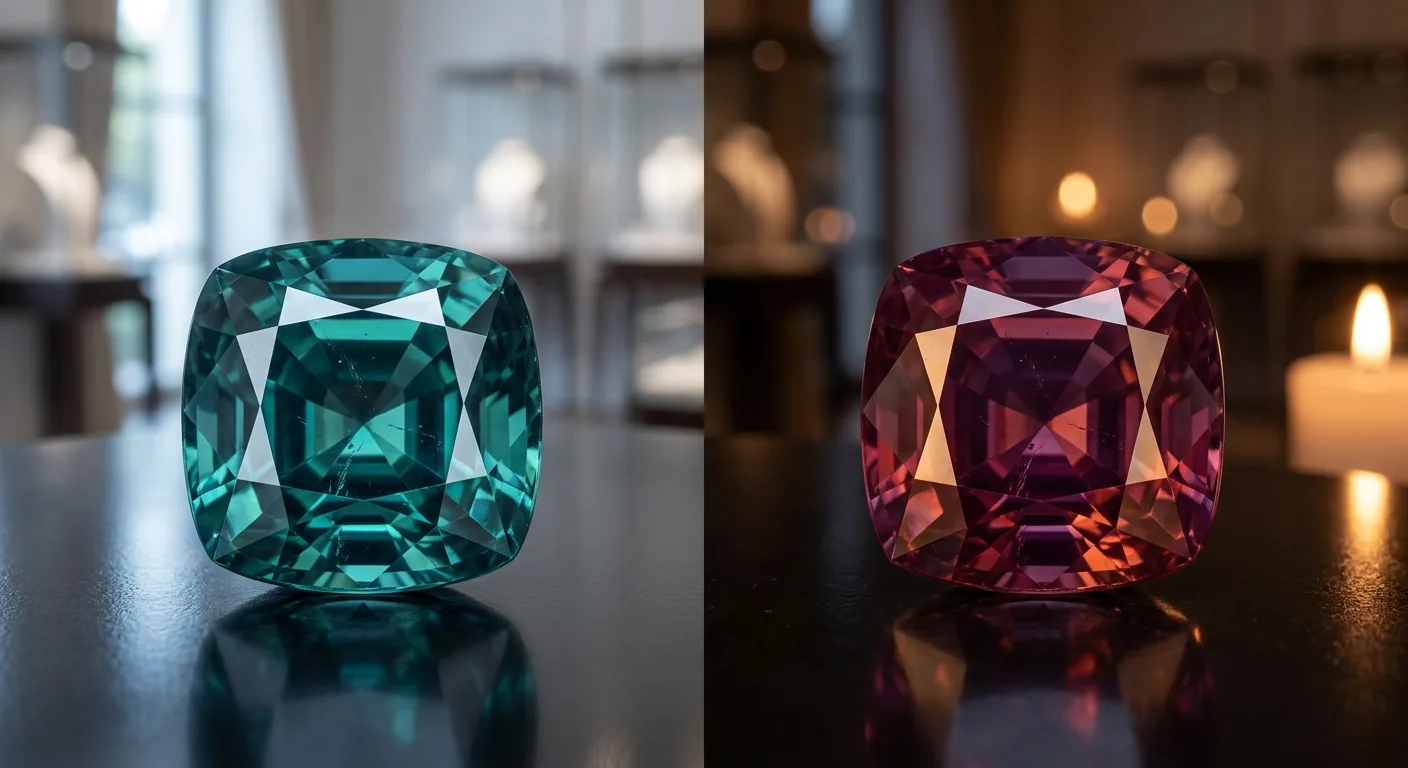
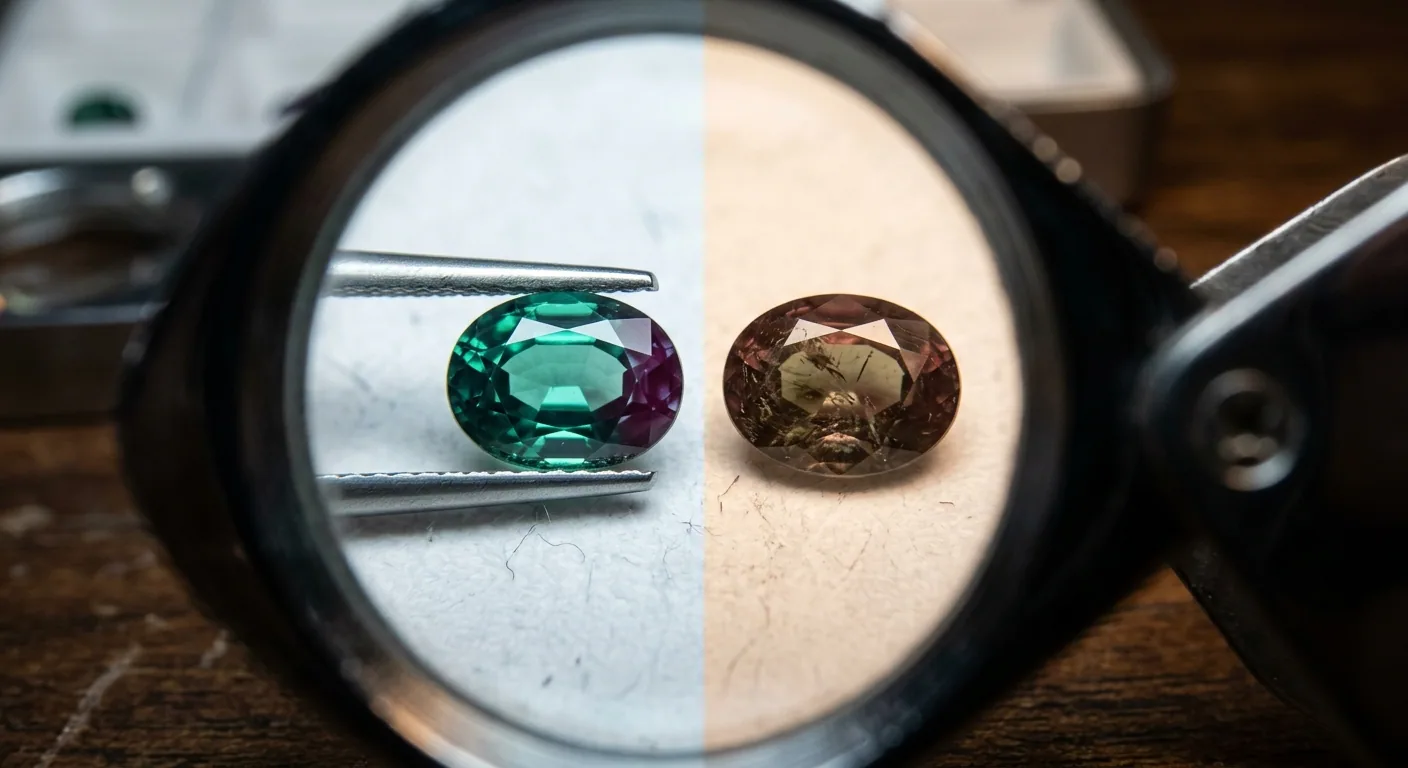
Natural alexandrite is the colour-changing variety of the mineral chrysoberyl. It shifts from a greenish tone in daylight to a reddish or purplish one under incandescent light, it scores 8.5 on the Mohs scale, and and it shares its refractive index, specific gravity and absorption spectrum with the lab-grown version. That last part is why the question is hard: the two are separated under magnification, not by looking at the colour.
Let's get the awkward part out of the way first. We do not sell alexandrite. In years of buying stones in Sri Lanka I bought exactly one, a 0.90 carat at $850, and it is gone. Almost every page ranking for this stone is written by someone with alexandrite in a cart, and that shapes what they tell you. We have no parcel to move here, so what follows is just the identification criteria, the real prices, and one alternative most guides skip.
TL;DR
Natural and lab-grown alexandrite are the same mineral with the same refractive index, specific gravity and spectrum. Magnification is the key test: pulled synthetics show curved striae and gas bubbles, flux synthetics show hexagonal platinum platelets, natural stones show angular fluorite or apatite crystals. Strong red fluorescence points to synthetic. Colour-change sapphire gives you a similar effect at roughly one tenth of the price per carat.
What the Colour Change Really Looks Like (GIA Never Says Emerald or Ruby)
The trade sells this stone with a slogan: emerald by day, ruby by night. It is a great line. It is also not what the reference books describe.
The standard gemmological description of alexandrite reads: yellowish, brownish, grayish or bluish green in daylight or fluorescent light, changing to orangy or brownish red to purplish red in incandescent light. Read that again and notice what is missing. No emerald. No ruby. Four of the six daylight adjectives are qualifiers that lower the colour, not raise it.
That gap between the slogan and the grading vocabulary is where most disappointment lives. Buyers arrive expecting a traffic light and receive a stone that goes from grey-green to muddy brown-red. Both are alexandrite. Only one is worth real money.
The shift, in grading language rather than the trade's
The stones that actually reach the bluish green and purplish red ends of those ranges, with little grey or brown in either state, are the ones that carry the premium. The muddy ones are common.
Two more things worth separating. The colour change depends on the light source. Pleochroism, which alexandrite also has strongly, depends on the viewing angle: green, orange and purple-red trichroism are all listed for this stone. They are different phenomena and sellers blur them constantly.
Cutting matters more than it does in most stones, because the cutter has to orient the rough so the strongest shift shows face-up through the crown. That usually costs weight. A well-oriented 0.80 carat beats a lazy 2 carat, every time.
Natural vs Lab-Grown Alexandrite: The Tests That Actually Separate Them
Here is the thing nobody selling lab-grown alexandrite likes to lead with. Synthetic alexandrite is not an imitation. It is chrysoberyl, grown in a crucible instead of in rock, and its reference values match the mined stone line for line: refractive index 1.746 to 1.755, birefringence 0.008 to 0.010, specific gravity 3.73, and an absorption spectrum listed as, quite literally, the same as natural.
So every test that separates a sapphire from glass is useless here. Both are biaxial positive. Both show strong green, orange and purple-red trichroism. A refractometer will not save you and neither will a spectroscope.
What does work, in GIA's own wording, is that magnification is the key test for separating synthetic from natural alexandrite. Three growth methods are in commercial use, and each leaves its own fingerprint.
| What you see at 10x to 40x | What it means |
|---|---|
| Curved striae, needle-like inclusions, minute gas bubbles | Pulled synthetic (Czochralski). Nature does not grow in curves. |
| Hexagonal or triangular metallic platelets, veil-like inclusions, tubes or parallel planes of flux | Flux-grown synthetic. Those platelets are platinum from the crucible. |
| Gas bubbles with a swirled appearance | Floating-zone synthetic, the method most guides forget to mention. |
| Angular included crystals, often fluorite or apatite, plus negative crystals, fingerprints, liquid and needle-like inclusions, twinning | Natural. Angular foreign crystals are the single most reassuring thing you can find in this stone. |
There is one non-magnification clue worth knowing. GIA gives natural alexandrite a fluorescence of inert to moderate red under both long-wave and short-wave UV, and the synthetic moderate to strong, with the plain-language verdict that strong red fluorescence indicates synthetic. It is a pointer, not a proof, and it needs a UV lamp you probably do not own.
One correction while we are here, because we had it wrong on this page for months and so does much of the internet: UV-visible spectroscopy does not separate natural from synthetic alexandrite. The spectrum is the same. Spectroscopy separates alexandrite from its look-alikes, which is a different job.
Practical consequence: for any natural alexandrite above about one carat, a report from an independent laboratory is not a nicety, it is the only thing standing between you and a $200 stone with a $15,000 price tag. This is also why we publish our own certification and dispute policy rather than asking anyone to take a seller's word for it.
How to Tell If Alexandrite Is Real: What You Can Check, and What You Cannot
Before magnification, there is a cheaper filter. Most stones sold as alexandrite to people who are not looking carefully are not synthetic alexandrite at all. They are a different mineral entirely.
Checks you can do yourself:
- Two light sources, same minute. Daylight or a fluorescent tube, then a traditional incandescent bulb or a candle. Never judge from a photo, and never from a seller's video: white balance does the colour change for you.
- Name both colours out loud. If the honest answer is grey-green to grey-purple, the stone may still be genuine, but you are not looking at a premium stone and should not pay for one.
- Watch the direction. Tilt the stone under one fixed light. If the colour moves as you tilt, that is pleochroism. The colour change only appears when the light changes.
- Ask what it weighs. Natural alexandrite above one carat is genuinely scarce. A clean, vividly changing 3 carat offered at a friendly price is the oldest tell in this trade.
- Read the report, not the label. A card that says "certified alexandrite" with no laboratory named on it is a label. Look for a named independent laboratory and a stated natural-or-synthetic conclusion.
Checks you cannot do yourself: separating pulled synthetic from natural. That needs magnification and someone who has seen curved striae before. This is also the honest reason we are not the ones to sell you this stone: the verification cost on alexandrite is high relative to the ticket, and we do not have a standing relationship with Brazilian or Ural material the way we do with Sri Lankan sapphire.
The most common substitute deserves its own note. Vanadium-coloured synthetic corundum has been sold as alexandrite for decades. Per GIA, synthetic colour-change sapphire goes grayish blue in daylight to reddish purple or purple under incandescent light, so it shifts, just not the way alexandrite shifts. Its refractive index is 1.762 to 1.770 and it is uniaxial negative, where alexandrite is biaxial positive. Any laboratory separates the two in a minute.
What Natural Alexandrite Actually Costs, Including the One I Bought
Price writing on this stone is dominated by two numbers that have nothing to do with each other: auction records, and whatever a vendor's own inventory happens to be worth.
The record is real and it is worth knowing. On 11 December 2024, a 16.53 carat oval untreated Brazilian alexandrite ring sold at Sotheby's for $1.9 million, roughly five times its $400,000 to $600,000 estimate and a new auction record for the stone (National Jeweler, 2024). That is a museum-grade object. It tells you nothing about what you will pay.
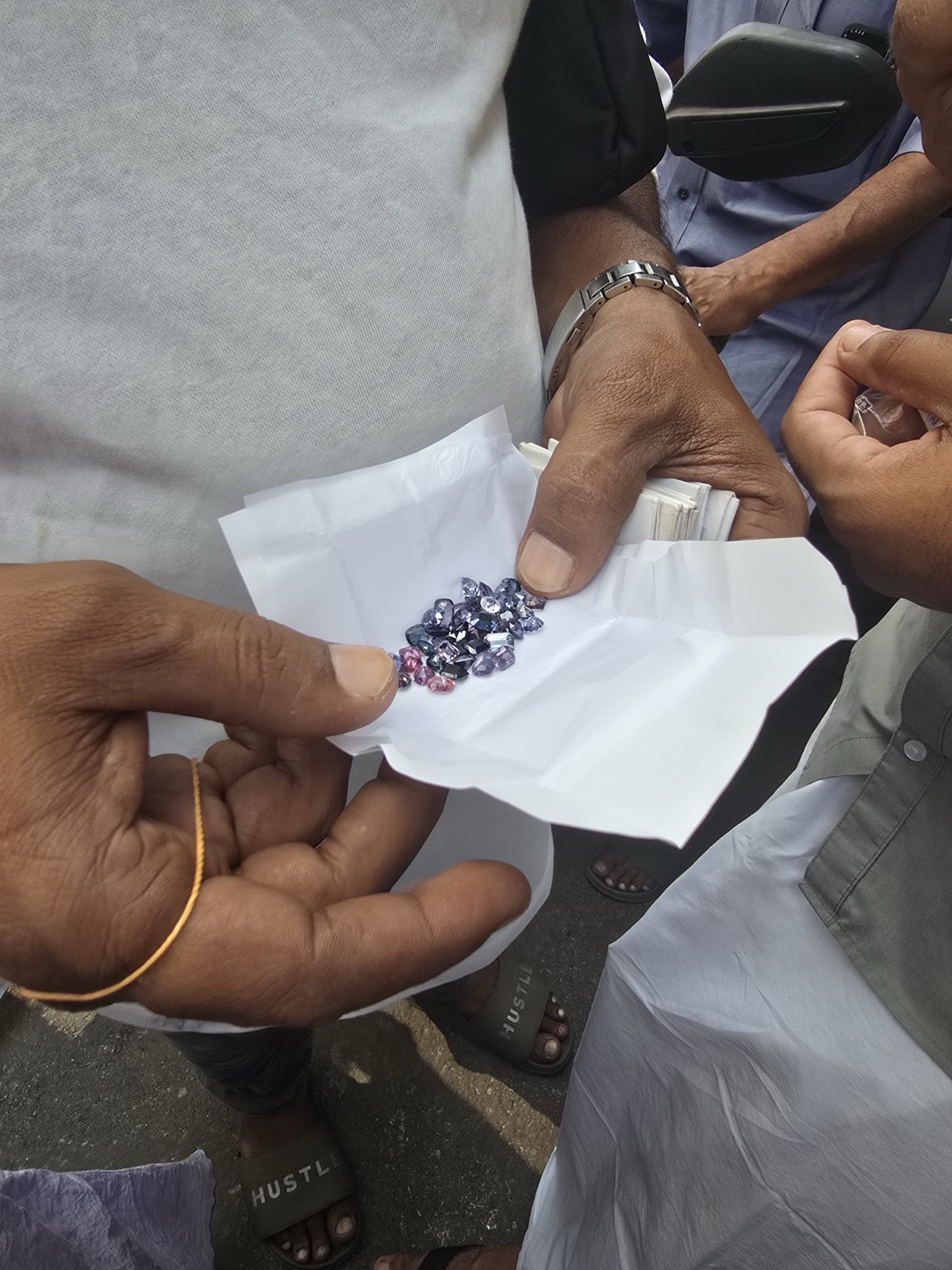
Here is the number I can actually stand behind, because it left my own account. The one natural alexandrite I bought was 0.90 carat and cost $850, about $940 per carat. Weak-to-moderate change, visible inclusions, Sri Lankan material. That is the unglamorous middle of this market and nobody publishes it, because $940 per carat does not sell a story about rarity.
| What you are looking at | Realistic price per carat |
|---|---|
| Under 1 ct, weak to moderate change, visibly included | Roughly $900 to $3,000 (the stone I bought sat at the bottom of this band) |
| 1 to 3 ct, strong distinct change, eye-clean | Roughly $5,000 to $20,000 |
| 3 ct and above, near-complete vivid change | $20,000 and up, thinly traded and usually placed privately |
| Lab-grown, any size | Roughly $50 to $500 |
Two forces set that spread, and only one of them is size. Colour change quality is the dominant variable: the percentage of the stone that shifts, and how little grey or brown sits in either colour. Clarity comes second, and alexandrite is a GIA Type II stone, which means inclusions are expected. An eye-clean one is a genuine premium, not a baseline.
Why so expensive at the top? The original Ural deposits that produced the benchmark stones were largely worked out by the early 1900s. Brazil, Sri Lanka, Tanzania and Madagascar produce today, Brazil supplying most of the fine material. Gem-quality rough is scarce in all of them, and the cutting loss needed to orient the change makes it scarcer.
What we will not do is tell you this is a place to park money. We sell stones because of what they do in your hand, and anyone quoting you a forecast on a market this thin is selling the forecast, not the stone.

Alexandrite Hardness: 8.5 on Mohs, No Cleavage, Excellent Toughness
This is the one area where alexandrite is unambiguously excellent, and where the numbers are simple.
Alexandrite sits at 8.5 on the Mohs hardness scale. GIA rates its toughness as excellent and records no cleavage, which is the more useful half of that sentence. Hardness tells you about scratching. Cleavage tells you whether a knock can split the stone along a plane, and that is what actually destroys gems. Topaz is an 8 and still splits. Alexandrite does not have that weakness.
| Property | Alexandrite | Why it matters |
|---|---|---|
| Mohs hardness | 8.5 | Below diamond and corundum, above almost everything else you would set in a ring |
| Toughness | Excellent | Resists chipping on impact |
| Cleavage | None | No plane for a knock to split |
| Crystal system | Orthorhombic | Cutters orient the rough to this to place the colour change face-up |
Practically: warm water, a drop of mild dish soap, a soft brush, rinse, dry with a lint-free cloth. Skin oils on the pavilion dull the colour change faster than anything else. Ultrasonic and steam are generally fine but skip both if the stone is heavily included or fractured, because thermal shock does not care how hard a gem is. Keep chlorine and bleach away from the setting. Store it separately so it does not scratch softer stones. Our full jewellery care and maintenance guide covers the rest.
The Alternative Almost Nobody Mentions: Colour-Change Sapphire
If what you want is a stone that changes colour under different light, and not specifically the word alexandrite, there is a far less discussed option. GIA is blunt about it.
Colour-change sapphires are sometimes called alexandrite-like sapphires. Yet colour-change sapphires and alexandrites have very different markets. Colour-change sapphires are much less expensive than alexandrites. They sell for approximately one-tenth the price per carat. (GIA)
One tenth. Not a discount, a different market. The typical corundum change runs from blue or violet in daylight to violetish purple or strongly reddish purple under incandescent light, and vanadium is the trace element behind it, where chromium drives alexandrite.
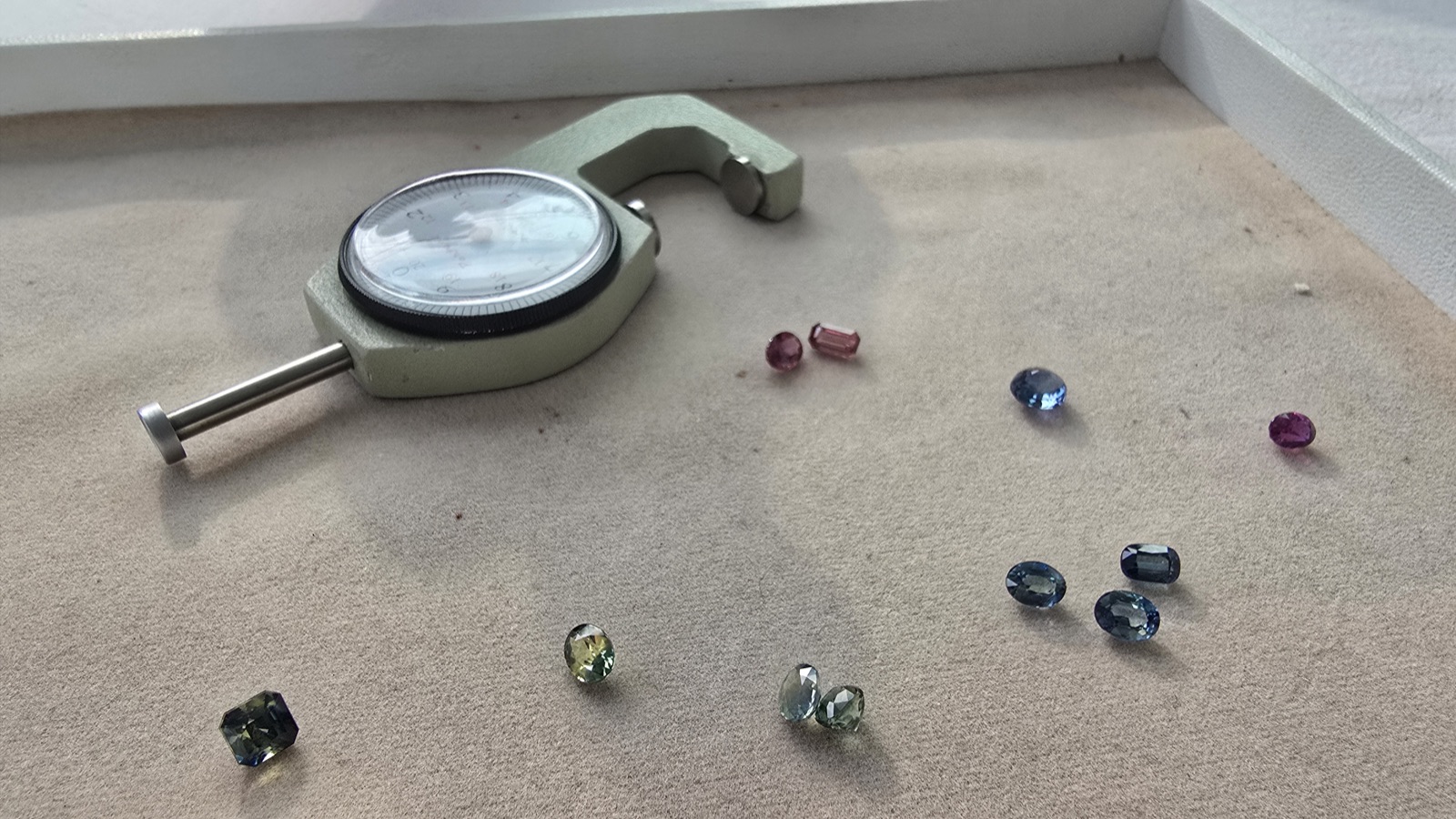
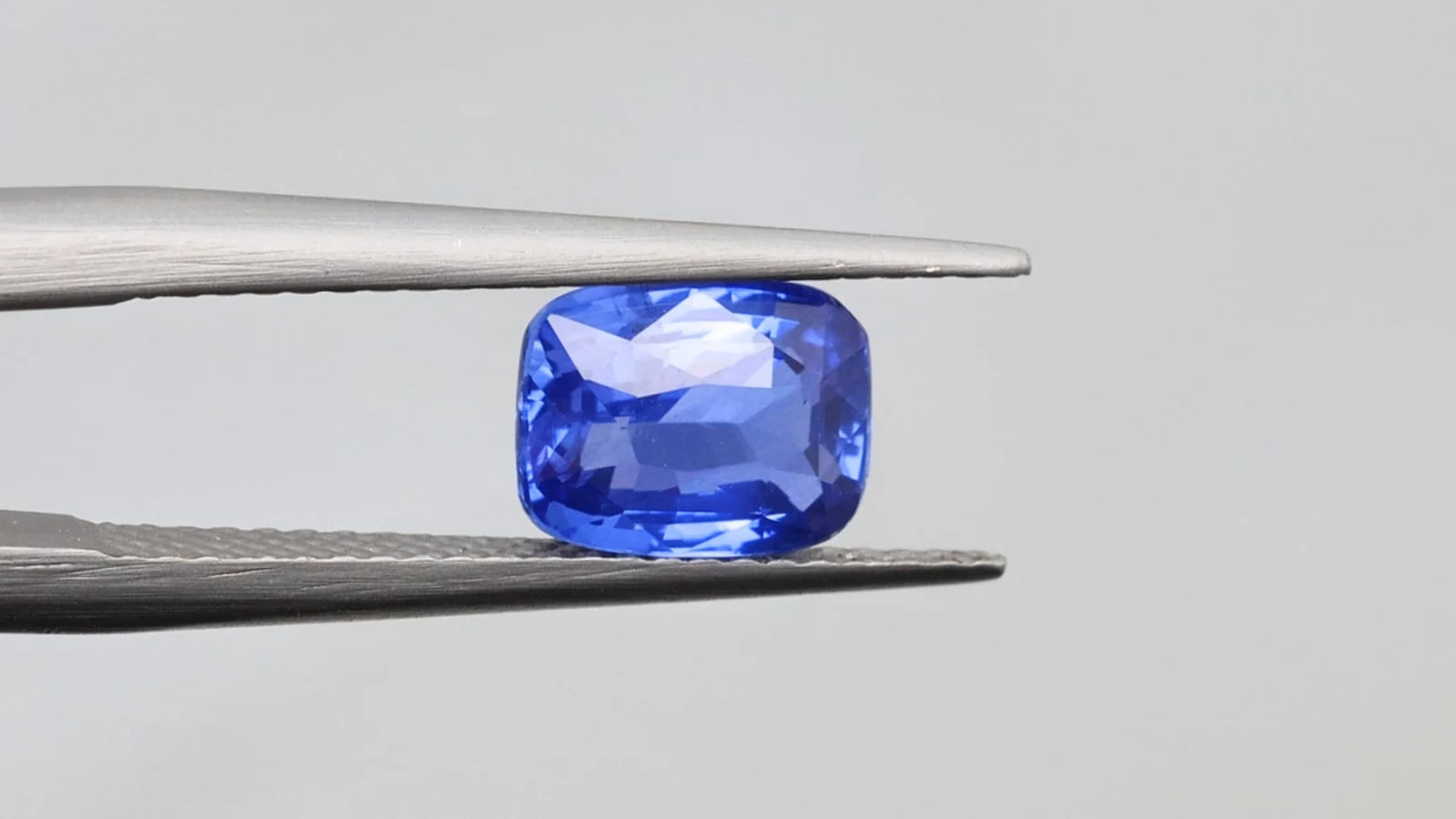
This one I can talk about from inventory rather than theory. We currently hold two colour-changing Ceylon sapphires, 1.51 and 2.04 carat, both shifting blue to violet, at $1,052 each. That is about $700 and $516 per carat. Set the 2.04 carat against the $940 per carat I paid for a 0.90 carat alexandrite with a weaker change, and the arithmetic makes itself.
There is a second bridge worth knowing, and it is a family matter. Alexandrite is chrysoberyl, so the non-phenomenal members of the same species are the closest relatives you can actually buy. We hold three green chrysoberyl, 1.51, 3.58 and 4.68 carat, from $348 to $946 for the whole stone. Same mineral, same 8.5 hardness, same excellent toughness, no colour change, and a price that is not built on a Russian legend.
Neither is a substitute if you specifically want alexandrite. Say that clearly. But most people asking about this stone are chasing the phenomenon, and the phenomenon is available for a tenth of the money. If you want to understand how corundum produces this range at all, our guide to sapphire colours goes through it.
Why I Have Only Ever Bought One Alexandrite
Years of buying in Sri Lanka, and one alexandrite. People assume that means I could not find any. It is closer to the opposite.
Sri Lanka is a genuine alexandrite source and has been since the late 1800s. The problem is not supply, it is what supply looks like at my end of the chain. What gets brought to a buyer who asks for alexandrite is rarely fine alexandrite. It is pale material with a shift you have to be told about, or it is colour-change sapphire under a better name, or it is something that needs a laboratory to settle. Every one of those needs verification before I can put a price on it, and verification on a stone this contested costs more than my margin on it.
So I stayed where my relationships actually are. I know which Ratnapura dealers cut sapphire honestly and who heats what. I do not have that map for alexandrite, and buying a stone whose identity I cannot vouch for, to resell to someone trusting me, is the one thing I am not willing to do. Our whole position on certification is that a stone should be contestable before you buy it, not after.
The honest version of this page, then, is: here are the criteria, here is what it really costs, and here is a cheaper route to the same effect. If you still want a natural alexandrite, buy it from a specialist who holds stock and stands behind an independent report. That is not us, and pretending otherwise would have been the easier page to write.
Quick answers
How can you tell if alexandrite is real?
What is the difference between natural and lab-grown alexandrite?
Does lab-grown alexandrite change colour?
How much does natural alexandrite cost per carat?
What is alexandrite's hardness on the Mohs scale?
Is alexandrite more expensive than diamond?
Is alexandrite a good investment?
What is the alexandrite colour change actually described as?
What is the difference between alexandrite and colour-change sapphire?
Where is alexandrite found today?
Can alexandrite be worn every day?
Why is alexandrite so expensive?
Is alexandrite the June birthstone?
So Where Does That Leave You
Natural alexandrite is a remarkable stone and a difficult purchase. The identity question is real, the price range is enormous, and the people best placed to answer your questions are usually the people with a stone to sell you.
If you want the phenomenon rather than the name, colour-change sapphire delivers it at roughly one tenth of the price per carat, on the trade's own reckoning, and we have two of them on the table right now. If you want the species, green chrysoberyl is the same mineral without the legend attached. And if you want natural alexandrite specifically, go to a specialist who holds stock and puts an independent report next to it.