Aquamarine Ring Emerald Cut: A Buyer's Guide That Skips the Sales Talk
Color, the dreaded window, carat, metal, price in 2026, and how to tell aquamarine from blue topaz, from our Sri Lanka sourcing notes.

What is an emerald cut aquamarine ring?
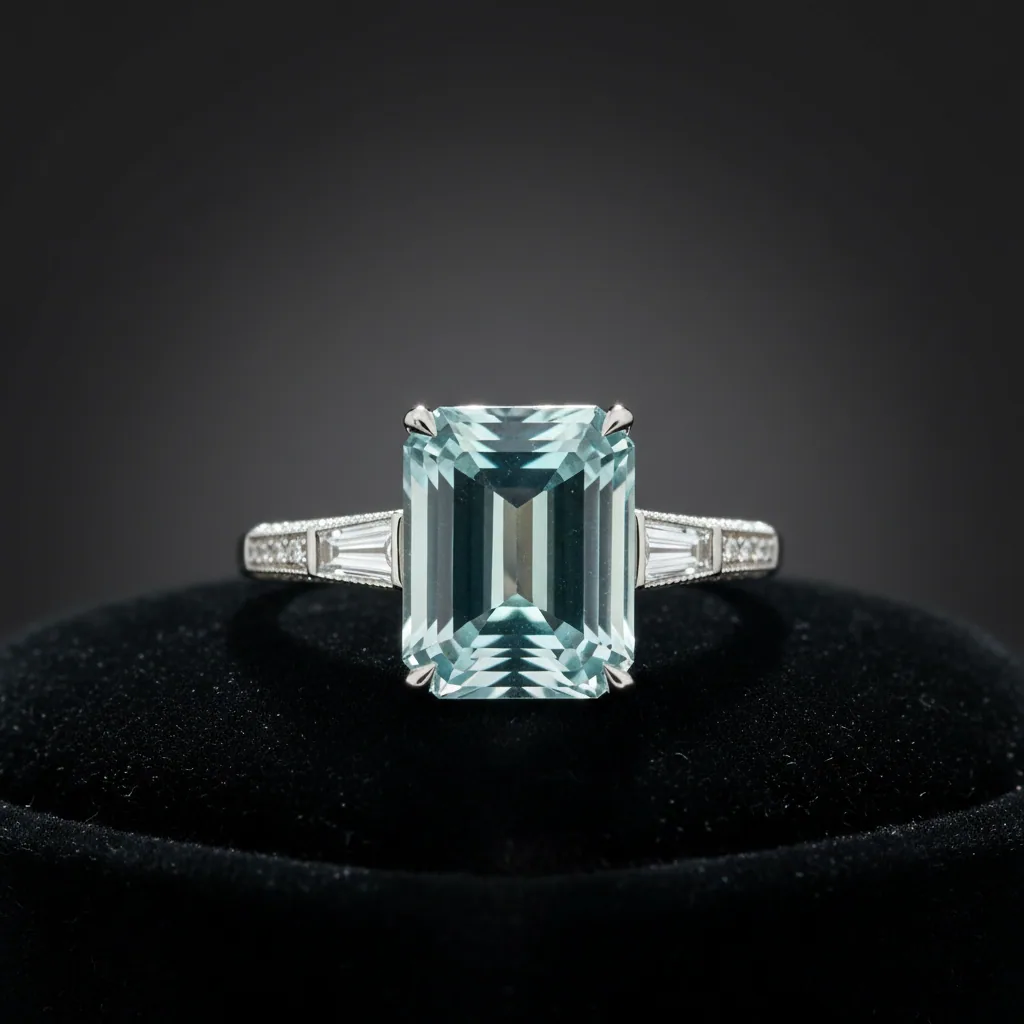
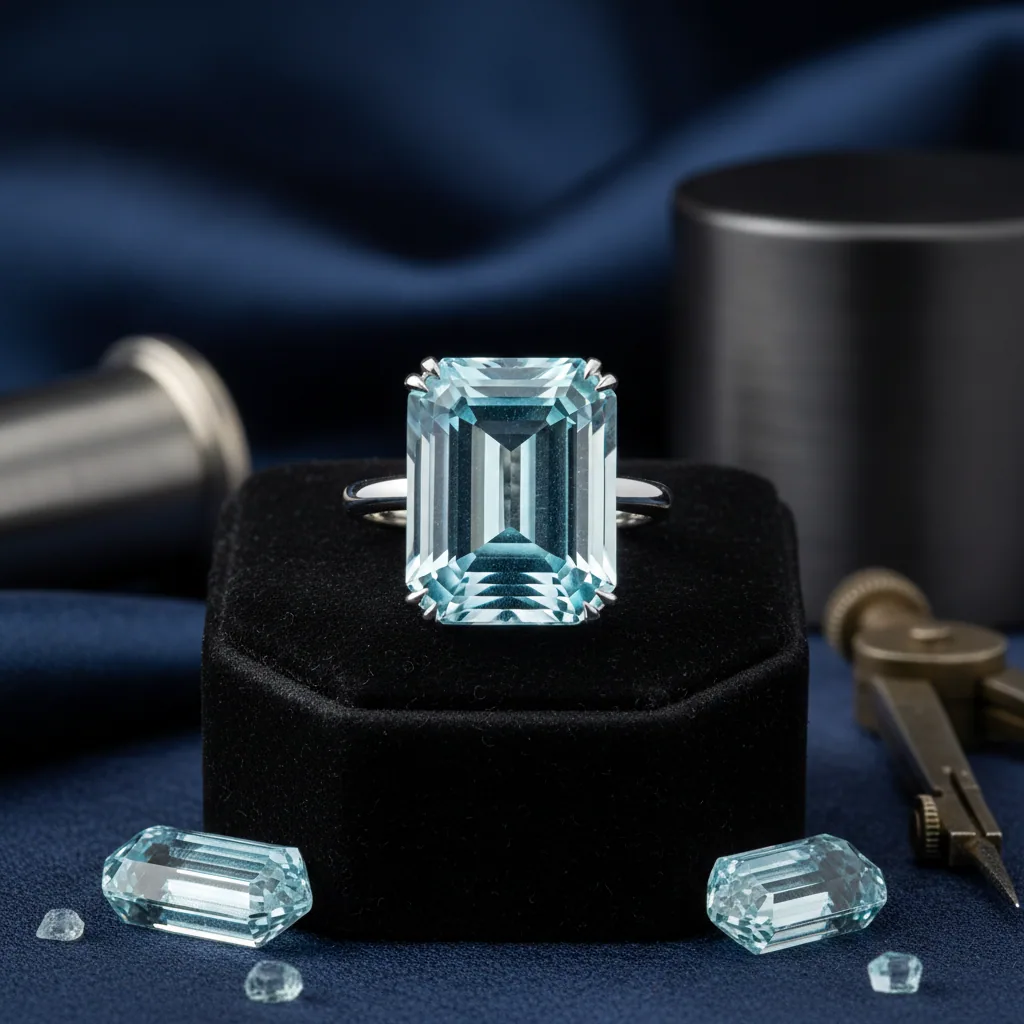
An emerald cut aquamarine ring pairs a blue beryl with a rectangular step cut. The cut has cropped corners and long, flat facets that run parallel to the edges like a flight of stairs. The top opens into a wide, glassy table. Put the two together and you get a calm, architectural look that leans elegant rather than flashy.
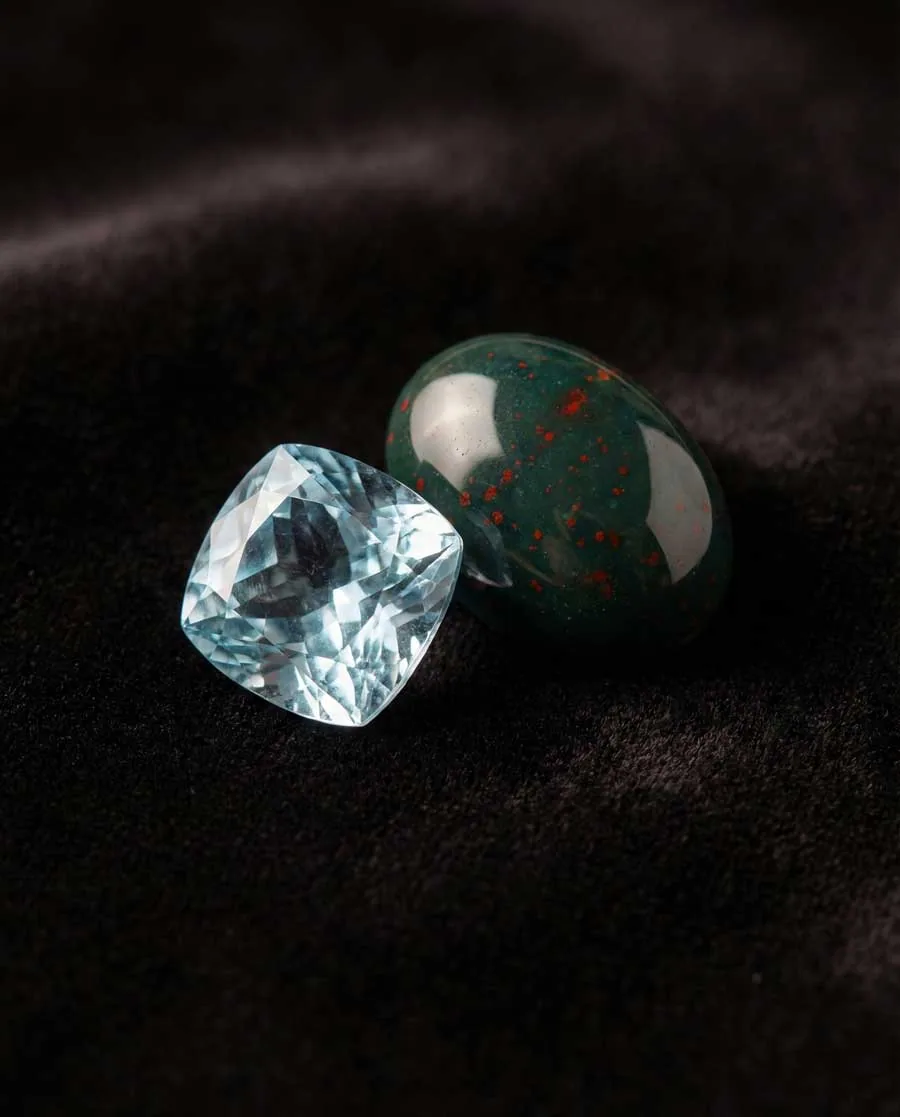
Aquamarine itself is the blue to blue-green variety of beryl. Its famous color comes from traces of iron. Aquamarine is a beryl, the same mineral family as emerald, tinted blue by iron rather than the chromium that turns emerald green (GIA, 2025). So this stone is, quite literally, emerald's cooler cousin wearing the same cut its cousin made famous.
One quick note on words. The "emerald cut" describes a shape, not the green gemstone. An emerald cut aquamarine has no emerald in it at all. People mix this up constantly, so if a listing is vague, ask. For the wider menu of shapes and how they wear, our guide to engagement ring styles is a good companion read.
Why does the emerald cut suit aquamarine so well?
Short answer: the emerald cut trades sparkle for depth. Its wide open table acts like a window into the stone, pulling your eye down into the blue instead of bouncing light off the surface. For a gem prized for its clean color, like aquamarine, that is exactly what you want.
Brilliant cuts chop a stone into hundreds of tiny mirrors. Lovely on a diamond. On a soft, pale blue gem it can scatter the color until the stone looks a bit washed out. The step cut does the opposite. Those long facets behave like a hall of mirrors, throwing broad flashes of light and letting the body color read deep and even.
There is a practical bonus too. Aquamarine is usually eye-clean, meaning no inclusions you can spot without a loupe, so it can take an open cut that a heavily included stone never could. The shape also stretches the look of the finger and, carat for carat, faces up larger than a round. We love it on a long hand. Honestly, it is our favorite cut for a blue beryl.
How do you read the color of an emerald cut aquamarine?
Short answer: color is the single biggest driver of beauty and price, so judge it first. Look for a blue that holds its saturation across the whole stone, with no pale dead zones. Sky blue is the classic. A richer, slightly deeper blue, sometimes called Santa Maria after the Brazilian source, sits at the top.
Aquamarine runs from the faintest icy blue to a soft blue-green. Most stones on the market lean light, so saturation is what separates a forgettable stone from one that stops you. The open table of an emerald cut shows this honestly. A pale stone will look pale, full stop. There is no faceting trick to fake depth here.
About treatment, let us be straight with you. Most aquamarine is gently heated to coax out greenish or yellow tones and settle the blue. This heat is stable, permanent, and accepted across the trade, though an untreated, naturally deep blue stone still earns a premium (GIA, 2025). Color does most of the heavy lifting on value. Color drives roughly 60 to 70 percent of an aquamarine's worth, and a well cut stone commands a 10 to 20 percent premium over a poorly cut one (Giliarto, 2026). Aquamarine is also the March birthstone, which is part of why these rings sell hard in late winter.
Clarity and the window the emerald cut cannot hide
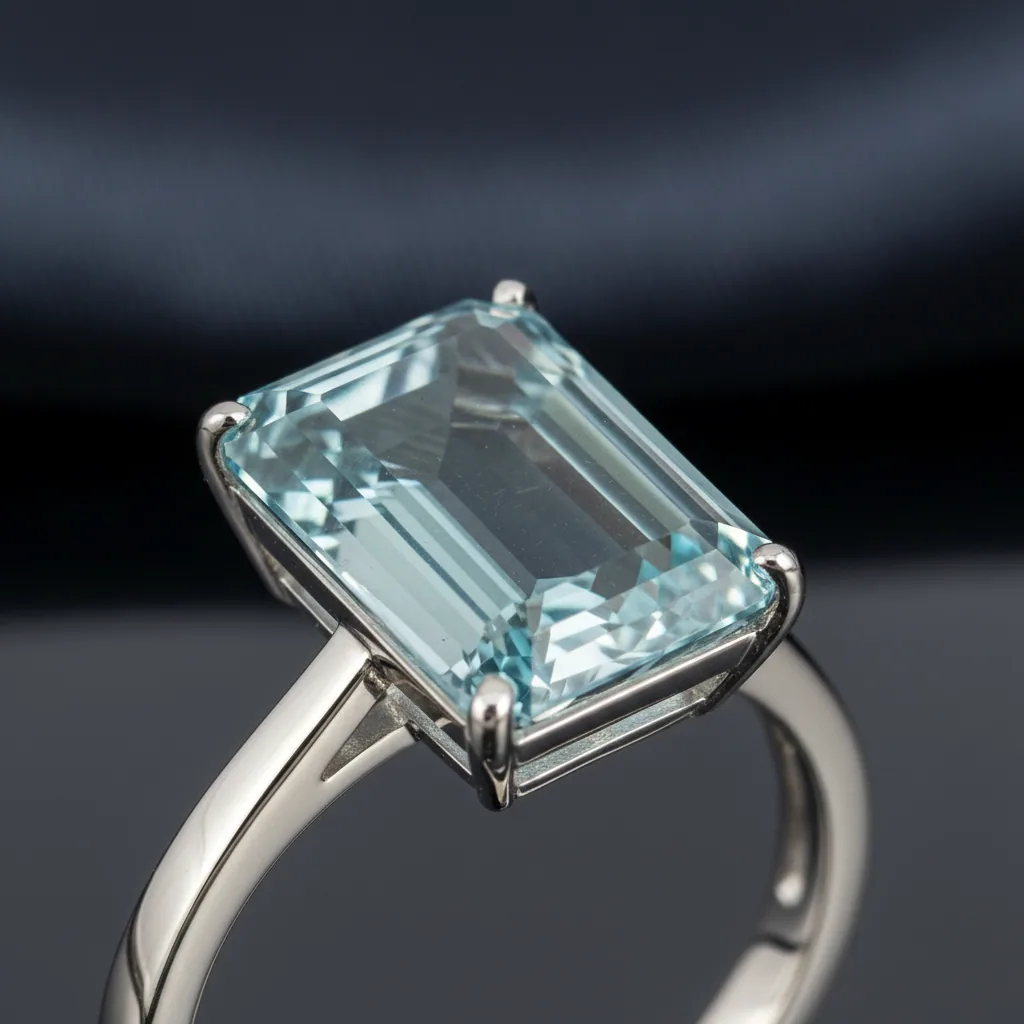
The step cut is brutally fair. Because the facets are large and the table is open, any flaw inside the stone is on full display. For most aquamarine this is fine, since the stone is usually eye-clean. But there is one fault the emerald cut reveals that buyers miss: the window.
A window is a see-through dead patch in the middle of the stone, where you can read text through it like glass. It happens when a stone is cut too shallow. And cutters go shallow on purpose, to save weight. A flat, heavy stone keeps more carats than a properly proportioned one. You pay for the weight and lose the glow.
This is the whole game, and it is where we get opinionated. A stone can be cut for the scale or cut for the jewel. Cut for the scale, you keep carats and end up with a window. Cut for the jewel, you give up a few points of weight and gain a stone that holds color edge to edge. Tilt any emerald cut under a lamp. If the center goes glassy and pale, walk away.
From our sourcing desk
We spend our time where this stone leaves the ground. Aquamarine has been pulled from the Ratnapura gravels of Sri Lanka for more than two thousand years, the same pits that give up Ceylon sapphire. After years buying on those tables, the rule we live by is simple: never buy a stone cut to flatter the balance. An independent laboratory checks proportions and treatment on each stone before it ever reaches a setting. A window is not a discount. It is a stone someone hoped you would not tilt.
What carat size and length-to-width ratio should you choose?
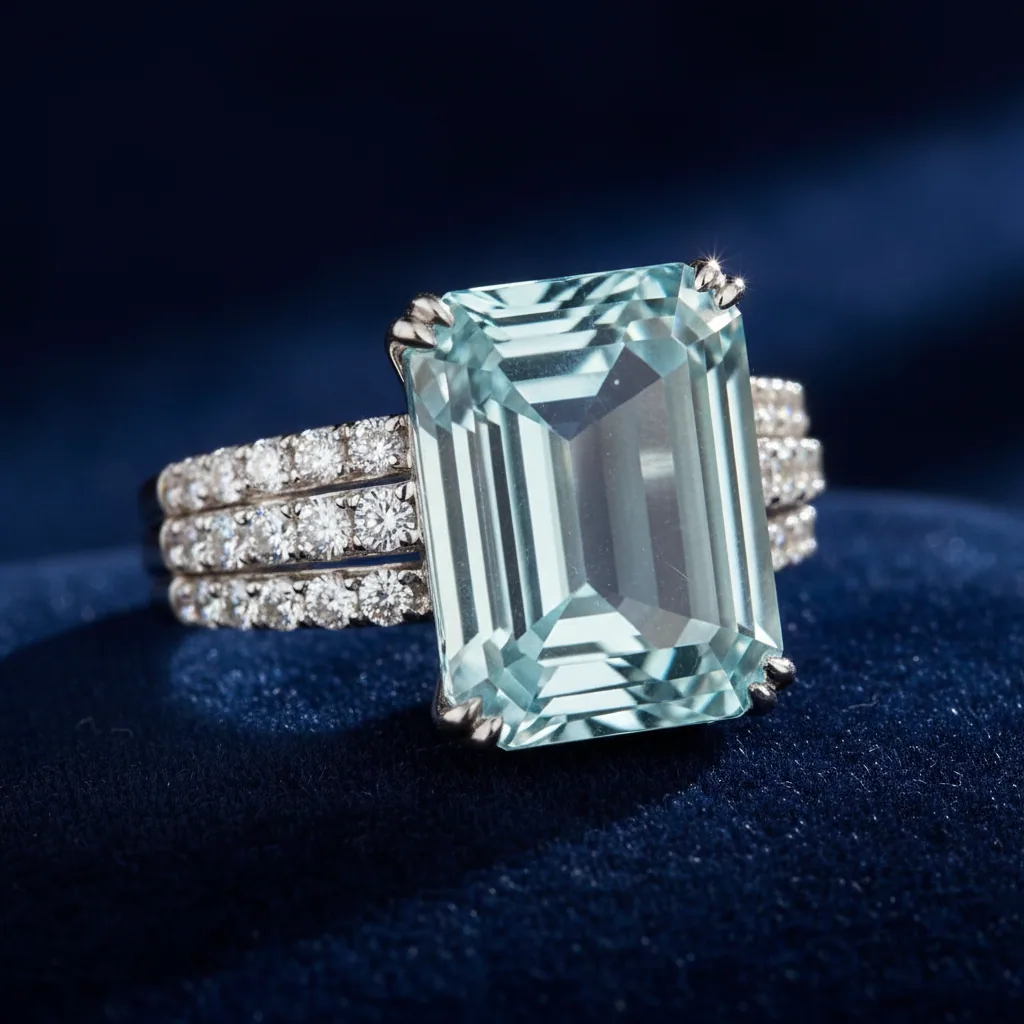
Short answer: most center stones land between 1 and 2 carats, and the classic emerald cut ratio runs from 1.30 to 1.50 (length divided by width). Pick the ratio your eye likes, then size for your finger, not for a number.
Aquamarine is generous on size. A one carat aquamarine measures around 6.5 mm across, slightly wider face up than a one carat diamond because beryl is the lighter material, with a specific gravity near 2.72. So your money buys more visible stone here than it would in a diamond. A bigger stone also shows color more vividly, which matters for a gem that can read light.
On ratio, it comes down to taste. Around 1.50 gives the long, elegant rectangle most people picture. Closer to 1.30 looks a touch squarer and bolder. Go near 1.05 and you are looking at a square step cut, often called an Asscher. None is better, they just wear differently. Try both against your hand before you commit, and check your size with our ring size chart so an elongated stone sits straight.
Is an aquamarine ring durable enough to wear every day?
Short answer: yes, with normal care. Aquamarine ranks 7.5 to 8 on the Mohs scale, hard enough for daily wear, yet brittle enough to chip if it takes a sharp knock (GIA, 2025). It also has no cleavage plane, which actually helps, since it will not split cleanly the way some stones do.
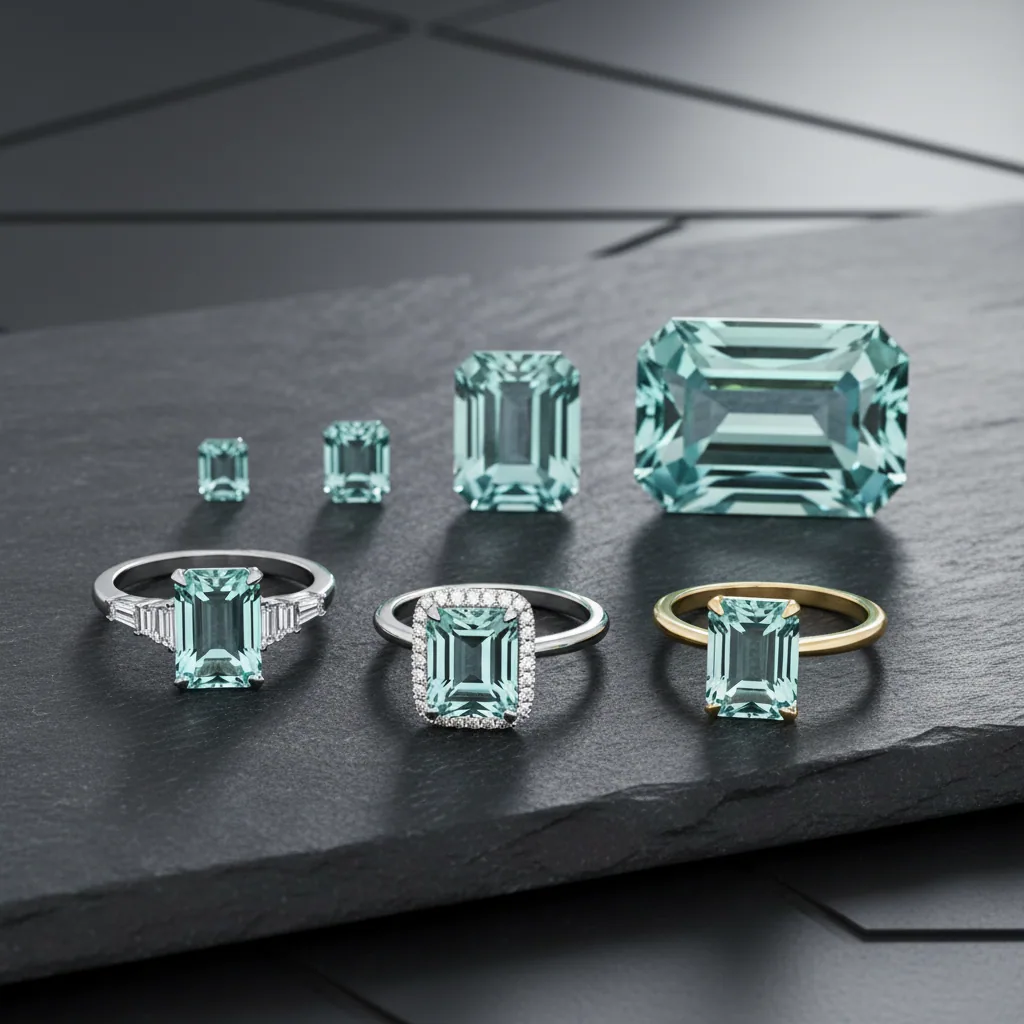
The weak spot on an emerald cut is the corners. They are the thinnest points and the first thing to meet a door frame. A bezel or half-bezel setting tucks those corners behind metal and is the smart move for an everyday ring. Prongs look airier but leave the corners exposed, so size them well.
Two more habits. Keep the ring out of long, direct sun, because aquamarine can fade with heavy, prolonged exposure. And clean it gently: warm water, a drop of dish soap, a soft brush behind the stone where grime hides. Ultrasonic cleaners are usually fine as long as the stone has no fractures or liquid inclusions. Our full routine lives in the jewelry care and maintenance guide.
Which metal setting makes an emerald cut aquamarine glow?
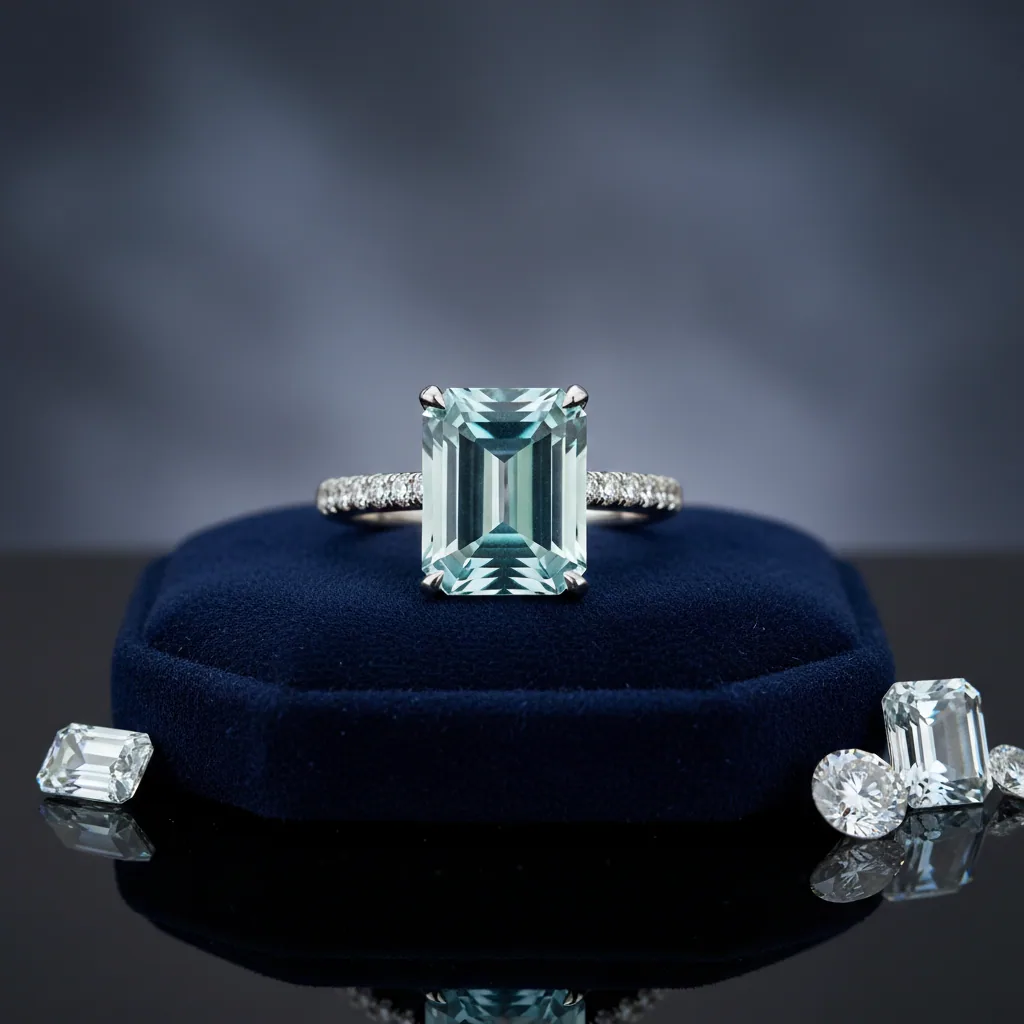
Short answer: cool metals push the blue forward, warm metals soften it. White gold and platinum mirror aquamarine's icy tone and make a light stone read crisper. Yellow or rose gold add a warm contrast that suits a deeper, blue-green stone and gives a vintage feel.
There is no wrong choice, only different moods. If your aquamarine is pale, lean cool to keep it from looking watery. If it is a rich Santa Maria blue, warm metal can be gorgeous because the stone has color to spare. Set the band against the stone in daylight before you decide. Screens lie.
One more thing worth saying out loud. In this ring the aquamarine is the lead. If you add diamonds, let them play the side note, a slim halo or two tapered baguettes, never the headline. The colored stone is the reason you are here.
How much does an emerald cut aquamarine ring cost in 2026?
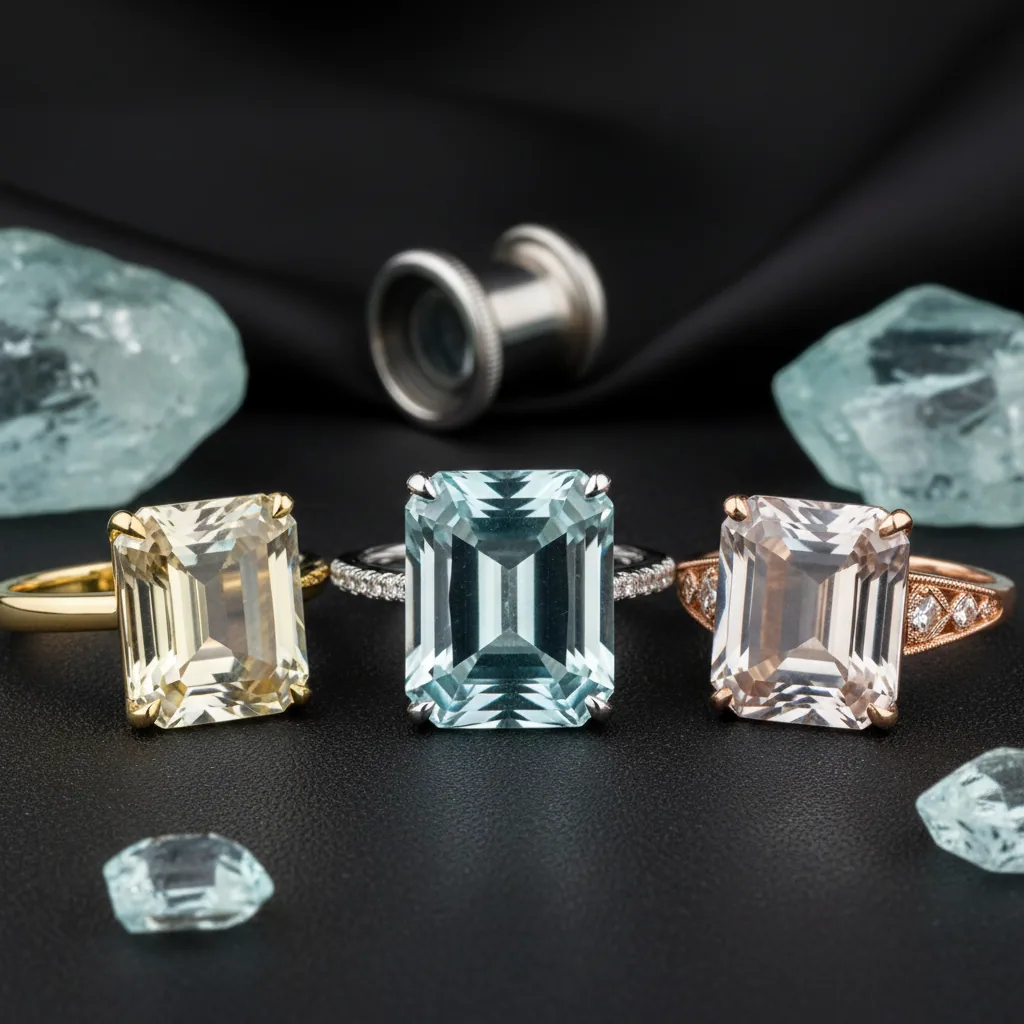
Short answer: fine loose aquamarine trades around 200 to 500 dollars per carat, and a finished 2 to 3 carat emerald cut ring usually lands between 2,000 and 3,000 dollars, depending on color, cut, and metal.
Here is the rough ladder by quality. Commercial stones run 20 to 80 dollars per carat. Good material sits at 80 to 200. Fine aquamarine traded near 200 to 500 dollars per carat in 2026, while exceptional deep blue stones crossed 1,000 dollars per carat (Giliarto, 2026). Across retail, full rings span from a few hundred dollars to well past ten thousand for large, top-color pieces.
What moves the number? Color first, by a wide margin, then cut quality and carat. A clean, saturated, well proportioned stone costs more, and it should, because it is the one that still looks alive in ten years. One piece of advice we give every client: buy the stone that stops you on the table, not the one that proves something to a room. A colored stone earns its place by how it makes you feel when the light hits it, not by a figure on a receipt.
Aquamarine or blue topaz: how to tell them apart
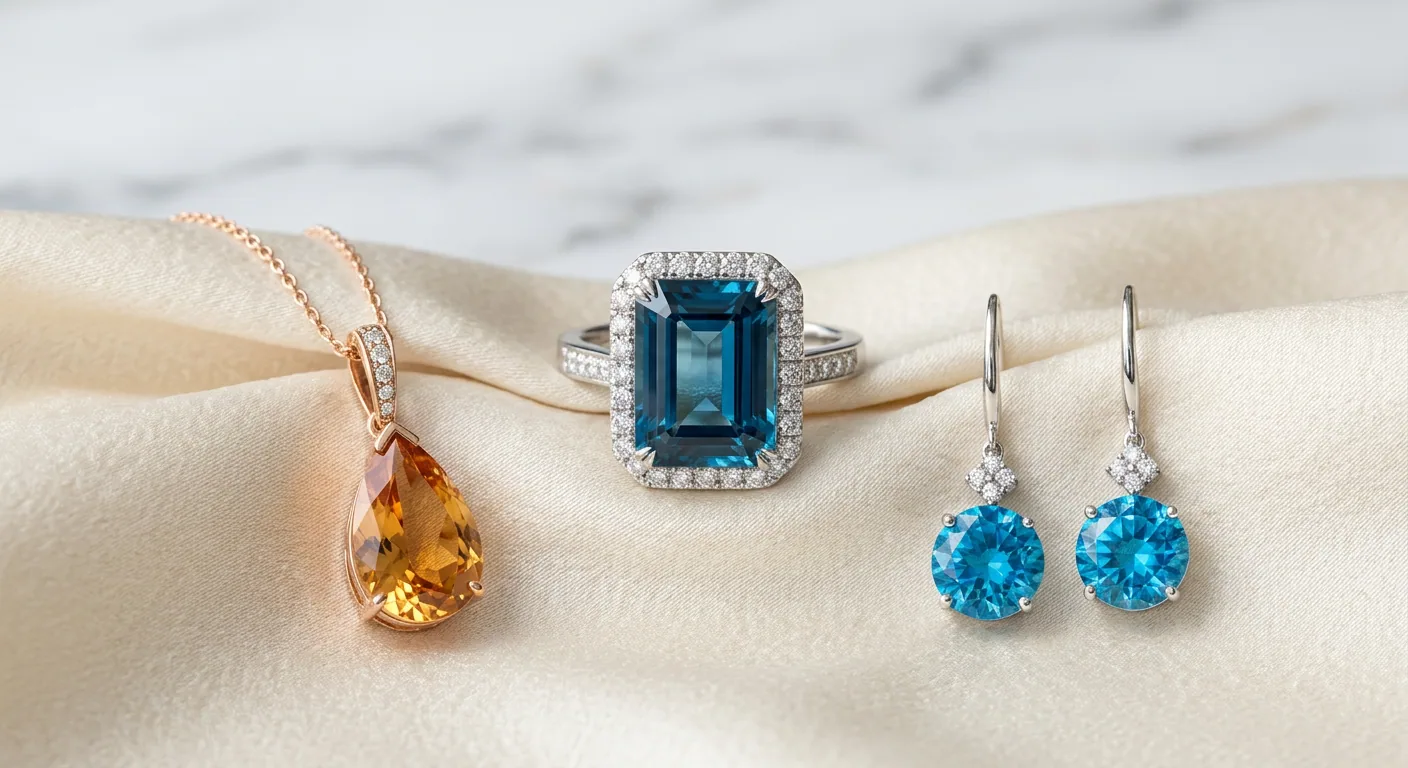
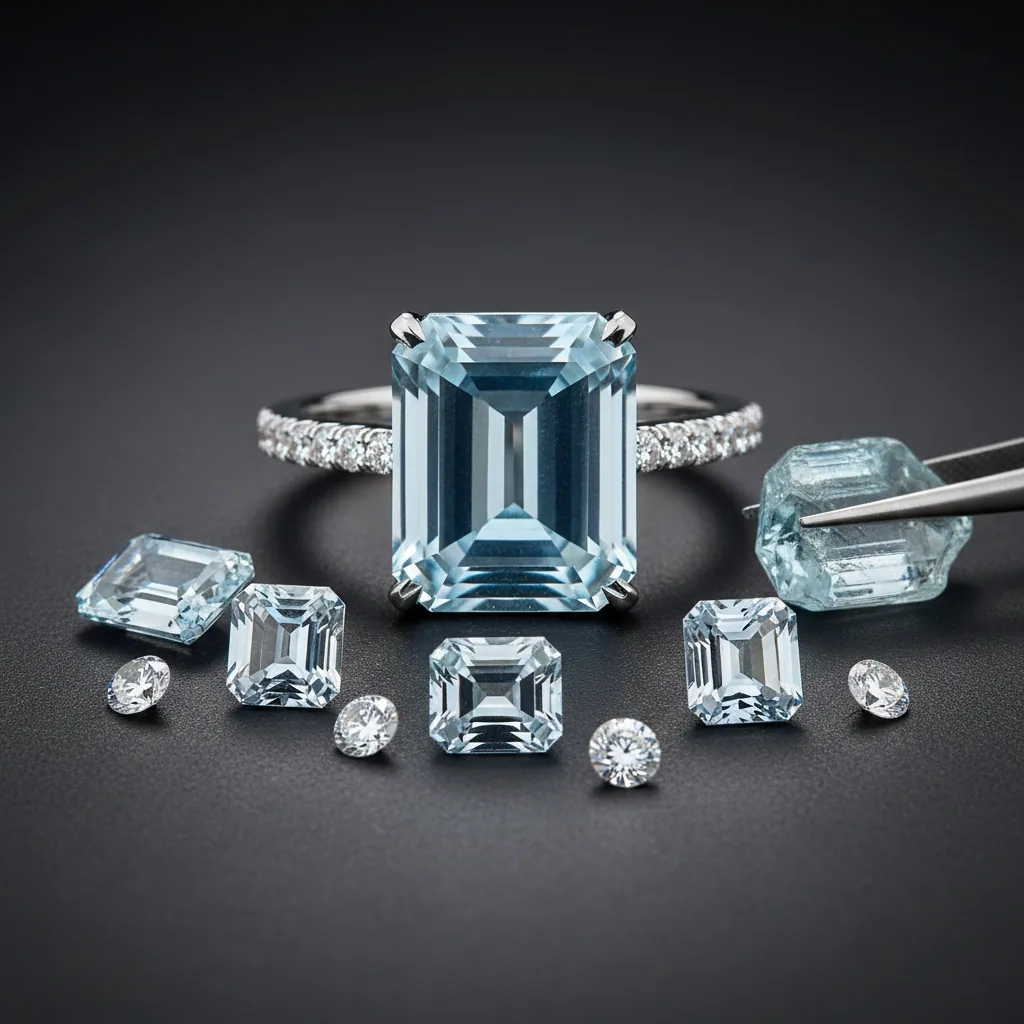
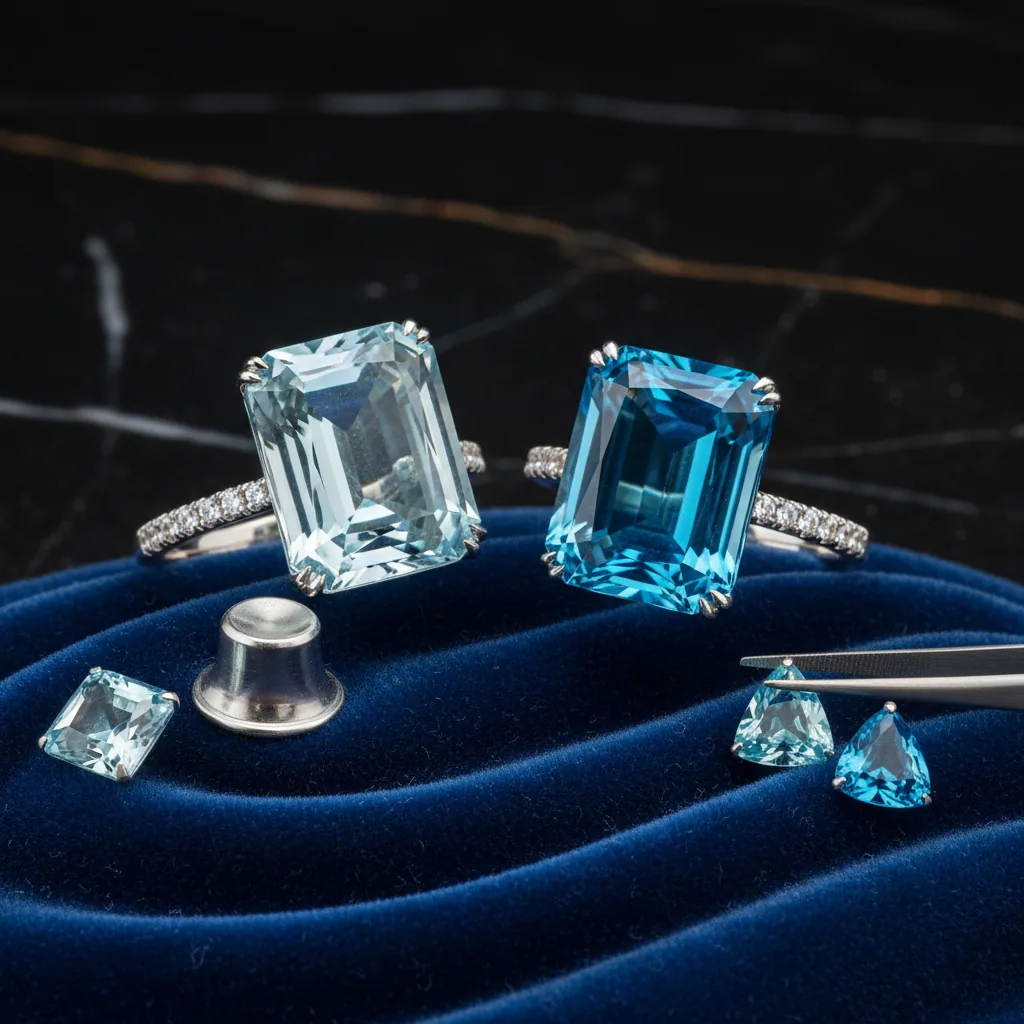
Blue topaz looks similar from across a room, costs less, and gets sold as the budget twin. They are not the same stone, and the differences matter for a ring you will wear for years.
- Mineral: aquamarine is beryl; blue topaz is an aluminum fluorosilicate. Different families entirely.
- Color: most blue topaz is irradiated to a vivid, uniform blue, and that color holds in sunlight. Aquamarine's blue is softer and more natural, but can fade under heavy sun.
- Durability: topaz is a touch harder but has perfect cleavage, so it can split along a plane from a single bad knock. Aquamarine has no cleavage, which makes it more forgiving day to day.
- Size for weight: aquamarine is lighter, so a one carat aqua looks roughly 20 to 25 percent larger face up than a one carat blue topaz.
- Rarity: aquamarine is scarcer and generally holds its appeal better.
For an everyday emerald cut aquamarine ring, we lean aquamarine for the no-cleavage toughness and the natural color. If you want the comparison in full, our topaz jewelry guide goes deeper. And if nothing off the shelf fits, we can cut and set a stone to your exact ratio.
Quick answers
Is an emerald cut good for aquamarine?
How much does an emerald cut aquamarine ring cost?
What carat size looks best in an emerald cut aquamarine ring?
Is aquamarine hard enough for an engagement ring?
Does aquamarine fade in sunlight?
How can I tell aquamarine from blue topaz?
Is aquamarine usually heat treated?
What length-to-width ratio is best for an emerald cut aquamarine?
How do I clean an emerald cut aquamarine ring?
What color aquamarine is most valuable?
Choosing an emerald cut aquamarine ring with open eyes
An emerald cut aquamarine ring is a confession of a stone. The step cut shows the color, the clarity, and any shortcut the cutter took to save weight. That honesty is the point. Judge the blue first, tilt the stone for a window, protect the corners, and pick the metal that flatters your shade.
Do that and you end up with a ring that still looks alive in ten years, chosen because it moved you, not because it ticked a box. If you would like us to source or cut a stone to your exact ratio, with an independent laboratory report on every piece, come find us. We will tilt it under the lamp together.