Pink Sapphire Ring with Diamonds: Setting, Metal and the Small Diamonds
Halo, three stones or side diamonds; white, yellow or rose gold; natural or lab-grown small diamonds: how to build a pink sapphire ring that lasts, and the ten most searched styles, pictured in pink.

Yes, a pink sapphire ring with diamonds can be worn every day: the sapphire rates 9 on the Mohs scale, and among natural gems only diamond scratches it. Choose the pink first, then a setting that frames it without swallowing it. Get both stones described in writing: the sapphire's treatment, and whether the small diamonds are natural. Our loose pink sapphires are below.
- Daily wear
- Yes: 9 on the Mohs scale
- Only natural gem that scratches it
- Diamond: store rings apart
- Small diamonds
- Ask in writing: natural or lab-grown
- White gold or platinum
- Shows any tint in the diamonds
- Center stone, 1 to 3 ct
- Typically asked $1,280 to $2,710 per carat
- Before resizing
- Show the jeweler the report
Is a pink sapphire ring with diamonds made for every day?
Yes. A pink sapphire is corundum, like ruby, colored by chromium. It rates 9 on the Mohs scale and its toughness is usually excellent, so it takes a ring worn daily. Large fractures, and some treatments, make a stone less durable: ask before you decide.
Here's the twist with diamonds. Diamond is the only natural gem that scratches sapphire. So keep the ring away from other diamond jewelry: two rings rubbing in a drawer is how a sapphire gets scratched. Give each ring its own pouch or slot.
Nine even steps, then diamond
The Mohs scale is a ranking: each mineral scratches the ones below it. Steps 1 to 9 are drawn equal. The step up to diamond is much wider.
SofterMohs rankHarder
How much wider depends on the test. In scratch tests done with a weighted diamond point, diamond came out 140 times harder than corundum. Tests that press a dent into the stone use another scale.
Who scratches whom?
Pick two.
Gems
Everyday things
Sapphire (9) and dust and sand (about 7)
Harder: Sapphire. It scratches the other and is not scratched back.
On a ring
Dust and sand are mostly quartz, at about 7. A gem ranked below topaz can pick up scratches over time. Sapphire sits two ranks above quartz.
Every material against sapphire
| Material | Mohs hardness | Against sapphire | On a ring |
|---|---|---|---|
| Diamond | 10 | Scratches sapphire | It can mark a sapphire. Keep the two from rubbing together, on the hand or in the box. |
| Moissanite (synthetic) | 9.25 | Scratches sapphire | Synthetic moissanite is listed at 9.25, just above sapphire. Keep the two from rubbing together, on the hand or in the box. |
| Ruby | 9 | They scratch each other | Ruby and sapphire are the same mineral, corundum. They can scratch each other: store each stone apart. |
| Spinel | 8 | Sapphire scratches it | The sapphire is the one that marks the other. Keep it apart from softer gems in the jewelry box. |
| Topaz | 8 | Sapphire scratches it | The sapphire is the one that marks the other. Keep it apart from softer gems in the jewelry box. |
| Emerald | 7.5 to 8 | Sapphire scratches it | The sapphire is the one that marks the other. Keep it apart from softer gems in the jewelry box. |
| Amethyst and citrine | 7 | Sapphire scratches it | The sapphire is the one that marks the other. Keep it apart from softer gems in the jewelry box. |
| Tanzanite | 6 to 7 | Sapphire scratches it | The sapphire is the one that marks the other. Keep it apart from softer gems in the jewelry box. |
| Dust and sand | about 7 | Sapphire scratches it | Dust and sand are mostly quartz, at about 7. A gem ranked below topaz can pick up scratches over time. Sapphire sits two ranks above quartz. |
| Steel nail | about 6.5 | Sapphire scratches it | A steel nail sits at about 6.5, below sapphire. The precious metal of a setting is softer than the stone: have the prongs checked. |
| Glass | about 5.5 | Sapphire scratches it | A glass plate sits at about 5.5, well below sapphire. The stone can scratch glass, not the other way round. |
| Fingernail | about 2.5 | Sapphire scratches it | A fingernail sits at about 2.5, far below sapphire. |
The ten reference minerals
| 1 | Talc |
|---|---|
| 2 | Gypsum |
| 3 | Calcite |
| 4 | Fluorite |
| 5 | Apatite |
| 6 | Orthoclase |
| 7 | Quartz |
| 8 | Topaz |
| 9 | Corundum |
| 10 | Diamond |
Everyday values are approximate. The rule: a material scratches anything ranked the same or lower.
The metal is the soft part. A stone that sits loose can wear through a prong, and the small prongs of a halo wear out faster. Have them checked. For the full picture on wear, see our guide to sapphire engagement rings.
The 10 most searched engagement ring styles, in pink
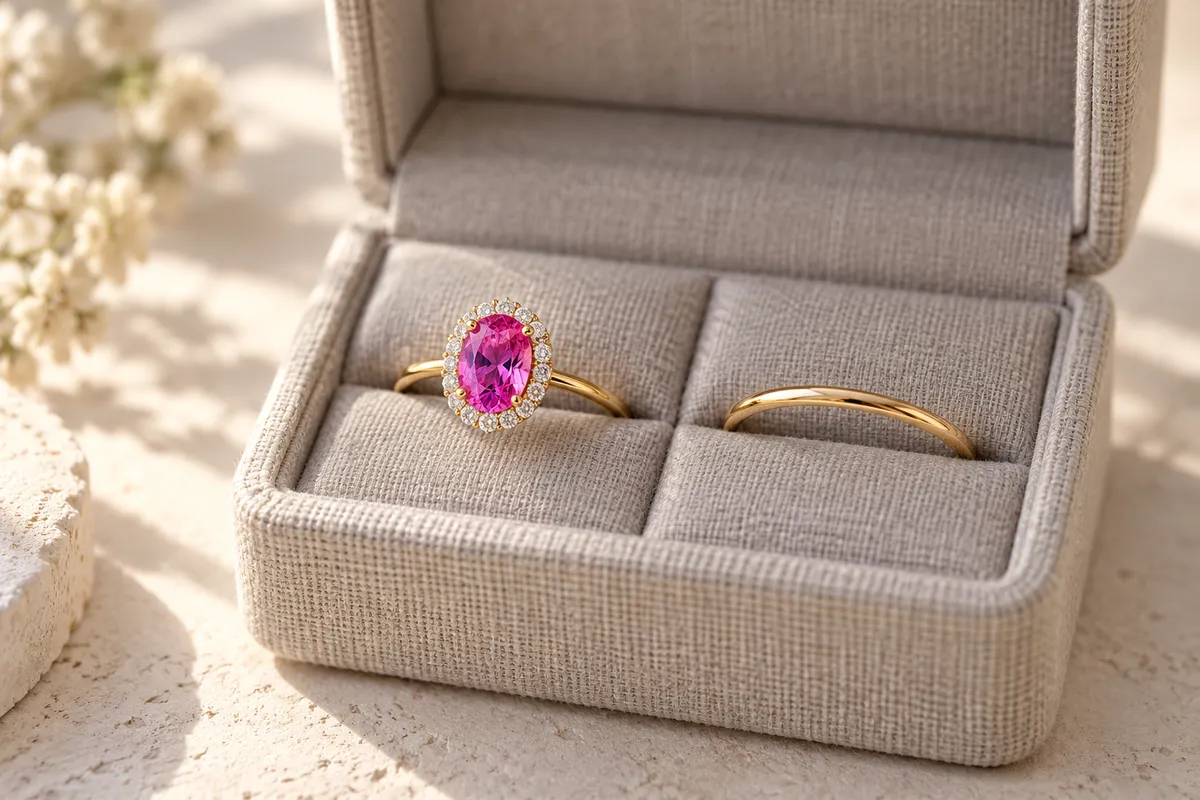
Which styles are people looking at right now? We read Pinterest's search data for the United States (Pinterest Trends, 30 days to 29 September 2026). Too few searches name pink sapphire for its styles to be ranked on their own, so we kept the ten most searched engagement ring styles and pictured each one with a pink sapphire and diamonds. Marquise leads, with searches up 50% in a year. Oval and emerald cut follow.
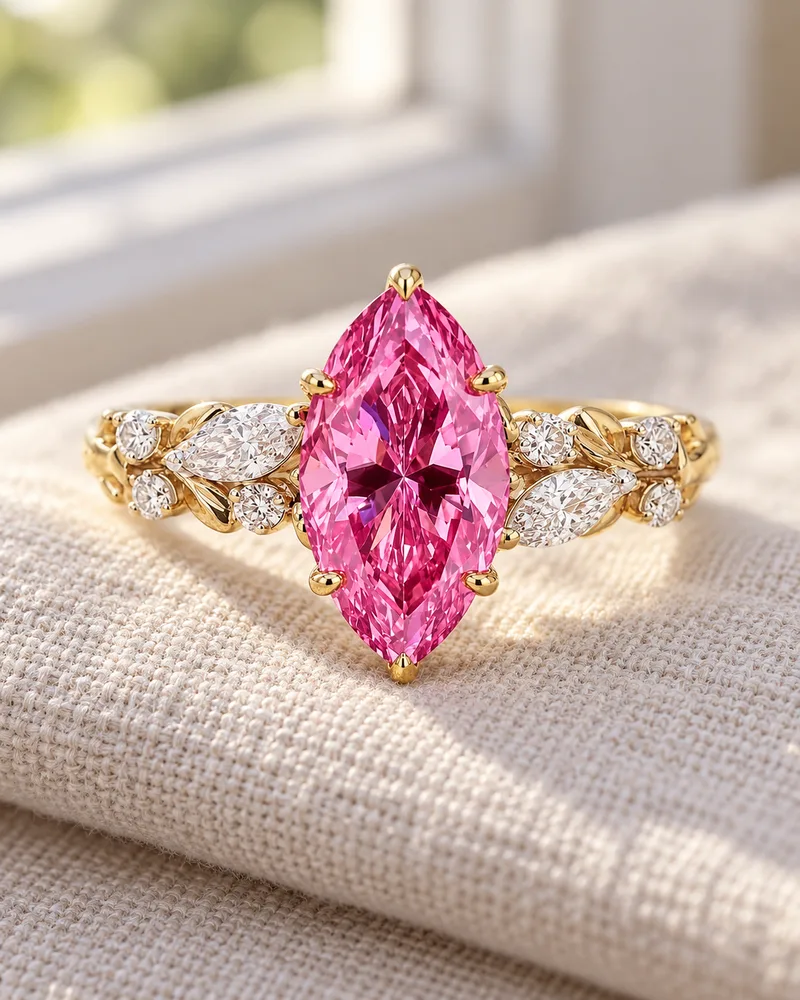
1Marquise
A long oval pointed at both ends. Searches are up 50% in a year.
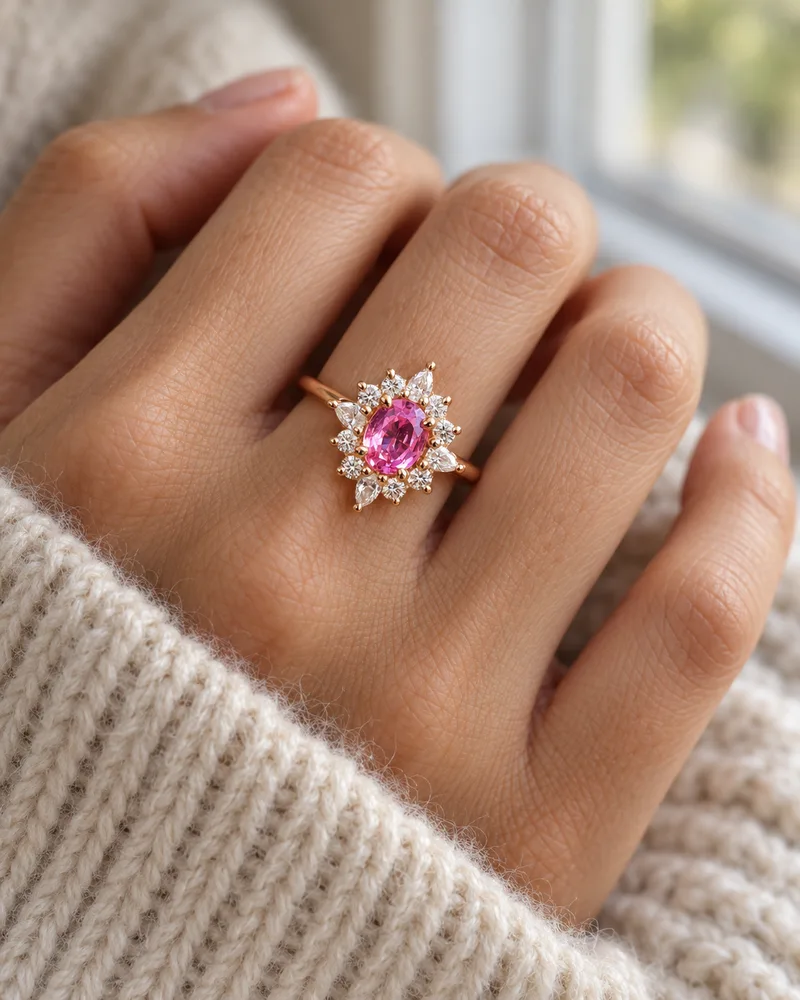
2Oval
A rounded, elongated outline with no corners.
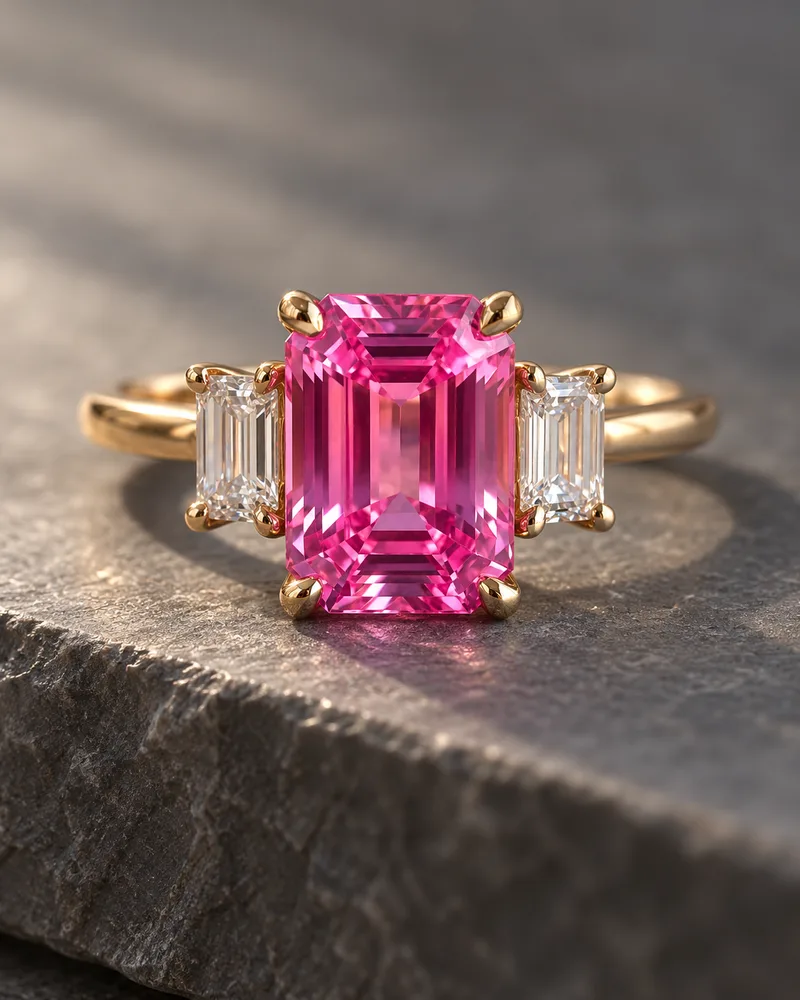
3Emerald cut
A rectangle with cut corners and long, parallel facets.
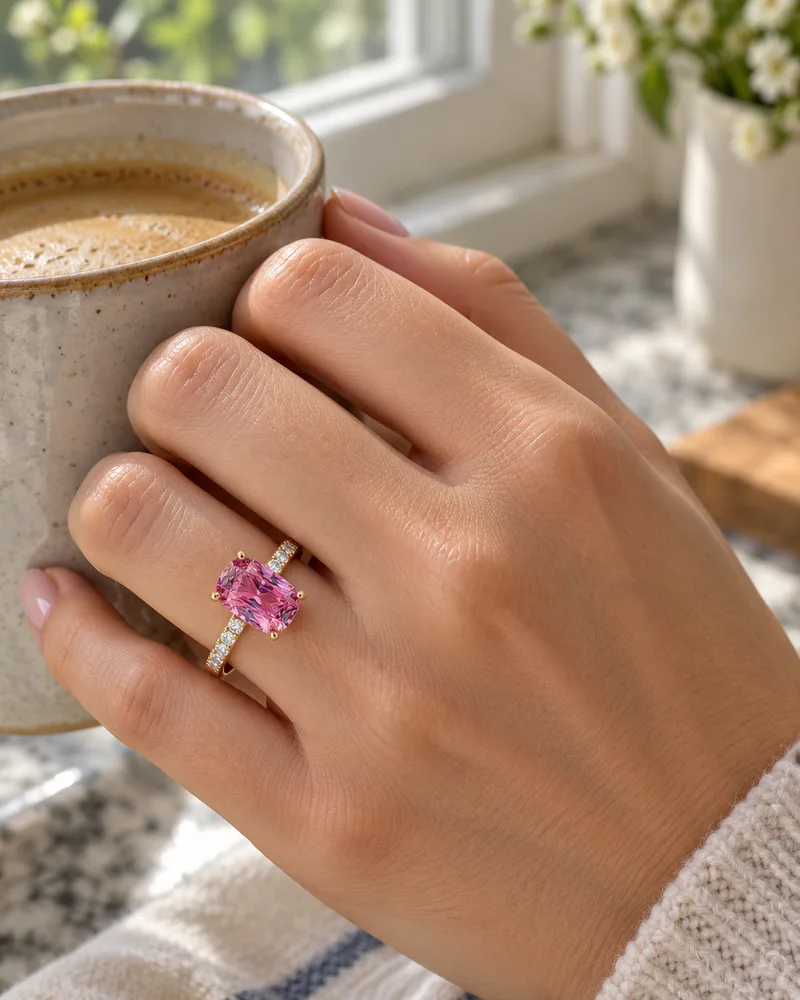
4Elongated cushion
A long rectangle with rounded corners and curved sides.
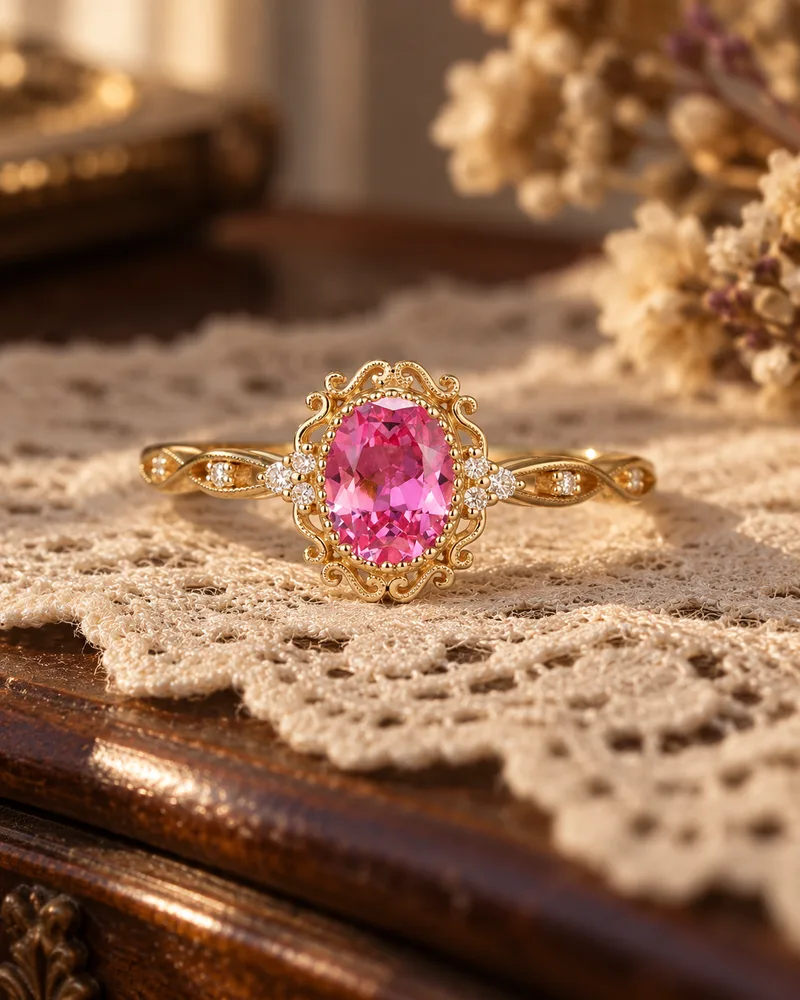
5Vintage
Openwork metal, a beaded edge and pierced shoulders, like an heirloom.
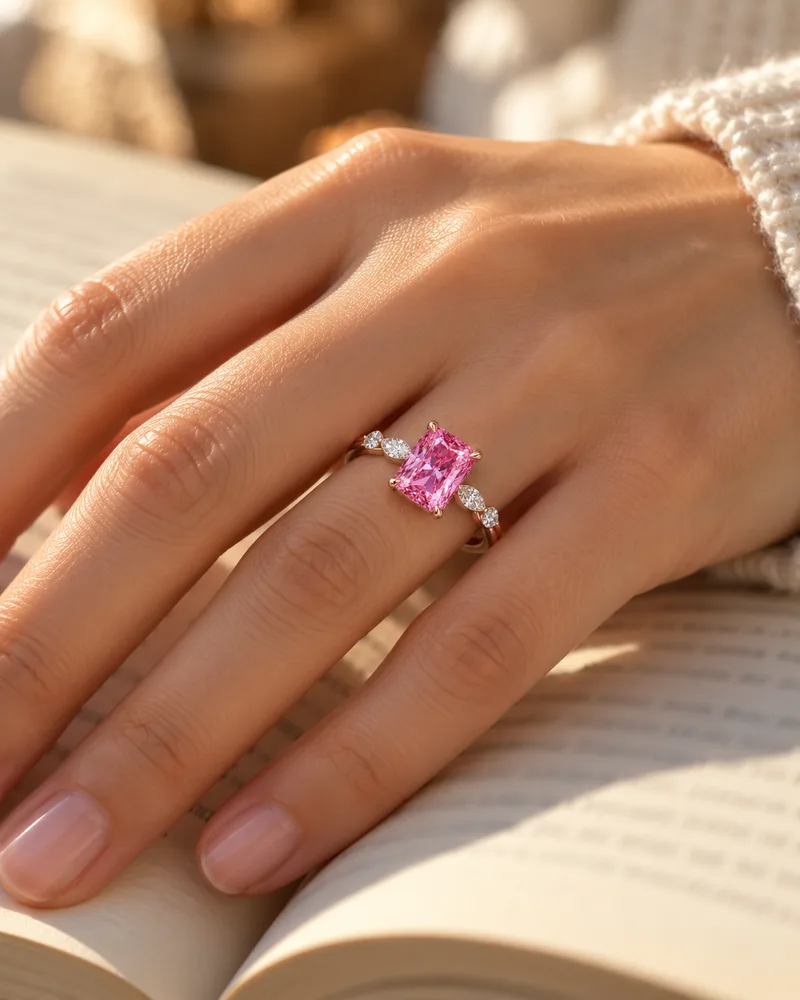
6Radiant
A rectangle with cropped corners and many small facets.
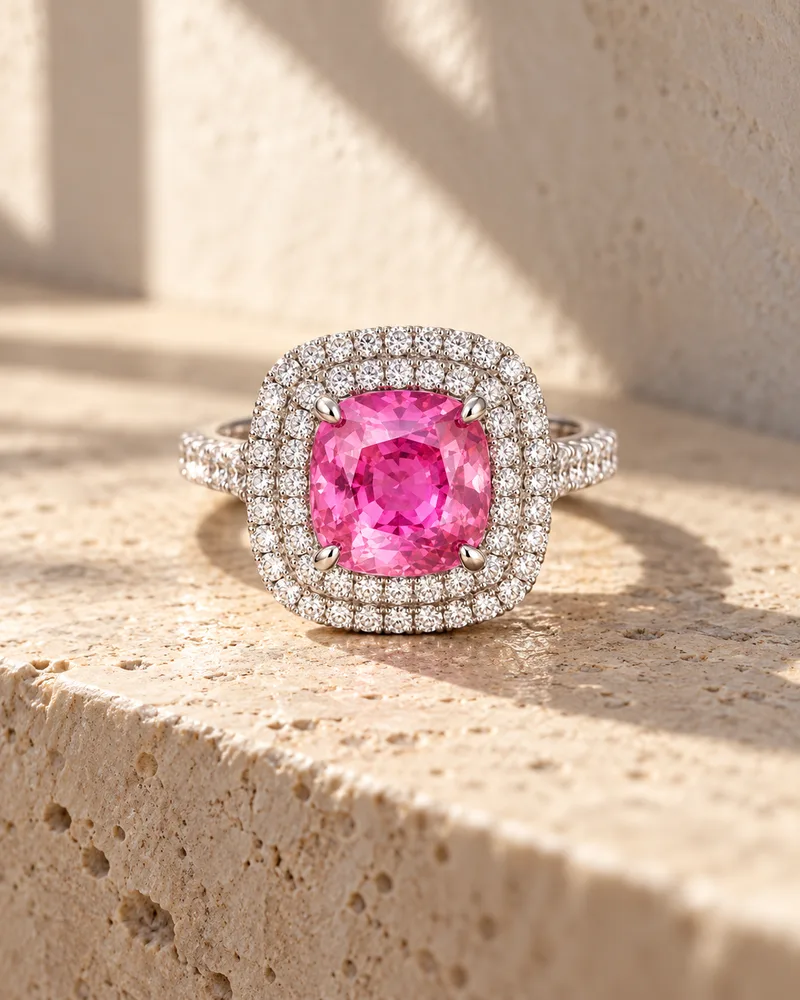
7Cushion
A soft square with rounded corners.
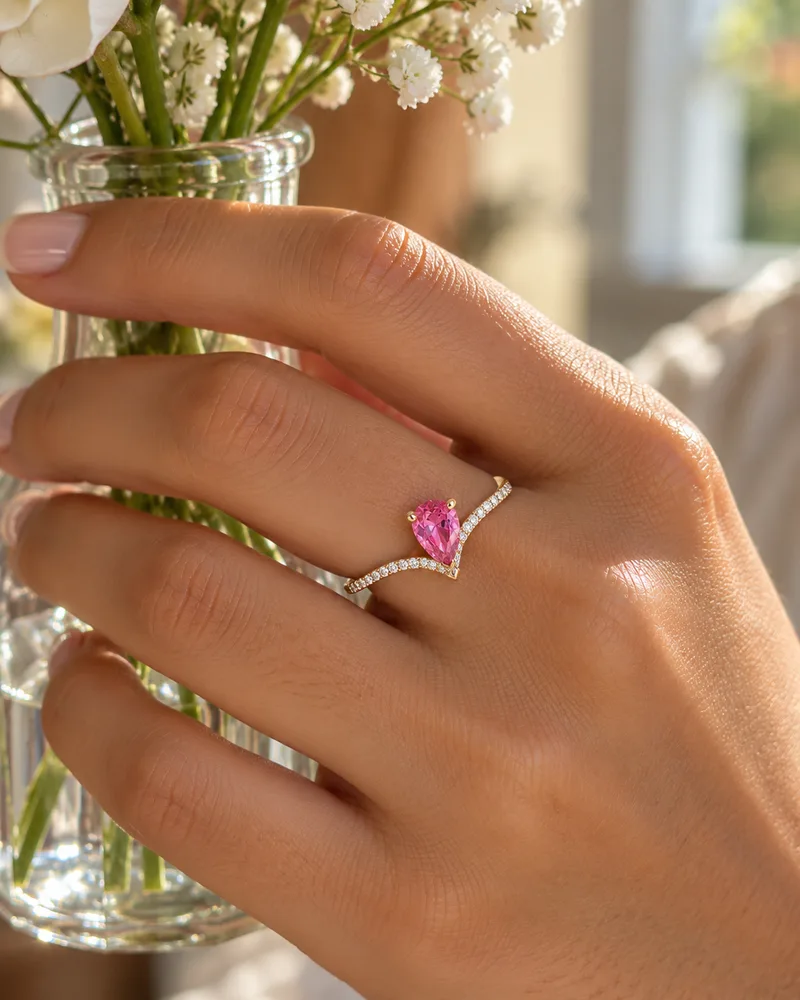
8Pear
A teardrop: one rounded end, one point.
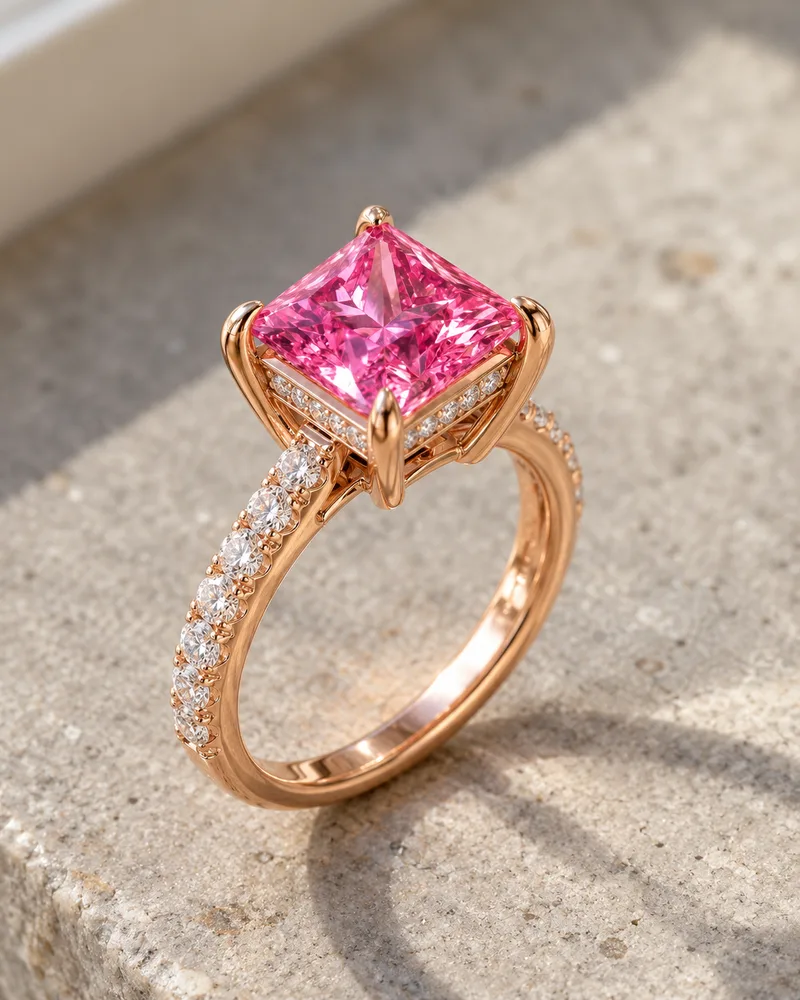
9Princess
A square outline with marked corners.
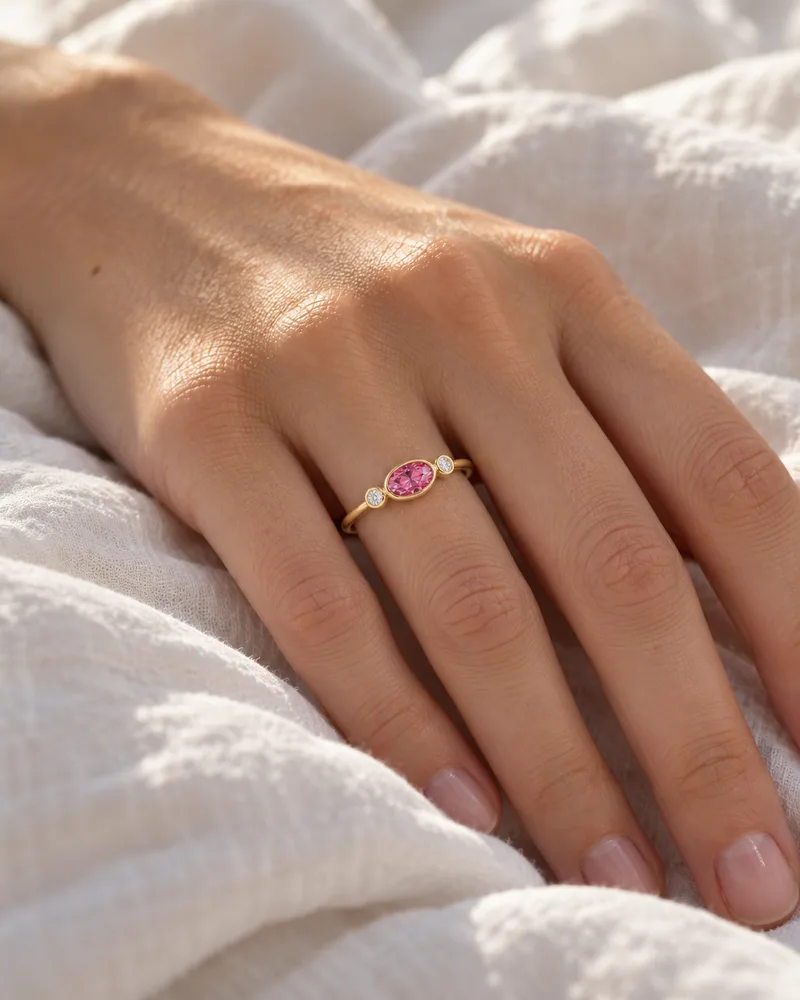
10Bezel
A rim of metal wraps the whole edge of the stone, with no prongs.
Illustrations, not rings from our stock. A style is only a frame: choose the pink first, then the shape that suits it.
Halo, three stones or side diamonds: which setting suits a pink sapphire?
Each setting gives the diamonds a different job.
- Halo. A ring of small diamonds around the center. The pink can read as wide as the halo, which helps a smaller stone. The cost: many small prongs, which wear out faster.
- Three stones. A diamond on each side. Pick side stones that read clearly smaller, so the eye lands on the pink first.
- Side diamonds or pavé. Small diamonds set into the band itself. Pavé is secure, since the stones sit in metal, and the unbroken line can make the center look larger.
- Bezel. A rim of metal around the pink, with or without diamonds on the shoulders. It guards the edge against knocks.
My view: the diamonds are the frame. If you notice the halo before the stone, the frame is too big.
White, yellow or rose gold with a pink sapphire?
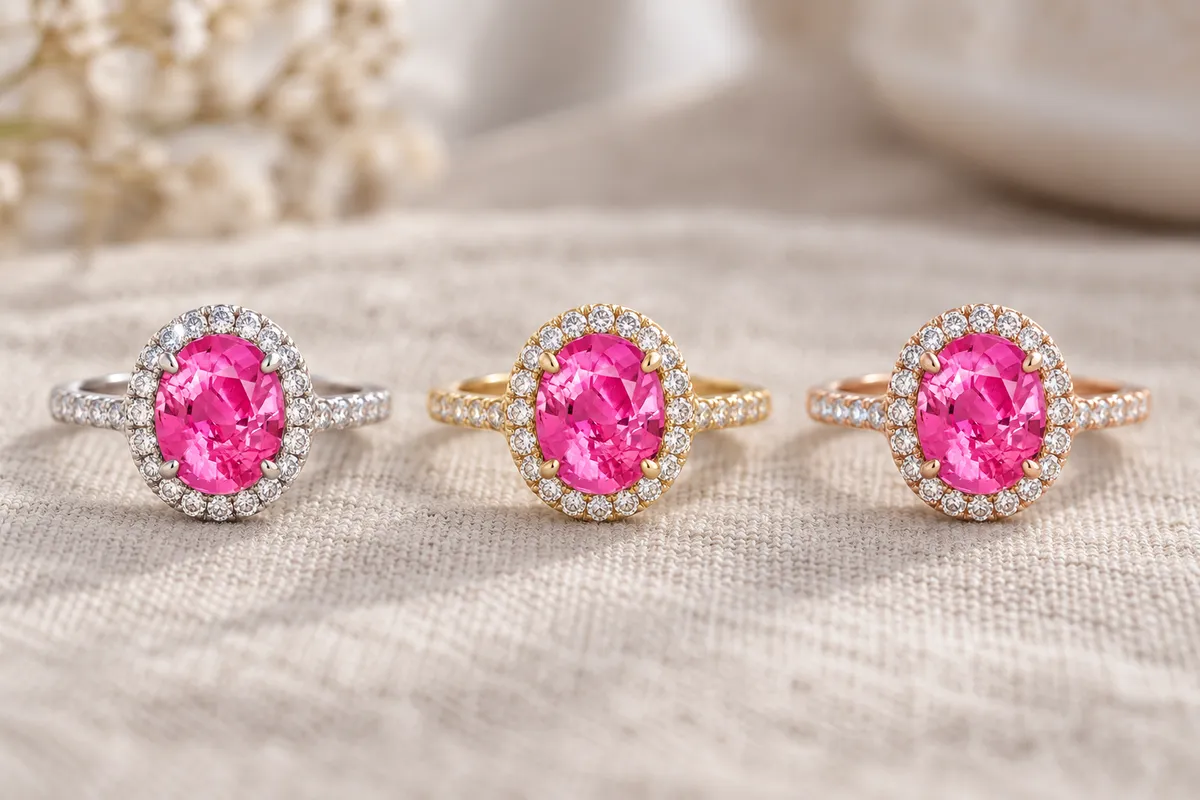
Start with what the metal does to the diamonds. Yellow gold helps hide a faint yellowish tint in a diamond; white gold and platinum make that tint easier to see. So in white metal, ask for whiter small diamonds. In yellow gold, a slightly warmer grade passes.
For the pink itself, it's taste. Rose gold blends with it and warms a pastel; white metal sets it apart, cooler and sharper. I'd judge it on your own hand. Colors shift with the light, so look in daylight and under a warm lamp before you decide.
Natural or lab-grown: what are the small diamonds in the ring?
The small diamonds around a center stone are sold in parcels. Lab-grown and treated diamonds have been found mixed into parcels of natural ones: in one parcel screened in 2017, 101 of 323 stones were undisclosed lab-grown. Laboratories now run automated screening for exactly this.
Lab-grown small diamonds are not a fault in themselves. Not knowing is. Ask the seller to write down three things: natural or lab-grown, total carat weight, and color grade. Our guide to the lab-grown diamond ring explains the difference.
Pink sapphire or pink diamond: what changes in a ring?
Both look pink. The mineral, the cause of the color and the light they return differ.
| Pink sapphire | Pink diamond | |
|---|---|---|
| Mineral | Corundum | Diamond |
| Pink comes from | Chromium | A distortion of the crystal lattice |
| Mohs hardness | 9 | 10 |
| Dispersion (fire) | 0.018 | 0.044 |
A diamond splits light into colors more than twice as much as a sapphire, so a pink diamond flashes more. Pink to red diamonds have long been among the most prized diamonds of all. They can also be lab-grown or treated to pink, so the report matters just as much. If your pink leans toward red, read ruby vs pink sapphire.
How much does a pink sapphire ring with diamonds cost?
The price starts with the center stone. On 7 October 2026 we read the asking prices of pink sapphires of 1 to 3 carats at five independent sellers: typically $1,280 to $2,710 per carat, with a full span of $150 to $8,670. These are asks, not sale prices.
Color moves the price. Highly saturated pinks are rare and sell quickly; light, weakly colored ones cost less. Compare both ends in our vivid hot pink and pastel pink sapphires. The small diamonds, the metal and the atelier come on top. We don't print a finished-ring range: the asks we found for complete rings ran too wide to mean anything.
The full grid is in our sapphire price per carat, how the pink is judged in our pink sapphire buying guide, and the wider market, with sources, in our colored gemstone statistics.
Heated, diffused or filled: what to tell the jeweler
Heat is widespread in sapphire and stable, so assume it unless a report says otherwise. Two other treatments matter more in a ring.
- Diffusion. Color is driven into the stone at very high heat; beryllium can push a pink toward orange. It holds up in wear, but in some stones the color can be lost if the stone is repolished or recut.
- Filling. Fractures or cavities filled with glass or resin. High heat can damage the filling, and ultrasonic or steam cleaners are never safe for it.
One risk applies even to an untreated stone: soldering flux containing boron etches the surface of corundum. So before any resizing or prong repair, hand the jeweler the report. At home, warm soapy water is safe for every version. To read the treatment line, see heated vs unheated sapphire and what a gemstone certificate proves. And measure your ring size before the ring is made, so it never has to go back to the bench.
Your six questions for the seller, ready to send
Tick them as you get answers. The button copies all six, ready to send.
6 points
A message ready to send to the seller, with all the questions.
See the message
Hello, I am interested in this pink sapphire ring with diamonds. Before I decide, could you answer a few questions in writing?

1. Is the pink sapphire untreated, heated, diffused or filled? Could you confirm it in writing?
2. What are the dimensions of the pink sapphire in millimetres, and its weight in carats?
3. Are the small diamonds natural or lab-grown, and were they tested?
4. What is the total weight and the colour grade of the small diamonds?
5. Which metal is the ring made of, and what is its fineness (for example 18 k, 14 k or platinum)?
6. Is there a report from an independent laboratory for the pink sapphire? Could you send it before any resizing or repair?

Thank you for your time.
Quick answers
Is a pink sapphire good for an engagement ring?
Is pink sapphire expensive?
Is pink sapphire rare?
Which metal goes best with a pink sapphire and diamonds?
Choose the pink, then the frame
A pink sapphire takes daily wear. Pick the pink first, a setting that frames it and a metal that suits the small diamonds, and get both stones described in writing. Browse our loose pink sapphires; if the one you want isn't there, describe it and we'll look for it. Then we make the ring around it, at your size.