Ruby vs Garnet: How to Tell Your Red Stone Apart
Two minerals, one red. What color, a UV lamp, the scale and a laboratory can each tell you, which one holds up in a ring, and what each asks per carat.

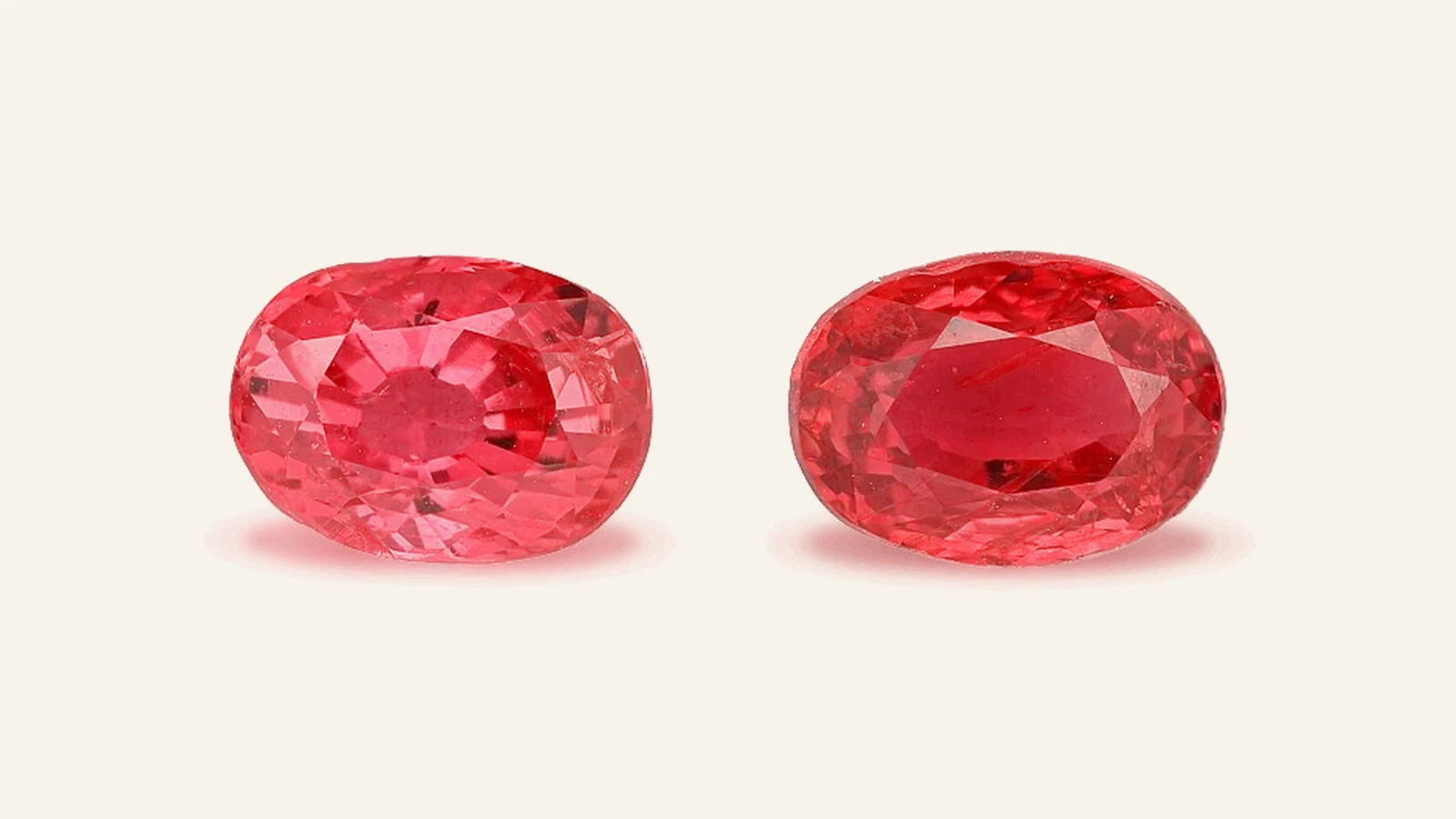
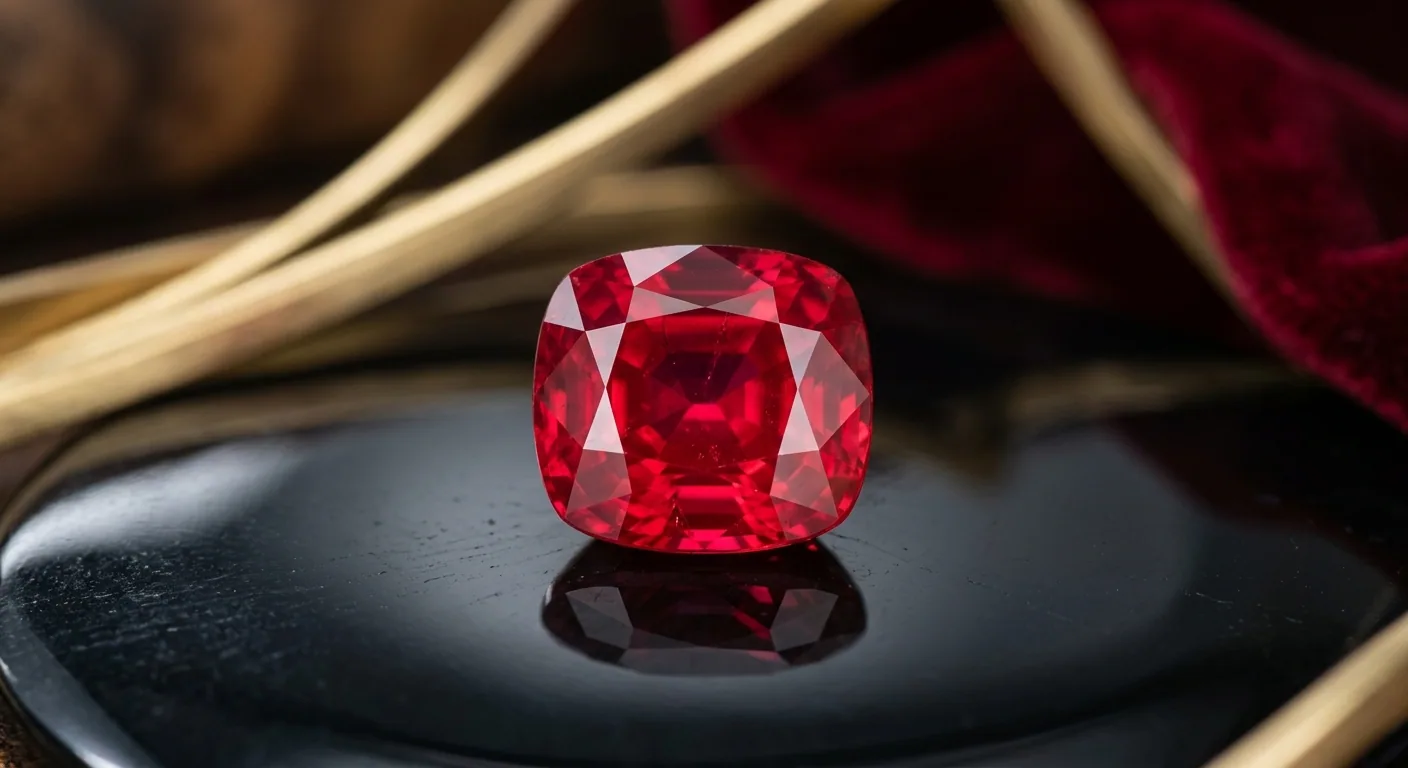
Ruby or garnet? By eye, you often can't be sure: a fine red garnet can pass for ruby. They are different minerals. Ruby is corundum, 9 on the Mohs scale and doubly refractive. Garnet is 7 to 7.5 and singly refractive. A laboratory separates them with standard tests. Ruby asks far more per carat; garnet is rarely treated.
| Ruby | Red garnet | |
|---|---|---|
| Mineral | Corundum | Garnet group (pyrope, almandine) |
| Usual red | Orangy to purplish red, red dominant | Darker, brownish to purplish red |
| Mohs hardness | 9 | 7 to 7.5 |
| In the lab | Doubly refractive | Singly refractive |
| Under UV | Often glows red | Stays dark |
| Treatment | Usually heated | Rarely treated |
Can you tell ruby from garnet by color?
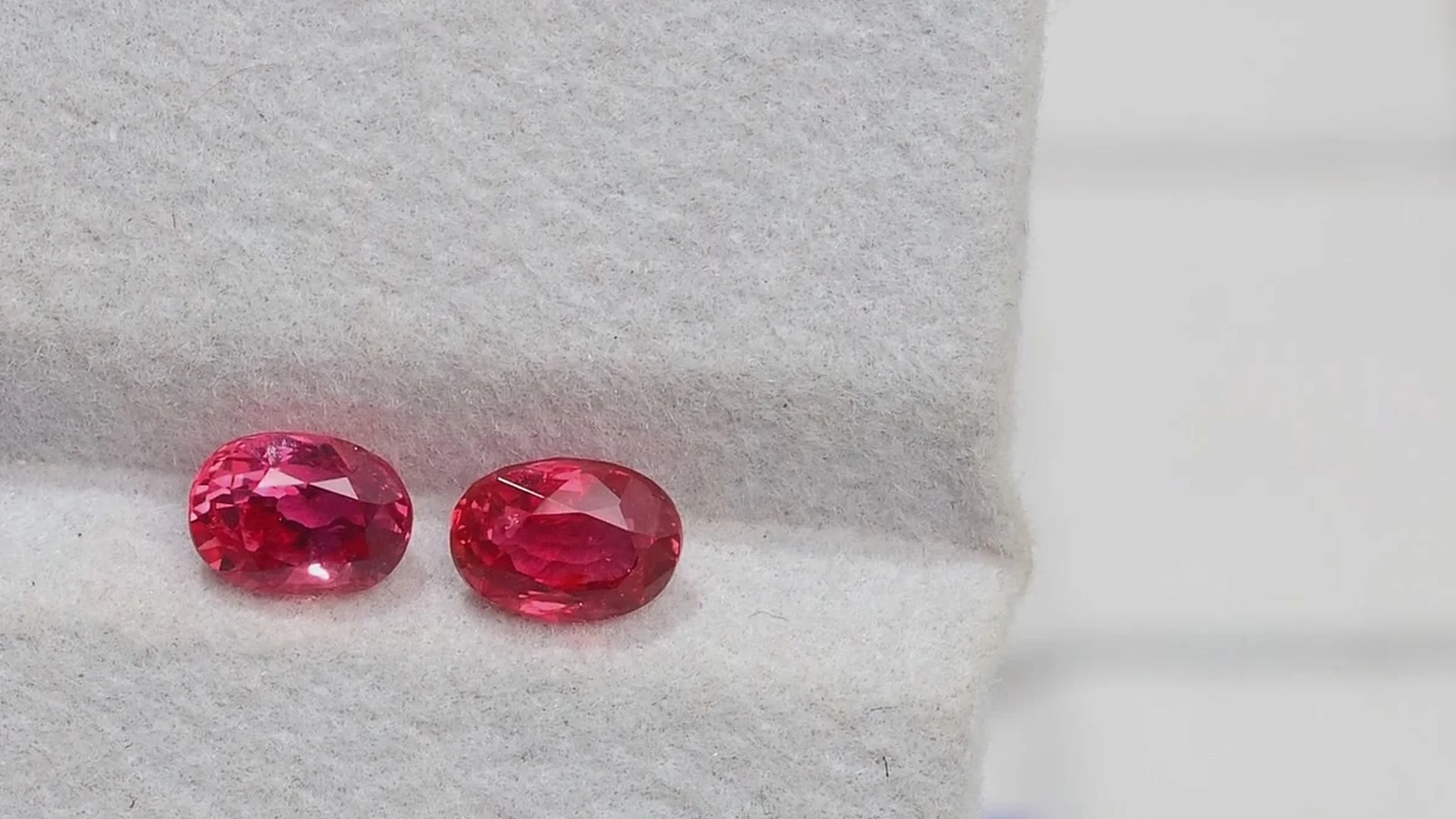
Sometimes, never for certain. Ruby runs from orangy red to purplish red, and red must dominate. Most red garnets sold today, mixtures of pyrope and almandine, are darker and less saturated, from brownish red to purplish red, and large ones turn darker still.
Then the exceptions arrive. A fine rhodolite, the most valuable red garnet, can look more like ruby than garnet, and some pyropes rival ruby's red. The trade has long played on that: “Cape ruby” is an old, misleading name for pyrope, and older jewelry often set dark almandine over reflective foil to lighten it. So color narrows the field. It doesn't name the stone. On the pink side, ruby has another border: ruby vs pink sapphire.
What can a UV lamp, the scale or a loupe tell you?
Each gives a hint, none a verdict.
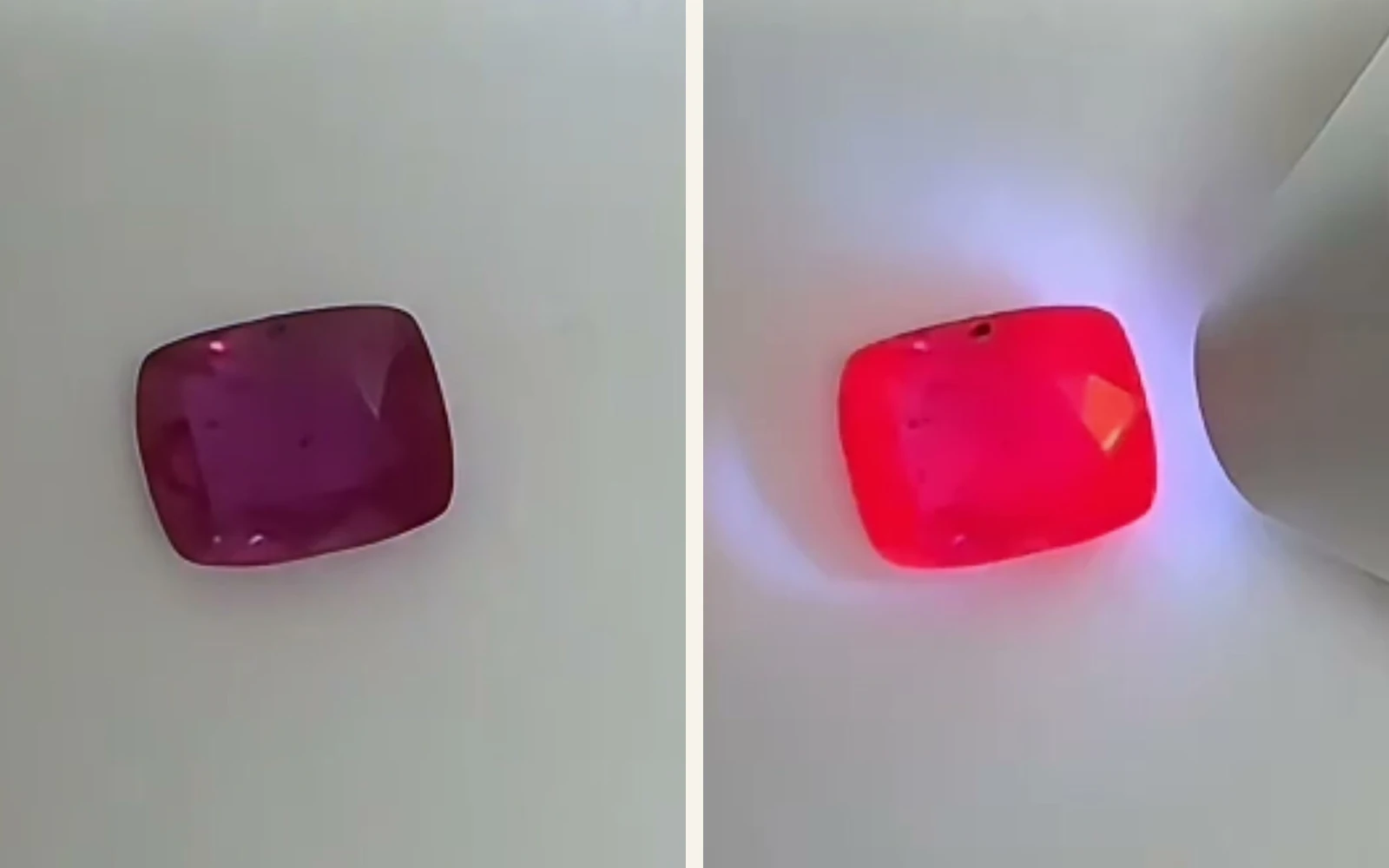
- UV light: many rubies glow red under ultraviolet, thanks to the chromium that colors them. Red garnet stays dark. So a glow points away from garnet. No glow proves nothing: iron dampens it, and rubies from iron-rich deposits, such as Thailand and Cambodia, glow weakly or not at all. A strong glow can also come from synthetic ruby.
- Weight: no help. Ruby's density is about 4.00, red garnets about 3.78 to 4.05.
- Loupe: both can hold fine needles, crossing at 60 degrees in ruby and at about 70 and 110 in almandine. That takes a microscope and a trained eye.
How does a laboratory tell ruby from garnet?
With light. Garnet is singly refractive: one refractive index, and no change of shade under a dichroscope. Ruby is doubly refractive: two readings, and two shades, orangy red and slightly purplish red. The index alone can mislead, since ruby reads 1.762 to 1.770 and pyrope-almandine garnets 1.750 to 1.780. The double reading decides, and the spectroscope confirms it.
The same tests can't tell natural ruby from synthetic: only magnification does. Read the report, not the label. Here is what a gemstone certificate proves.
Which is better for an everyday ring?
Ruby, by a clear margin. It rates 9 on the Mohs scale, harder than any natural gem except diamond, and its toughness is usually excellent. Red garnet rates 7 to 7.5, with fair to good toughness: level with quartz, the 7 that makes up most dust, so it still makes a good ring stone. It simply shows wear sooner on a hand that never takes it off. Tell your jeweler it is garnet before any repair, since a sudden change of temperature can crack it.
Ruby or garnet in a ring: hardness and toughness
Hardness is resistance to scratches, toughness is resistance to knocks. A ring needs both. Tap a stone.
Touch a point to read about the stone.
Diamond Mohs 10 · Toughness: Good in its cleavage directions, exceptional in all others
10 on the Mohs scale, harder than any other gem. A hard knock at the wrong angle can still chip it.
Ruby Mohs 9 · Toughness: Usually excellent
9 on the Mohs scale, harder than any natural gem except diamond, with usually excellent toughness: made for a ring that never comes off. It can scratch a garnet.
Red garnet Mohs 7 to 7.5 · Toughness: Fair to good
7 to 7.5 on the Mohs scale, fair to good toughness: a good ring stone, level with the quartz in dust. On a hand that never takes it off, it shows wear sooner than ruby.
Quartz (dust) Mohs 7 · Toughness: Good
7 on the Mohs scale. Most dust in the air is quartz: a stone below it slowly dulls in wear and cleaning. Red garnet sits level with it or just above, ruby far above.
| Stone | Mohs | Toughness |
|---|---|---|
| 1Diamond10 on the Mohs scale, harder than any other gem. A hard knock at the wrong angle can still chip it. | 10 | Good in its cleavage directions, exceptional in all others |
| 2Ruby9 on the Mohs scale, harder than any natural gem except diamond, with usually excellent toughness: made for a ring that never comes off. It can scratch a garnet. | 9 | Usually excellent |
| 3Red garnet7 to 7.5 on the Mohs scale, fair to good toughness: a good ring stone, level with the quartz in dust. On a hand that never takes it off, it shows wear sooner than ruby. | 7 to 7.5 | Fair to good |
| 4Quartz (dust)7 on the Mohs scale. Most dust in the air is quartz: a stone below it slowly dulls in wear and cleaning. Red garnet sits level with it or just above, ruby far above. | 7 | Good |
Points that would overlap are moved apart a little. The exact values are in the table.
Toughness has no number: it is rated in words, and one stone can sit on two lines. Inclusions, fractures or some treatments lower it for any single stone.
Source: Hardness and toughness as published in standard gemology references, checked on 2 November 2026.
Ruby vs garnet: price and treatment
Ruby can command the highest price per carat of any colored stone; red garnet is among the most affordable. In public asking prices we read in October 2026, a 1 to 3 carat ruby typically asked $1,760 to $10,230 a carat across five sellers, and a 2 to 5 carat rhodolite $30 to $230 across four. The weight bands differ, so read them as orders of magnitude, not a precise ratio. Full grid: ruby price per carat.
Treatment runs the other way. Up to 95 percent of rubies are heated, and some are filled. Garnet is rarely treated, and lab-grown garnet isn't made commercially.
Ruby or garnet: which should you choose?
- Choose ruby if you want red at its most intense, in a ring you never remove, and accept that it is very likely heated. Our natural ruby guide shows how it is graded; see our loose rubies.
- Choose garnet if you love a deep wine red or a purplish rhodolite, want size, and prefer a stone left as it came from the ground. See which garnet suits which piece, the January birthstone, and our loose garnets.
Quick answers
Is garnet a fake ruby?
Do garnets glow under UV light like rubies?
How can you tell a raw ruby from a raw garnet?
Is there a star garnet, like a star ruby?
The honest bottom line
Ruby and garnet can share a red, never a mineral. Your eye and a UV lamp can raise a doubt; only a laboratory settles it. Choose the red you love, then read its name on the report.