Pigeon Blood Ruby: What the Term Really Proves (and What It Doesn’t)
Three laboratories, three different answers, and one that refuses to print the words at all.
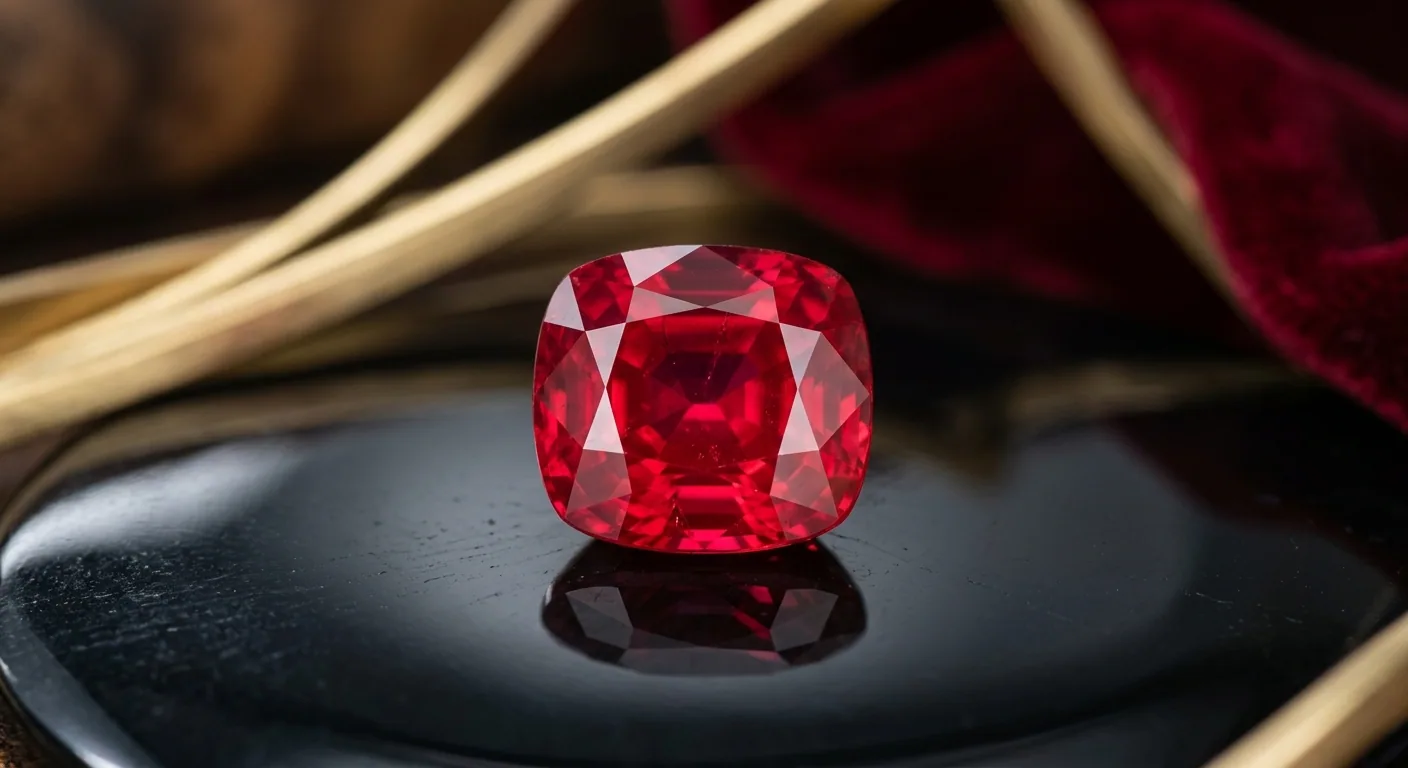
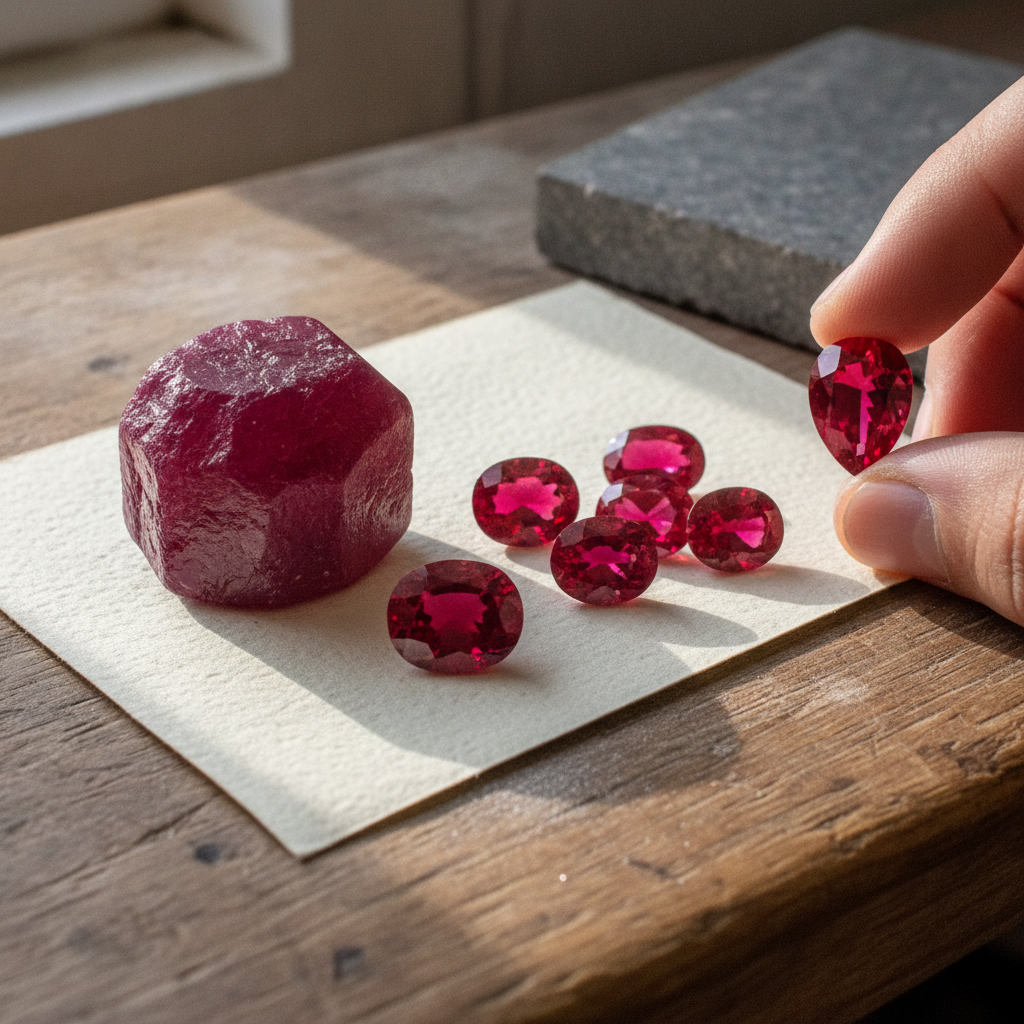
A pigeon blood ruby is a ruby whose colour a laboratory has judged vivid red, with medium to strong red fluorescence. It is a colour grade, not a proof of origin or purity. GRS grants it to heated stones from any country, Gübelin and SSEF grant it far more rarely, and GIA never prints the phrase at all.
Pigeon blood ruby: the short version
Let's be honest about what you're really asking. You saw “pigeon's blood” on a listing, the stone next to it looked similar and cost a third as much, and you want to know whether those two words are worth the difference.
Here's the answer, and it isn't the one most guides give you. A pigeon blood ruby is a ruby whose colour a laboratory has judged vivid red. It is a colour grade. It is not a property of the stone, not a proof of origin, and not a promise that the ruby was never heated.
Three of the most respected laboratories in the world treat that phrase three different ways, and a fourth refuses to print it at all. So the same ruby can leave one bench as pigeon's blood and another as, simply, red. Same stone. Same chromium. Different sentence on a piece of paper, and often a very different price.
What follows is what each lab actually requires, what the words prove, what they quietly do not, and how to read that line on a report before you pay for it.
What is a pigeon blood ruby, exactly?
The definition most of the trade leans on belongs to GRS, the Swiss laboratory that turned an old dealer's nickname into a written standard in 1996. GRS publishes its criteria openly, which is more than most labs bother to do, and they reward a slow read.
The GRS pigeon’s blood test, in four lines
| Colour | “Vivid red”, intensity level 3 on a 4 point scale. High intensity, low tone, no brown or orange overtone. |
| Chromium | Roughly 0.3 to 0.5 wt% or higher. |
| Iron | None to medium, with a chromium to iron ratio above 1. |
| Fluorescence | Medium to strong under 365 nm ultraviolet light. |
Source: GRS GemResearch Swisslab, published GRS-type “Pigeon’s Blood” criteria, standard introduced 1996.
Now notice what is not on that list. There is no country. There is no word “unheated”. GRS states plainly that the grade applies independently of origin, and that a qualifying stone can be either heat treated or unheated. Beryllium treated, lead glass filled, surface diffused and synthetic rubies are shut out, along with two categories of heat residue. Everything else is fair game.
The fluorescence requirement is the oldest part of the idea, not a modern flourish. Per GIA, “historically, the term ‘pigeon's blood’ described the color of rubies with a soft, glowing, red fluorescence.” That soft glow is the thing dealers were pointing at two centuries ago, long before anyone owned a spectrometer.
Why do three laboratories give three different answers?
Because nobody owns the phrase. There is no governing body for gem trade terms, no ISO standard, no registry. Each lab decides for itself whether to print the words and how high to set the bar.
Who prints the words, and what they mean by them
| Laboratory | Prints it? | What that actually means |
|---|---|---|
| GRS | Yes, since 1996 | Published colorimetric criteria. Any country of origin. Heated or unheated. |
| Gübelin | Yes, sparingly | Held back for the very finest material, in practice unheated Burmese. |
| SSEF | Yes, sparingly | Same posture. Exceptional colour and fluorescence, rarely granted. |
| GIA | No, never | Describes colour in its own vocabulary. The phrase does not appear on the report. |
Sit with what that table means for a buyer. Someone holding a GRS pigeon's blood report and someone holding a Gübelin pigeon's blood report are not holding the same claim, even though the two reports read identically. The GRS call is a colour measurement that a heated Mozambican stone can pass. The Gübelin call is closer to a jury verdict on a stone that is exceptional by any measure.
GIA has been openly sceptical of this whole family of terms for decades. Per GIA, “fanciful descriptions like these are useful for evoking images, but they can be subject to misinterpretation when you're trying to describe a ruby's actual color.”
My own view, and you are welcome to disagree with it: GIA has the better position. A word that four laboratories define four ways is not a grade. It is a marketing surface with a lab report stapled to it. That does not make the stones any less magnificent. It makes the word a poor thing to buy. If you want the fuller version of that argument, we wrote it out in what a gemstone certificate actually proves.
Does “pigeon’s blood” mean the ruby is unheated?
No. This is the most expensive misunderstanding in the ruby trade, and it survives because almost nobody selling the phrase has a reason to correct it.
Read the GRS rules again. A stone qualifying for GRS-type pigeon's blood “can either be heat-treated or unheated”. Trade sources say the same thing in plainer language: a heated ruby can receive the classification if its colour meets the criteria after the furnace has done its work. The grade describes the colour in front of the gemmologist, not the road the stone took to get there.
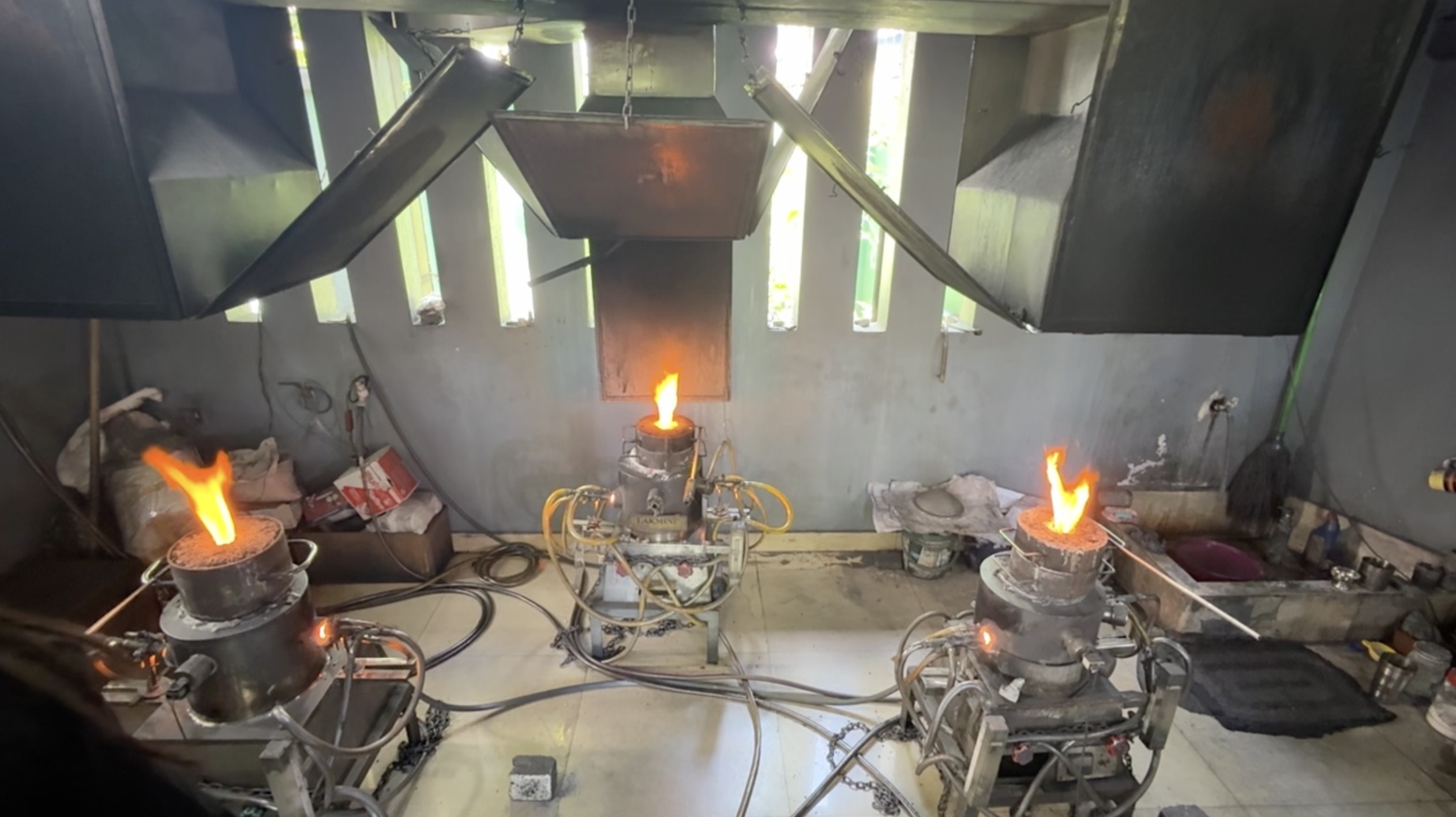
None of which makes heat a scandal. Most rubies on the market have seen a furnace, a properly heated ruby is still a natural ruby, and the treatment is stable. Those are the furnaces above, in a workshop a few hours from where we buy. The point is narrower and sharper: if unheated is what you want, then “no indications of heating” is the line you look for, and it sits somewhere else on the report entirely. Pigeon's blood will not tell you.
Unheated and pigeon's blood is a genuinely rare pairing, and it is that combination, not the phrase on its own, that carries the headline prices. We took the treatment question apart properly in unheated versus heated corundum, and the logic transfers straight across from sapphire to ruby, because they are the same mineral.
The Burma question, and the $34.8 million stone that broke it
Ask ten buyers what pigeon's blood means and eight will answer “Burmese”. Fair enough. The term did come out of the Mogok valley in Myanmar, where the finest reds have been coming out of the ground for centuries, and for a long time the shorthand held.
Then June 2023 happened. The Estrela de Fura, 55.22 carats of vivid red described as pigeon's blood, sold at Sotheby's New York for $34.8 million, or $630,288 per carat. World record for a ruby, and for any coloured stone ever sold at auction. It was cut from a 101 carat piece of rough pulled out of the ground near Montepuez.
Montepuez is in Mozambique. The single most expensive pigeon's blood ruby in recorded history is African.
Per GIA, “a single source never consistently yields gems that are all the same color and quality. In fact, the descriptive term might represent only a small percentage of stones from that source.” And the line that made me put my coffee down the first time I read it: “even if rubies are purchased at the Myanmar border, the stones might still be from Vietnam or Africa. This is particularly true with parcels.”
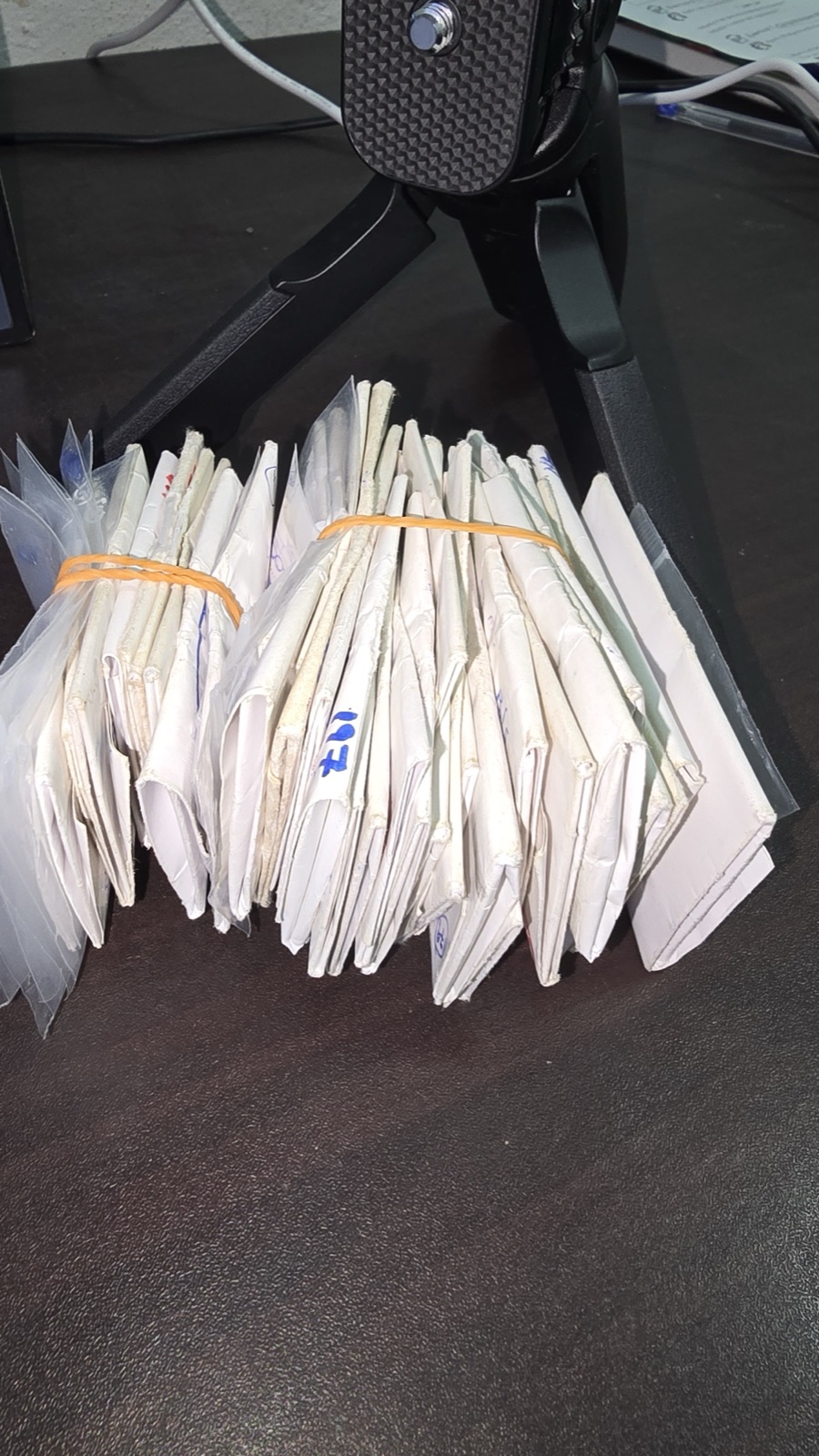
Here is the field version, because parcels are how I buy. When you are sitting at a table in Beruwala and a dealer tips a folded paper of red stones onto the cloth, nobody in that chain is issuing origin reports. The paper is a paper. Origin gets decided much later, by a laboratory, on a stone that has already changed hands three or four times. That is precisely why we document the chain instead of waving a country at people, and it is the whole argument of how we source at the mine.
What actually makes a ruby glow like that
Two elements decide almost everything. Chromium turns colourless corundum red, and the more of it there is, the deeper the red goes. Iron does the opposite: it quenches fluorescence, and it drags the red toward brown.
That is why the GRS ratio rule matters more than it looks. Chromium above iron is not an arbitrary threshold, it is a chemical fingerprint of a particular kind of deposit. Per GIA, Kenyan rubies “have high chromium and low iron content, causing intense fluorescence” precisely “because of their marble-hosted origins”. Mogok is marble hosted. So are deposits in Vietnam, Tanzania, Kenya, Afghanistan and Tajikistan. Basalt hosted deposits carry far more iron, and their reds read darker and flatter across a room.
So pigeon's blood is really a geology call wearing a country's clothes. The word points at Myanmar. The chemistry points at marble. Those overlap often enough that the shorthand worked for a century, and they came apart the moment Mozambique started producing.
Where the pigeon’s blood window sits
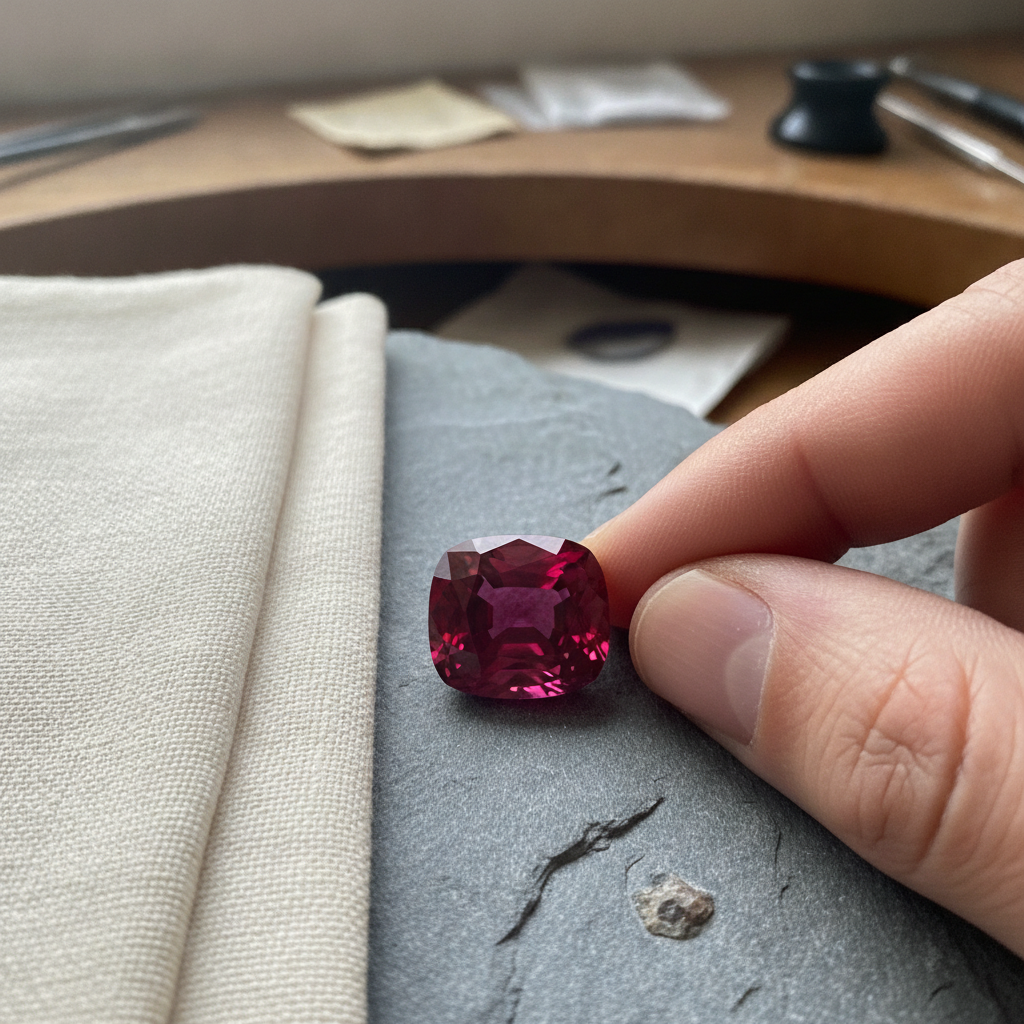
Screens are not gem labs. This shows the direction the colour travels, not a grading tool.
The lower boundary is its own argument. Lighten that vivid red far enough and laboratories stop calling the stone a ruby at all, which is a genuinely contested line we mapped out in ruby versus pink sapphire.
How much does the word add to the price?
A lot, and the numbers are public. Sotheby's puts fine pigeon's blood rubies at roughly $30,000 per carat in the 2 to 3 carat range, around $55,000 per carat from 3 to 4 carats, and past $300,000 per carat above 5 carats. The Estrela de Fura cleared $630,288 per carat.
Below the auction stratosphere, the trade rule of thumb is that a certified pigeon's blood ruby sells for two to five times an otherwise comparable stone without the call.
Read that again. Otherwise comparable. Same weight, same clarity, same cut, same treatment. The difference is a sentence on a report.
You are perfectly entitled to pay for it, and at the top of the market the word is tracking something real, because those stones are extraordinary and genuinely scarce. The trouble starts underneath. The same four syllables get printed by laboratories nobody in Geneva has heard of, on stones that would never survive a Swiss bench, and the multiplier gets charged anyway. A grading term with no owner is a term anyone can mint. We made the same case about a much bigger piece of jewellery vocabulary in why “semi precious” is a marketing myth.
How to read the line on a report without getting fooled
Five checks, in order. They take about four minutes and they are the difference between buying a ruby and buying an adjective.
- Check which laboratory issued it. GRS, Gübelin and SSEF are not interchangeable, and a pigeon's blood call from an unfamiliar lab is worth exactly what that lab's reputation is worth, which may be nothing.
- Find the treatment line separately. It is its own field. “No indications of heating” is the phrase that carries the premium. If the report is quiet about treatment, assume the stone was heated.
- Find the origin line separately. Country of origin is a distinct determination with its own confidence level, and some reports decline to state one. The colour grade never implies it.
- Verify the report number on the laboratory's own lookup page, and check the date. Reports get recycled, and photographs get borrowed.
- Ask to see the stone away from the spotlight. Fluorescence is real physics, jewellery lighting is theatre. A vivid red that holds up in daylight and in a dim room is the one worth the money.
If you want the deeper version of check two and check three, our guide to identifying and grading a natural ruby goes through the whole report field by field.
What we stock, and why none of it says pigeon’s blood
This is the part where most guides pivot to a checkout button. Ours pivots to a confession.
We do not have a pigeon's blood ruby. Not one. Our ruby shelf holds eight stones between 0.62 and 1.11 carats, priced from $572 to $1,394, which works out at $550 to $1,256 per carat. Exactly one of them is unheated. Those are honest mid market Ceylon stones, and they are lovely, and they are not competing in the same conversation as a 55 carat Mozambican record breaker.
I could have written this article with a “shop our pigeon's blood rubies” button at the bottom. Plenty of sites do, and some of them are pointing at stones I would not buy. What I can offer instead is the thing the word cannot give you: treatment stated on every single stone, weight measured rather than rounded up, and grading done by an outside gemmologist rather than by me. I source stones. I do not grade them, and I am not going to pretend otherwise.
If a deep red is what you're after and you want to see where our stones actually sit on that colour ladder, the purplish red rubies are the closest thing we hold, and the report on each one says so in plain language.

Quick answers
What is a pigeon blood ruby?
Is a pigeon blood ruby always unheated?
Does pigeon blood mean the ruby is from Burma?
Does GIA certify pigeon blood rubies?
How much is a pigeon blood ruby worth per carat?
Which laboratory should issue a pigeon blood report?
What causes the pigeon blood colour in a ruby?
Can two labs disagree about the same ruby?
Is a pigeon blood ruby worth the premium?
What should I check before buying a pigeon blood ruby?
The honest bottom line
Pigeon’s blood is not something a ruby is. It is something a laboratory agreed to write down, and the four labs that matter most cannot agree on what it takes to earn it. GRS will grant it to a heated Mozambican stone. Gübelin and SSEF hold it back for the extraordinary. GIA will not write it at all.
None of that makes the great rubies any less great. It just means the words on the report are not the stone. Look at the red first, in daylight, with the price tag turned over. Then read the treatment line, the origin line and the name of the lab, in that order. If the ruby still stops you, you have your answer, and it will have nothing to do with a pigeon.