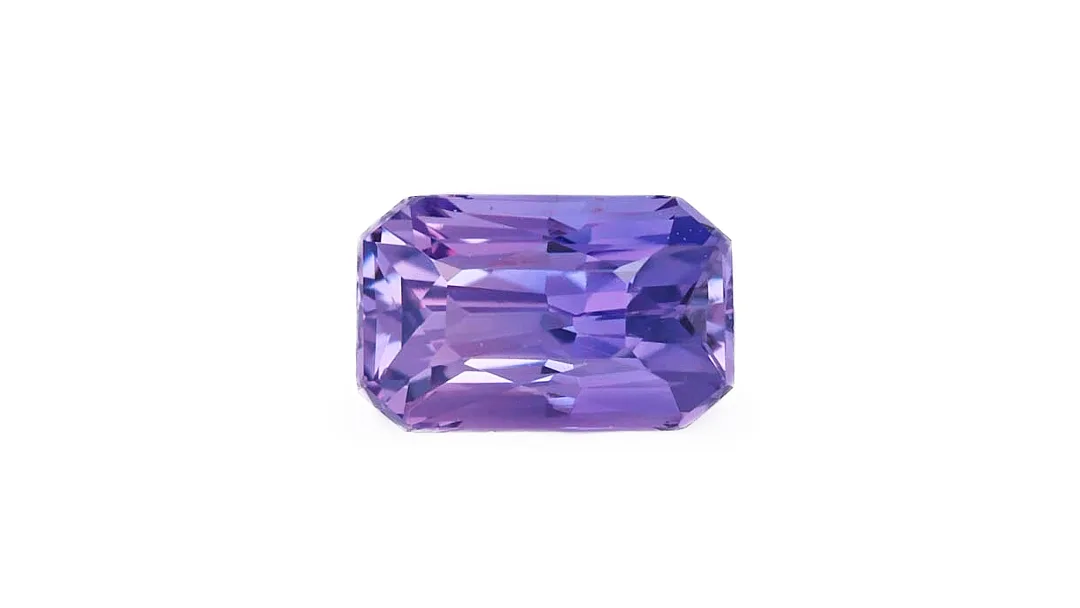
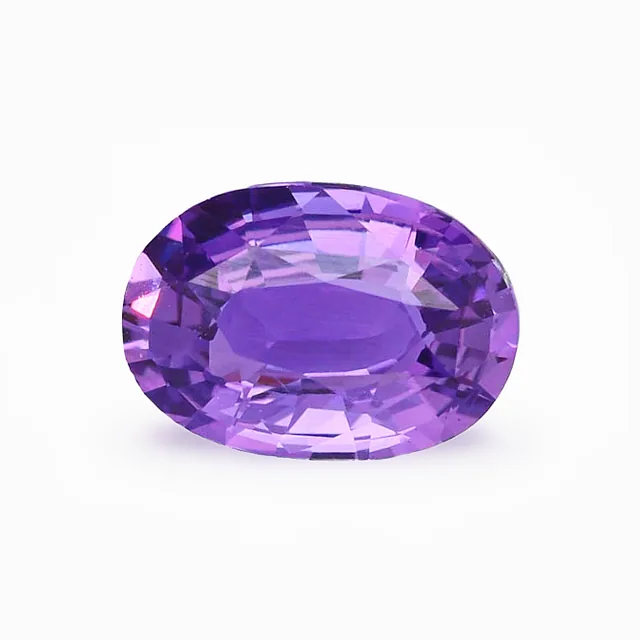
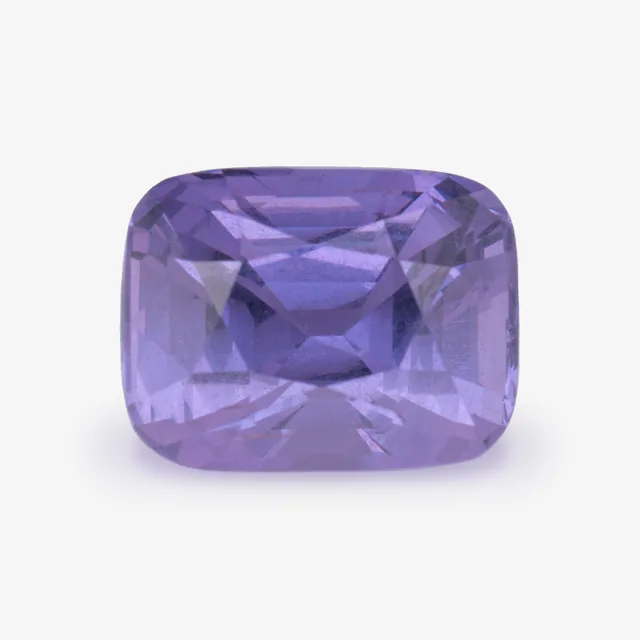
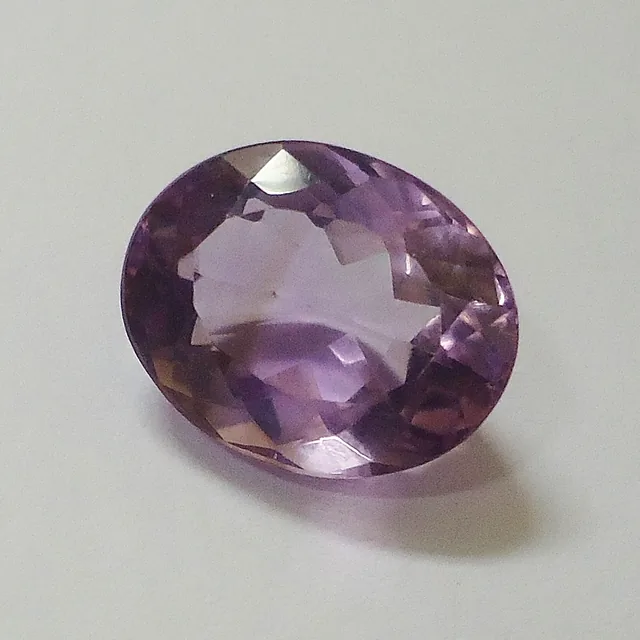
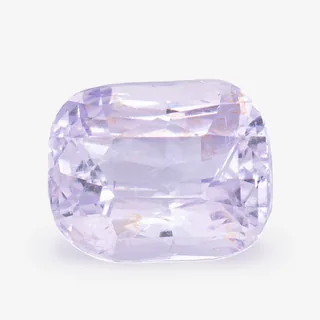
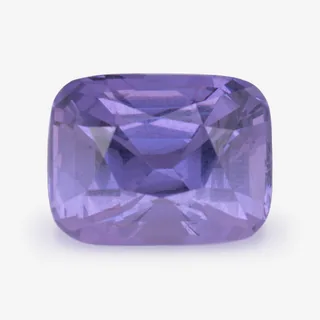
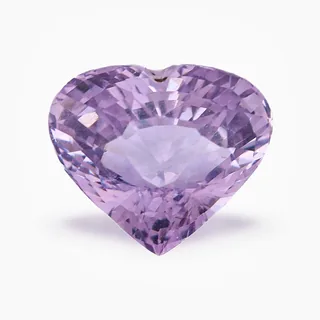
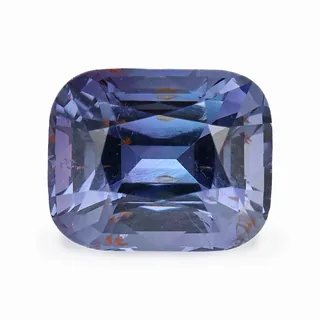
Violet Gemstones: 15 Purple Stones Ranked by Value, Durability and Rarity
A sourcer's ranked guide covering amethyst to purple diamond with real prices and sourcing tips
Quick Answer: What Are the Best Violet Gemstones?

What Makes a Gemstone Violet?
Violet in gemstones comes from a surprisingly small set of chemical actors. In most cases, trace amounts of transition metals absorb specific wavelengths of light and let the purple range pass through to your eye. That's the short version. The longer version involves crystal field theory, and it's worth understanding if you're spending real money on these stones.
Iron (Fe3+) is the main player in amethyst. Per GIA, the purple comes from color centers created when natural irradiation acts on those iron traces in the crystal. Vanadium produces the violet-blue of tanzanite, while chromium and iron together create the purple hues in sapphire. Then you have manganese, which gives kunzite and spinel their pink-violet character.
Here's the thing most guides skip: the same trace element produces wildly different colors depending on the crystal structure around it. Chromium makes rubies red in corundum, emeralds green in beryl, and purple sapphires violet, again in corundum. The host mineral matters as much as the coloring agent.
We see this firsthand when sorting parcels in Ratnapura. Two stones from the same gravel deposit, same coloring element, completely different colors. That's the beauty of it, honestly. Nature doesn't follow our color charts.
The violet spectrum in gemstones runs from pale lavender (think light amethyst or morganite with a violet tint) all the way to deep, saturated plum (fine tanzanite or Siberian amethyst). The most valued shade? A medium-dark purple with flashes of red or blue, depending on the stone. GIA calls this "vivid" saturation, and it commands the highest premiums across nearly every violet gem species.
The 15 Best Violet Gemstones for Jewelry
We've ranked these 15 violet gemstones by a combination of beauty, durability, availability, and value. Not just alphabetically, not by popularity. This ranking comes from handling and selling these stones, not from a textbook: what actually performs well in jewelry and holds its value over time.
1. Amethyst: The Undisputed Queen of Violet
Amethyst sits at the top for one simple reason: it delivers the best combination of beauty, durability, and affordability in the entire violet gemstone world. A 7 on the Mohs scale, excellent clarity in most specimens, and prices that range from $2/ct for commercial grade to $50/ct for top-tier "Deep Siberian" material.
The finest amethysts show a saturated reddish-purple with no visible color zoning. The deepest violet material comes from Zambia and Brazil, where iron content and natural irradiation conditions line up. Sri Lankan amethyst exists too, though it tends toward lighter, more lavender tones.
Let's be honest, amethyst has an image problem. Some people dismiss it because it's affordable. That's a mistake. A well-cut, eye-clean, 10-carat amethyst with vivid saturation is genuinely stunning, and it costs less than a mediocre 1-carat tanzanite. Price doesn't equal beauty.
The February birthstone works in rings, pendants, earrings, you name it. Heat treatment is common (it lightens or shifts color), but untreated stones from Uruguay and Zambia with natural deep color command 3-5x premiums. Always ask your dealer about treatment status.
| Grade | Color | Price/ct | Origin |
|---|---|---|---|
| Commercial | Light lavender | $2-8 | Brazil, Bolivia |
| Fine | Medium purple | $10-25 | Zambia, Uruguay |
| Exceptional | Deep Siberian | $30-50+ | Zambia, Russia |
2. Tanzanite: The Trichroic Violet-Blue Wonder
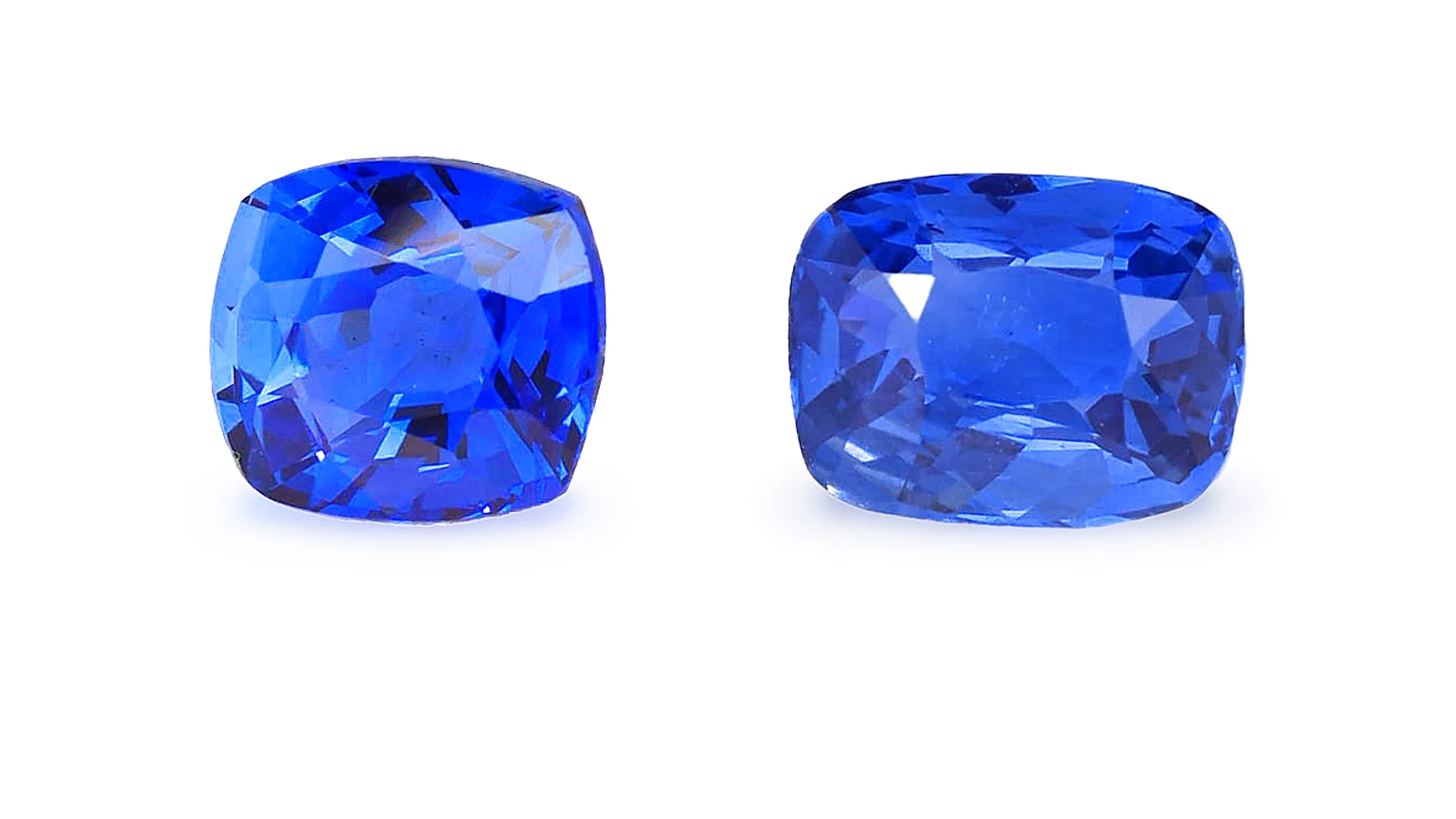
Tanzanite is, gram for gram, one of the most visually dramatic violet gemstones you can buy. It displays three distinct colors simultaneously: violet, blue, and burgundy, an optical property called trichroism. Tilt a fine tanzanite under incandescent light, and you'll see purple. Under daylight, it shifts blue. That dance of color is why Tiffany & Co. gave it a name and a marketing push back in 1968.
The catch? Tanzanite comes from exactly one place on earth: a 4-kilometer strip in the Merelani Hills of Tanzania. That single-source geology makes it roughly 1,000 times rarer than diamond by occurrence. Current mining conditions suggest significant deposits could be exhausted within 20-30 years, which has pushed prices steadily upward since 2020.
A fine tanzanite (3+ carats, vivid violet-blue, eye-clean) runs $300-800/ct in 2026. Smaller stones under 1 carat are more accessible at $100-250/ct. Nearly all tanzanite on the market is heat-treated to shift its natural brownish-purple to that iconic blue-violet. Untreated stones with naturally vivid color are exceptionally rare and carry 50-100% premiums.
Durability is tanzanite's weakness. At 6-6.5 Mohs with one direction of perfect cleavage, it's not ideal for daily-wear rings. We recommend it for pendants, earrings, or occasion rings with protective settings. A bezel mount helps significantly.
3. Purple Sapphire: The Durability King
If you want a violet gemstone you can wear every single day without worrying, purple sapphire is the answer. Corundum scores 9 on the Mohs scale, second only to diamond. No cleavage. Exceptional toughness. It's the gemstone equivalent of building a house on bedrock.
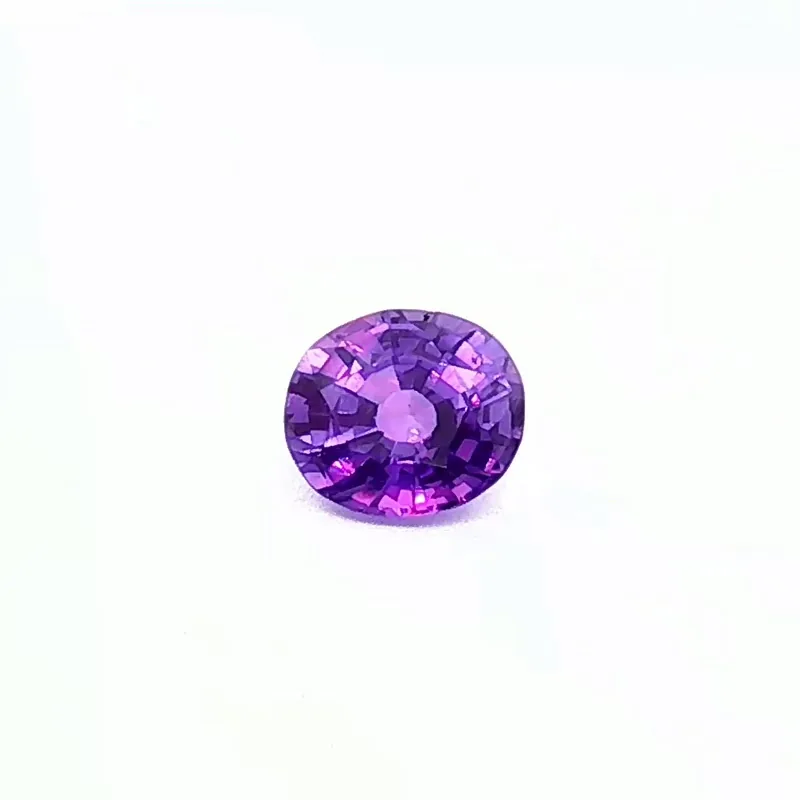
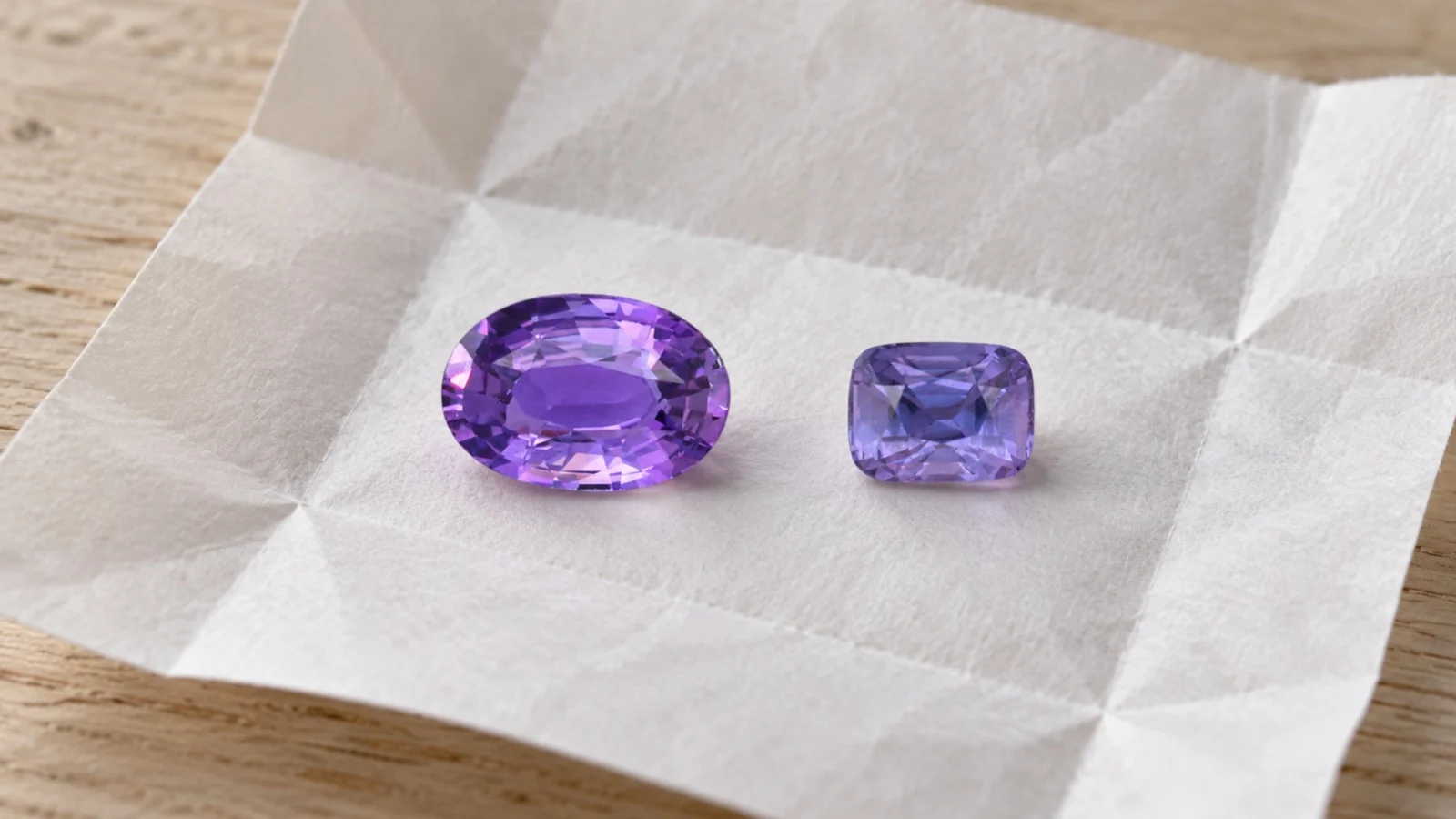
Purple sapphires get their color from a combination of chromium (which pushes toward red) and iron plus titanium (which pushes toward blue). The overlap creates violet. Sri Lanka produces some of the finest purple sapphires we've handled, typically in the 1-3 carat range with excellent transparency. Madagascar and Tanzania also produce quality material.
Prices vary dramatically by saturation and origin. A clean, 1-carat purple sapphire from Sri Lanka with vivid color runs $500-1,500/ct. Larger stones (3+ carats) with strong saturation can reach $2,000-4,000/ct. Compared to blue or pink sapphires of equivalent quality, purple remains undervalued by roughly 30-40%, which makes it one of the smarter buys in the corundum family right now.
In our experience sourcing from Ratnapura, about 8% of the sapphires we see in a given parcel show some degree of purple. Truly fine, vivid purple? Maybe 1-2%. That's rare enough to feel special, common enough to actually find and afford. Heat treatment is widespread, so unheated stones carry a 30-50% premium. Always request a GIA or SSEF report for stones over 1 carat.

4. Purple Spinel: The Most Underrated Violet Gem
If there's one stone on this list that deserves more attention, it's purple spinel. With an 8 on the Mohs scale, no cleavage, excellent brilliance, and the fact that it's never treated, spinel checks every box a serious gemstone buyer should care about.
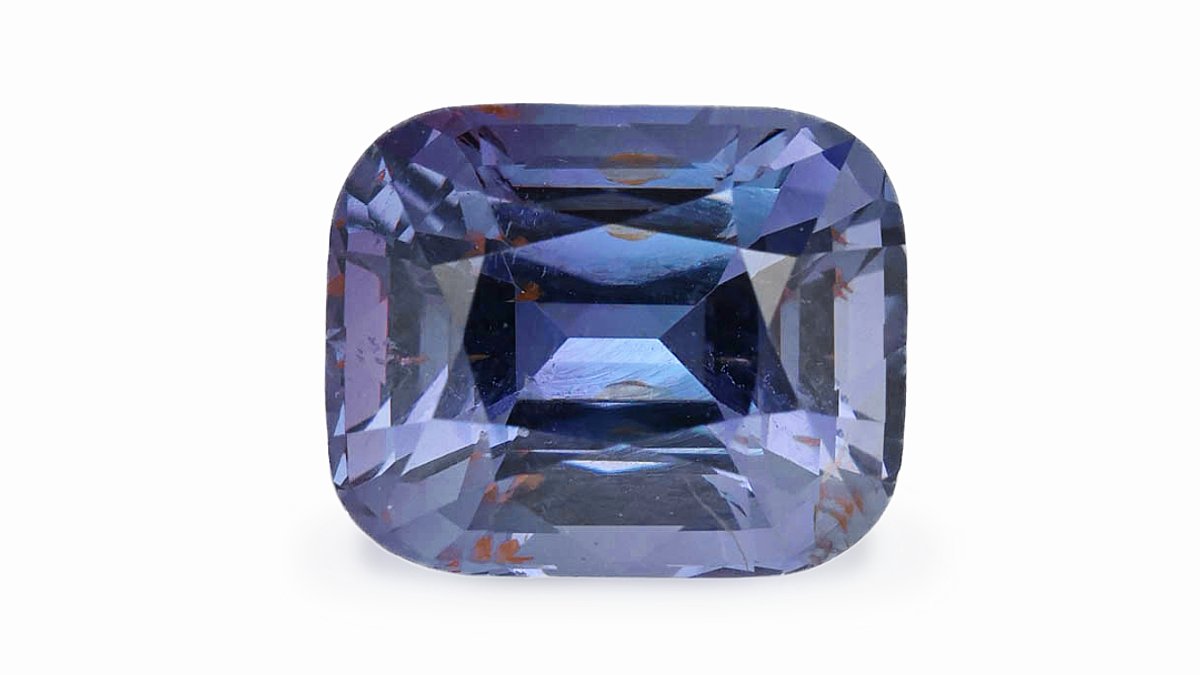
Purple spinel ranges from soft lilac to deep plum, with the finest material showing a vivid, saturated violet without any brownish or grayish overtones. Myanmar (Burma) produces the most sought-after purple spinels, but Sri Lanka and Tanzania also yield beautiful stones. We've seen exceptional lilac spinels from the Mahenge region in Tanzania that rival Burmese material.
Pricing: quality purple spinel runs $200-800/ct for most sizes. Top-tier Burmese stones over 3 carats can push past $1,500/ct. That's a fraction of what you'd pay for a comparable purple sapphire, and spinel arguably has better fire and brilliance thanks to its isotropic crystal structure (it's singly refractive, which means no doubling of facets and a cleaner sparkle).
The market is catching up. Five years ago, purple spinel was practically unknown outside collector circles. Today, it's recognized as the August birthstone alongside peridot, and demand is climbing. We think this stone is still underpriced relative to its quality. If you're looking for a violet gemstone that combines beauty, durability, and value, this is the one to watch.

5. Rhodolite Garnet: Affordable Purple Luxury
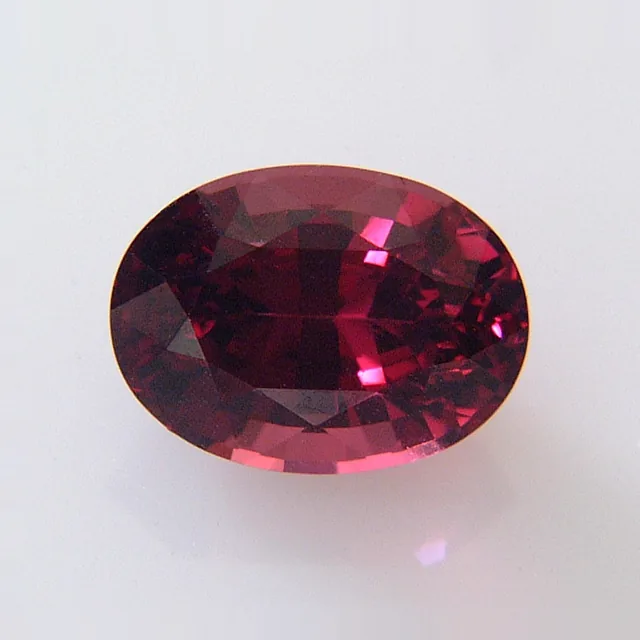
Rhodolite garnet hits a sweet spot between raspberry-pink and grape-purple that's hard to describe and impossible to ignore. It's a natural blend of pyrope and almandine garnet, and the best specimens show a rich, saturated purplish-red that some in the trade call "raspberry."
At 7-7.5 Mohs, rhodolite is durable enough for daily-wear jewelry. It has no cleavage and decent toughness. Price-wise, it's remarkably accessible: $20-100/ct for good quality, with exceptional stones rarely exceeding $300/ct even at larger sizes. Tanzania, Mozambique, and Sri Lanka are the primary sources.
Here's what makes rhodolite special: it never needs treatment. What you see is what nature made. In an industry where heat treatment, diffusion, and irradiation are standard practice, a naturally beautiful, untreated gemstone at this price point is genuinely rare. The color is typically consistent through the stone with minimal zoning, and clarity is usually eye-clean or better.
We've sourced stunning rhodolite from the gem gravels around Ratnapura that rival anything from East Africa. The Sri Lankan material tends toward slightly more purple tones, while Tanzanian rhodolite leans a bit more pink. Both are excellent, just different personalities.

6. Iolite: The Viking's Violet Compass
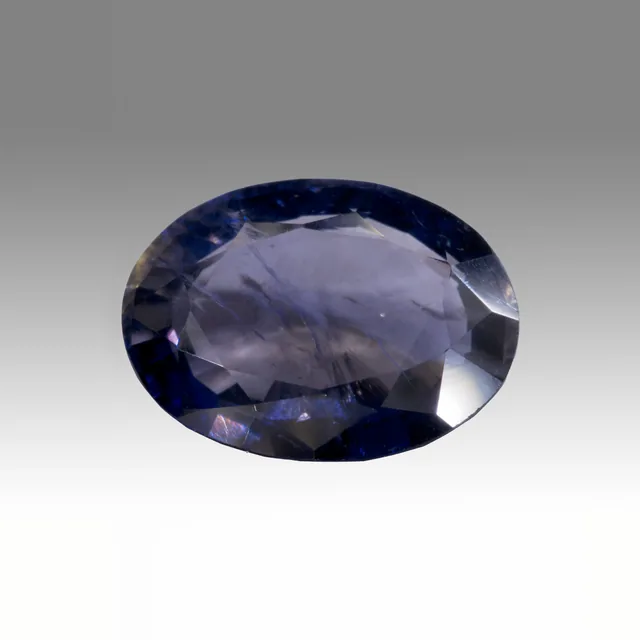
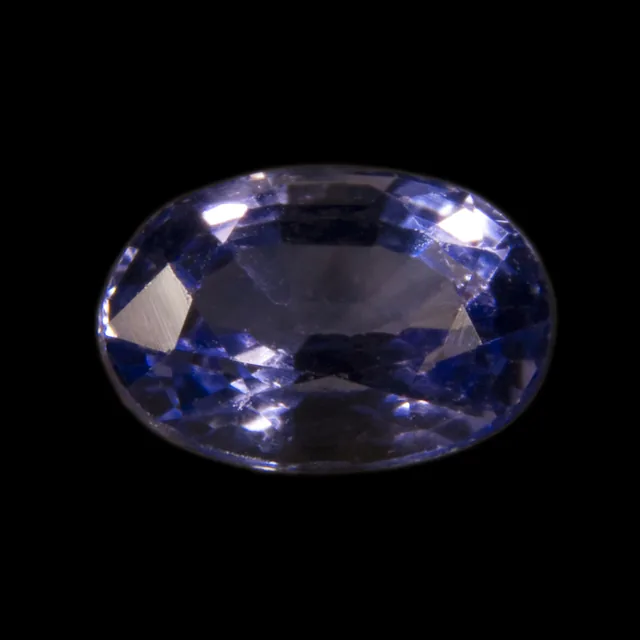
Iolite earns its nickname because Norse seafarers allegedly used thin slices of this stone as a polarizing filter to locate the sun on overcast days. Whether that's history or legend, iolite's optical properties are genuinely remarkable. It's one of the most strongly pleochroic gems in existence, showing violet-blue, gray-yellow, and near-colorless from three different crystal directions.
The best iolites display a rich violet-blue when viewed face-up, with good transparency and minimal gray. Sri Lanka, India, and Madagascar produce gem-quality material. At 7-7.5 Mohs, it's durable enough for most jewelry applications, though it has one direction of fair cleavage that cutters need to respect.
Pricing is extremely accessible: $10-60/ct for good quality, with exceptional stones topping out around $100/ct. That makes iolite one of the most affordable ways to get a violet-blue gemstone that could pass for tanzanite at a distance. In fact, some dealers market it as "water sapphire," though we discourage that practice. Let iolite be iolite. It doesn't need a borrowed name.
One buying tip: orientation matters enormously with iolite. A well-oriented stone shows vivid violet-blue face-up. A poorly cut one looks gray or brownish. Always view the stone from the top before buying, and avoid any specimen that shows significant gray from the face-up position.
7. Purple Tourmaline: The Color Chameleon
Tourmaline comes in virtually every color, but the purple varieties are particularly appealing. They range from raspberry-violet (sometimes called rubellite when red enough) to soft lavender. Per GIA, manganese produces tourmaline's reds and pinks while iron drives the blues; purple stones sit between those two regimes.
At 7-7.5 Mohs with no significant cleavage, purple tourmaline is well-suited for all jewelry types. The price range is broad: $30-200/ct for standard quality, up to $500+/ct for exceptionally vivid, clean stones over 3 carats. Brazil, Mozambique, Nigeria, and Afghanistan produce the best purple tourmaline on the market.
What sets tourmaline apart is the sheer range of purple shades available. You can find cool, bluish-violet specimens, warm reddish-purple stones, and everything in between. Some show strong pleochroism, shifting between purple and pink depending on viewing angle. That variability means you can really dial in the exact shade of violet you want, something that's harder to do with amethyst or tanzanite where the color range is narrower.
One caution: tourmaline commonly receives heat treatment to lighten dark stones or shift brownish-pink material toward a cleaner purple. This is an accepted industry practice, but if untreated material matters to you, request documentation and expect a 20-30% premium.
8. Kunzite: Delicate Violet for Special Occasions
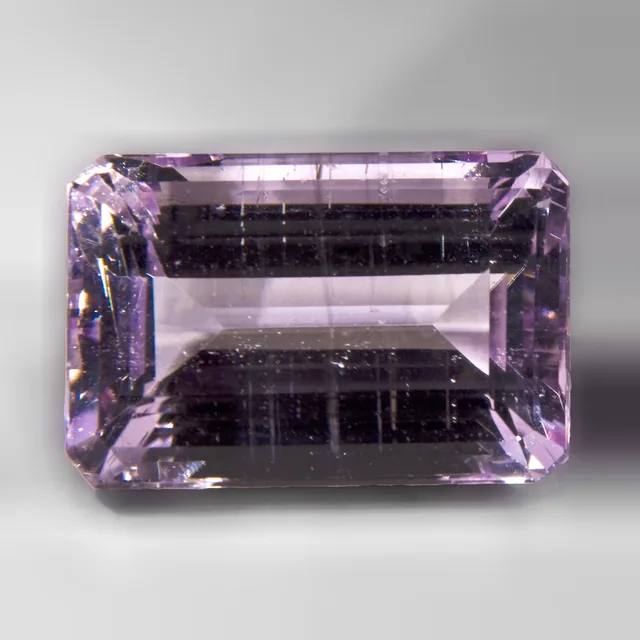
Kunzite is the pink-to-violet variety of spodumene, colored by manganese. When it leans purple rather than pink, it produces some of the most ethereal violet tones in the gemstone world, a soft, glowing lilac that photographs beautifully and catches light in a way that feels almost liquid.
The stones can be large. 10, 20, even 50-carat kunzites exist at reasonable prices ($15-80/ct), because the raw crystals from Afghanistan, Brazil, and Madagascar often form in substantial sizes. That means you can own a seriously impressive violet gemstone for a fraction of what tanzanite or purple sapphire would cost at similar sizes.
But there's a catch: kunzite is fragile by fine gemstone standards. At 6.5-7 Mohs with two directions of perfect cleavage, it can chip if struck at the wrong angle. Even more concerning, some kunzite fades with prolonged exposure to strong light. This isn't universal, but it's a real risk, especially for stones that have been irradiated to deepen their color.
Our recommendation: reserve kunzite for pendants, earrings, and cocktail rings worn occasionally. Don't set it in a daily-wear engagement ring. Store it away from direct sunlight when not being worn. Treated right, kunzite is stunning. Treated carelessly, it's heartbreaking.
9. Charoite: Russia's Violet Swirl
Charoite is instantly recognizable. No other gemstone looks quite like it. Swirling patterns of lavender, violet, lilac, and sometimes black or white create an almost psychedelic appearance that's completely natural. It's found in only one location on earth: along the Chara River in Siberia, Russia.
At 5-6 Mohs, charoite is softer than most gemstones on this list. It's best suited for pendants, earrings, brooches, and statement pieces that won't take daily abuse. When polished, it shows a silky to vitreous luster that enhances those swirling patterns dramatically.
Pricing is moderate and size-dependent: $3-30/ct for cabochon-grade material, with the finest swirled patterns commanding premiums. Charoite is never faceted (it's opaque to translucent), so it's always cut as cabochons, carvings, or beads.
Geopolitical note: since charoite comes exclusively from Russia, supply chains have been impacted by international sanctions since 2022. Available stock is increasingly from pre-sanction inventories, and prices have climbed 40-60% as a result. If you want charoite, buy it now. Supply isn't getting easier.
10. Lavender Jade: The Treasured Asian Violet
When most people hear "jade," they picture green. But lavender jadeite, colored by manganese and iron, produces a delicate violet that's prized in Asian markets, particularly in China, where it symbolizes nobility and grace. Fine lavender jadeite can command prices that rival imperial green in certain grades.
The best lavender jade shows even color distribution, good translucency (what the trade calls "good water"), and a smooth, waxy-to-vitreous polish. Myanmar remains the primary source of gem-quality jadeite, though Guatemala also produces material.
At 6.5-7 Mohs with exceptional toughness (jadeite is one of the toughest natural materials due to its interlocking crystal structure), lavender jade is excellent for bangles, pendants, and carved pieces. Pricing is highly variable: $50-500/ct for good quality, with the finest translucent specimens exceeding $1,000/ct. Be aware that dyeing is extremely common in the jade market. A reputable gemological lab report (HKJSL, GIA, or Gubelin) is essential for any significant purchase.
11. Sugilite: The Vibrant Purple Opaque
Sugilite (also marketed as "Royal Lavulite") is an opaque to translucent gemstone with an intense, saturated purple that's unlike anything else on this list. The finest material shows a uniform, deep violet-purple without the patches of black manganese that lower grades exhibit.
Found primarily in the Wessels Mine in South Africa, gem-quality sugilite has become increasingly scarce since the 1980s when it was first popularized. The mine produces mostly industrial-grade material now, and gem-grade sugilite comes almost entirely from existing stock.
At 5.5-6.5 Mohs, sugilite is suitable for pendants, earrings, and low-impact rings. Prices range from $5-50/ct for standard cabochon material to $100+/ct for the rare, highly translucent "gel sugilite" that glows purple like stained glass. That translucent variety is genuinely magnificent and seriously collectible.
12. Alexandrite: The Violet Color-Shifter
Alexandrite isn't traditionally classified as a violet gemstone, but we include it because the finest specimens shift from green in daylight to a rich violet-red under incandescent light. That dramatic color change, caused by chromium absorption, makes alexandrite one of the most fascinating gems in existence.
The problem? Quality alexandrite is staggeringly expensive. Clean stones over 1 carat with strong color change start at $5,000-15,000/ct, and museum-quality Russian specimens can exceed $70,000/ct. Brazil, Sri Lanka, and Tanzania produce alexandrite, but the Russian material from the Ural Mountains sets the standard.
At 8.5 Mohs (chrysoberyl), alexandrite is extremely durable. If you can afford one, it will outlast you. But most buyers encounter alexandrite only as small accent stones or as lab-created alternatives, which show the same color change at a fraction of the cost ($10-50/ct).
13. Purple Fluorite: The Collector's Showpiece
Purple fluorite produces some of the most vivid, deeply saturated violets in the mineral kingdom. Under UV light, many specimens fluoresce brilliantly (fluorescence was literally named after fluorite). The color comes from rare earth element impurities, and the results can be jaw-dropping.
But fluorite has a deal-breaking flaw for everyday jewelry: it's only 4 on the Mohs scale with four directions of perfect cleavage. A fluorite ring will scratch within weeks and can cleave from a modest impact. This stone belongs in a collection, displayed under good lighting, not on a finger.
That said, fluorite is dirt cheap ($1-10/ct), available in large sizes, and the color quality at its best rivals anything on this list. If you want a violet gemstone to display or to cut yourself as a lapidary project, fluorite is perfect. Just don't set it in a ring and expect it to survive.
14. Taaffeite: The Collector's Holy Grail
Taaffeite is so rare that for decades, every known specimen could fit in a single shoebox. Discovered in 1945 by Richard Taaffe, who noticed something odd about a stone he'd bought as spinel, taaffeite (now technically called "magnesiotaaffeite") is a beryllium magnesium aluminum oxide that's found primarily in Sri Lanka and Myanmar.
The best taaffeites show a delicate lavender-to-violet color with excellent transparency. At 8-8.5 Mohs, it's remarkably durable. The only issue is finding one. Annual production is measured in single digits of gem-quality specimens, and prices start at $2,500/ct, climbing rapidly for stones over 1 carat.
Taaffeite is rare enough that most dealers never knowingly handle one; the odd stone that surfaces in Sri Lankan alluvial parcels usually gets sorted as spinel until a loupe test says otherwise (taaffeite is doubly refractive, spinel is not). If you ever encounter one, buy it. Taaffeite isn't just rare, it's functionally irreplaceable.
15. Purple Diamond: The Ultimate Violet Rarity
Natural purple diamonds sit at the absolute apex of violet gemstones, both in rarity and price. The purple color in diamonds comes from post-growth plastic deformation of the crystal lattice combined with hydrogen absorption, and it's extraordinarily uncommon. The Argyle mine in Australia (now closed) produced most of the world's known purple diamonds.
Prices are stratospheric. A 0.5-carat natural purple diamond with good saturation can sell for $50,000-100,000/ct at auction. The most famous purple diamond, the 7.34-carat "Royal Purple Heart," has been valued at over $4 million. This is a gemstone for serious collectors, royalty, and museums.
For most buyers, a more realistic option is a purple-tinted diamond in the "Faint" to "Light" range, which can be found for $3,000-10,000/ct. Lab-grown purple diamonds are also emerging at $500-2,000/ct, offering the same crystal structure at more accessible prices.
How to Choose the Right Violet Gemstone for You
With 15 options on the table, choosing the right violet gemstone comes down to four factors. Let's break them down.
1. Purpose: Daily Wear vs. Occasional vs. Collection
For daily-wear rings, stick to stones rated 7+ on the Mohs scale with no significant cleavage. That means purple sapphire (9), spinel (8), rhodolite garnet (7.5), tourmaline (7-7.5), or amethyst (7). For occasional wear or pendants/earrings, tanzanite (6.5), iolite (7), and kunzite (6.5-7) work well. For display or collection only: fluorite (4) and charoite (5-6).
2. Budget: What Violet Costs at Every Price Point
Under $50/ct: amethyst, iolite, fluorite, rhodolite garnet. $50-500/ct: purple spinel, tourmaline, kunzite, tanzanite (small). $500-5,000/ct: purple sapphire, fine tanzanite, alexandrite (small). $5,000+/ct: alexandrite (fine), taaffeite, purple diamond.
3. Color Preference: Cool vs. Warm Violet
If you want cool, bluish-violet: tanzanite, iolite, purple sapphire. If you want warm, reddish-violet: rhodolite garnet, rubellite tourmaline, amethyst. If you want neutral, pure purple: spinel, kunzite, sugilite.
4. Treatment Tolerance
If untreated stones matter to you, focus on spinel (never treated), rhodolite garnet (never treated), iolite (never treated), and fluorite (never treated). Most other violet gemstones are commonly treated, which is perfectly fine but should be disclosed and reflected in price.
For a deeper dive into buying loose gemstones for jewelry, our dedicated guide covers the full purchasing process from certification to setting.
Violet Gemstone Prices: What to Expect in 2026
Prices have shifted noticeably over the past two years. Here's the current market as of May 2026, based on wholesale and retail pricing we track across our supply chain.
| Gemstone | Mohs | Price/ct (Good) | Price/ct (Fine) | Trend |
|---|---|---|---|---|
| Amethyst | 7 | $5-15 | $30-50 | Stable |
| Tanzanite | 6.5 | $100-300 | $400-800 | Rising (+12% YoY) |
| Purple Sapphire | 9 | $300-800 | $1,500-4,000 | Rising (+8% YoY) |
| Purple Spinel | 8 | $150-400 | $600-1,500 | Rising fast (+20% YoY) |
| Rhodolite Garnet | 7.5 | $20-60 | $80-300 | Stable |
| Iolite | 7 | $10-30 | $40-100 | Stable |
| Purple Tourmaline | 7.5 | $30-100 | $200-500 | Stable to rising |
| Kunzite | 6.5 | $15-40 | $50-80 | Stable |
| Charoite | 5.5 | $10-30 | $30-60 | Rising (+40% supply squeeze) |
| Lavender Jade | 7 | $50-200 | $300-1,000+ | Rising in Asia |
| Sugilite | 6 | $10-30 | $50-100 | Stable (limited supply) |
| Alexandrite | 8.5 | $1,000-5,000 | $10,000-70,000 | Rising strongly |
| Purple Fluorite | 4 | $1-5 | $5-10 | Stable |
| Taaffeite | 8 | $2,500+ | $5,000-15,000 | Rising (extreme rarity) |
| Purple Diamond | 10 | $10,000+ | $50,000-100,000+ | Rising (Argyle closed) |
The biggest movers in 2026? Purple spinel (demand is outpacing supply), tanzanite (mine depletion fears), and charoite (Russia sanctions). Amethyst and rhodolite remain stable, reliable options for budget-conscious buyers.
Are Violet Gemstones Treated? What You Need to Know
Treatment is a fact of life in the gemstone industry, and violet stones are no exception. Here's the honest breakdown by stone.
Always untreated: Spinel, rhodolite garnet, iolite, charoite, sugilite, fluorite. These stones reach the market in their natural state. If someone offers you "treated spinel," walk away. That's not a thing.
Commonly treated: Tanzanite (heat, nearly universal), amethyst (heat, sometimes irradiation), purple sapphire (heat, standard practice), tourmaline (heat), kunzite (irradiation). These treatments are stable, widely accepted, and should be disclosed but shouldn't scare you off.
Watch out for: Lavender jade (dyeing is epidemic in the market), sugilite imitations (dyed howlite or magnesite), and diffusion-treated purple sapphire (surface color only, the worst form of treatment for sapphire value).
The key rule: always buy from dealers who disclose treatment status and provide lab reports for significant purchases. At Joalys, we report treatment status for every stone we sell, no exceptions.
How to Care for Your Violet Gemstones
Different stones need different care. Here's the practical guide.
Safe for ultrasonic cleaners: Sapphire, spinel, rhodolite garnet, alexandrite. These are tough enough to handle mechanical cleaning without risk.
Warm soapy water only: Amethyst, tourmaline, iolite, tanzanite. These stones can handle gentle cleaning but may be damaged by ultrasonic vibrations, especially if they contain inclusions.
Handle with extra care: Kunzite (avoid prolonged light exposure, store in a dark pouch), fluorite (avoid any impact, display only), charoite (avoid chemicals, wipe with damp cloth).
Universal rules for all violet gemstones: remove rings before manual work, store pieces separately to prevent scratching (diamond earrings will destroy a tanzanite pendant in the same box), and keep kunzite and amethyst away from prolonged sun exposure, as both can fade over time. For a complete care guide, see our article on jewelry care and maintenance.
Where Are Violet Gemstones Found? Mining Origins Mapped
Violet gemstones come from remarkably specific geological environments scattered across the globe. Here's where the major stones are sourced.
Sri Lanka: Purple sapphire, spinel, amethyst, taaffeite, rhodolite garnet, iolite. The gem gravels of Ratnapura (literally "City of Gems") produce an astonishing variety of violet stones from a single alluvial deposit. We've pulled purple sapphires, spinels, and garnets from the same washing on the same day.
Tanzania: Tanzanite (Merelani Hills, exclusive source), rhodolite garnet (Umba Valley), purple spinel (Mahenge), alexandrite (Tunduru). East Africa is arguably the most important violet gemstone region in the world right now.
Brazil: Amethyst (Rio Grande do Sul, the world's largest producer), kunzite (Minas Gerais), tourmaline (Paraiba state). Brazilian amethyst floods the market and keeps prices accessible.
Russia: Charoite (Sakha Republic, sole source), alexandrite (Ural Mountains, historic source, now nearly depleted), amethyst (Siberia, the famous "Siberian" grade). Russian sources face ongoing supply chain challenges.
Myanmar: Spinel (Mogok, the finest), lavender jadeite (Kachin State), ruby and sapphire (including rare purple specimens). Myanmar produces the world's most prized spinels.
Madagascar: Purple sapphire, iolite, kunzite, rhodolite garnet. A relatively new source that has rapidly become one of the top producers of gem-quality violet material.
Understanding origin matters because it directly affects value. A Burmese purple spinel commands higher prices than an equivalent-looking stone from Sri Lanka, partly due to market perception and partly due to genuine differences in color quality. Similarly, "Siberian" amethyst from Russia carries premiums over Brazilian material, though the actual color difference is often minimal to trained eyes.
Violet Gemstones in Engagement Rings: Are They Practical?
Short answer: some are, some aren't. Here's the honest assessment from someone who's seen hundreds of gemstone engagement rings come back for repair.
Excellent choices: Purple sapphire (9 Mohs, bombproof), alexandrite (8.5, expensive but indestructible), purple spinel (8, excellent all-around).
Good with caveats: Rhodolite garnet (7.5, needs a protective setting), amethyst (7, will show wear after 5-10 years of daily use), purple tourmaline (7-7.5, similar to amethyst).
Not recommended for daily wear: Tanzanite (6.5, cleavage risk), kunzite (6.5, cleavage and fading), iolite (7, but cleavage in one direction), fluorite (4, absolutely not).
If you're set on a violet engagement ring, purple sapphire is the safest bet. It gives you lifelong durability, a unique color that stands out from the crowd, and it costs significantly less than a comparable-quality blue sapphire. We mount purple sapphires in both bezel and prong settings for engagement rings, and the results are consistently stunning.
For more ring options, explore our full engagement ring guide covering every gemstone and setting style.
JOALYS
Everything Begins with the Stone
One stone, chosen by hand at the source. The piece comes afterwards.
Keep the gemstone loose, or commission a piece made around it — made to order, never off the shelf.
Frequently Asked Questions
Our Take on Violet Gemstones
The violet gemstone market offers something for every buyer, from $5/ct amethyst to six-figure purple diamonds. If we had to pick just three for 2026? Purple sapphire for engagement rings (unbeatable durability), purple spinel for the one the market has not caught up with yet, and amethyst for anyone who wants beautiful violet without overspending.
We source violet gemstones directly from Sri Lanka, and what strikes us every time is how each stone has its own personality. Two purple sapphires from the same parcel can tell completely different stories. That's why we always recommend seeing a stone before buying, or at minimum, purchasing from a dealer who provides detailed photography, video, and independent certification.
Whatever violet gemstone catches your eye, buy the color that moves you. That's the only rule that actually matters.