Pear Cut Bow Tie Effect: How to Spot One Before You Buy
Ratio, bow tie, karat and the sapphire question, answered by the sourcer who buys the rough in Ratnapura rather than by the shop trying to sell you the setting.

What Is a Pear Engagement Ring in Gold, Exactly?
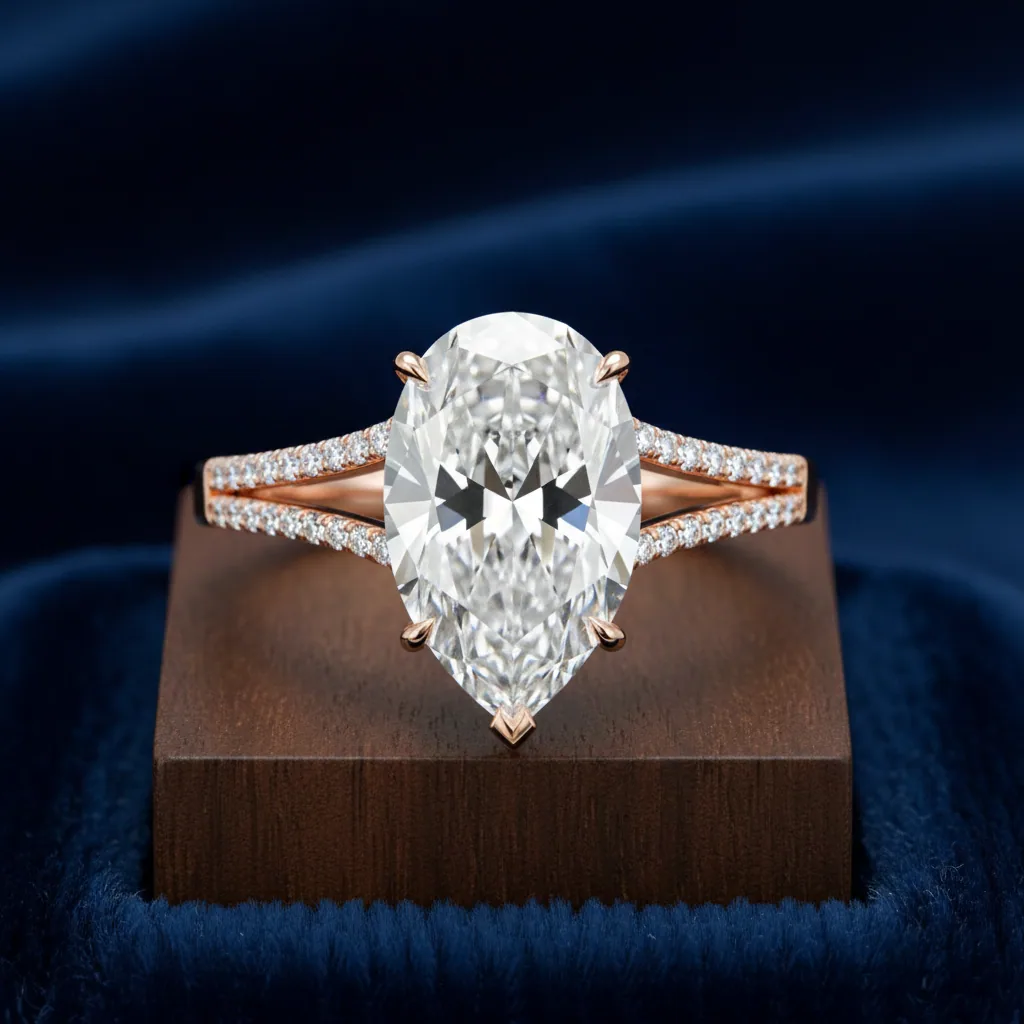
A pear engagement ring marries a teardrop shaped center stone to a band of gold. The cut is a hybrid, half round brilliant on the wide end, half marquise pointing toward your fingertip. According to historical jewelry records, the pear was first cut by Flemish polisher Lodewyk van Bercken around 1475, which makes it one of the oldest fancy shapes still in production.
The shape gives you a few things at once: more surface area than a round of equal weight, a finger-elongating effect, and a silhouette nobody mistakes for anything else. Set in gold, especially warm 18k yellow, the pear reads as both vintage and modern depending on how you build the rest of the ring.
People sometimes call it a teardrop ring, which is the same thing. Some jewelers, including our setting bench, prefer the term pear because teardrop biases buyers toward sadness rather than the lift the cut actually creates on the hand.
Pear Cut Bow Tie Effect: What It Is and How to Spot One
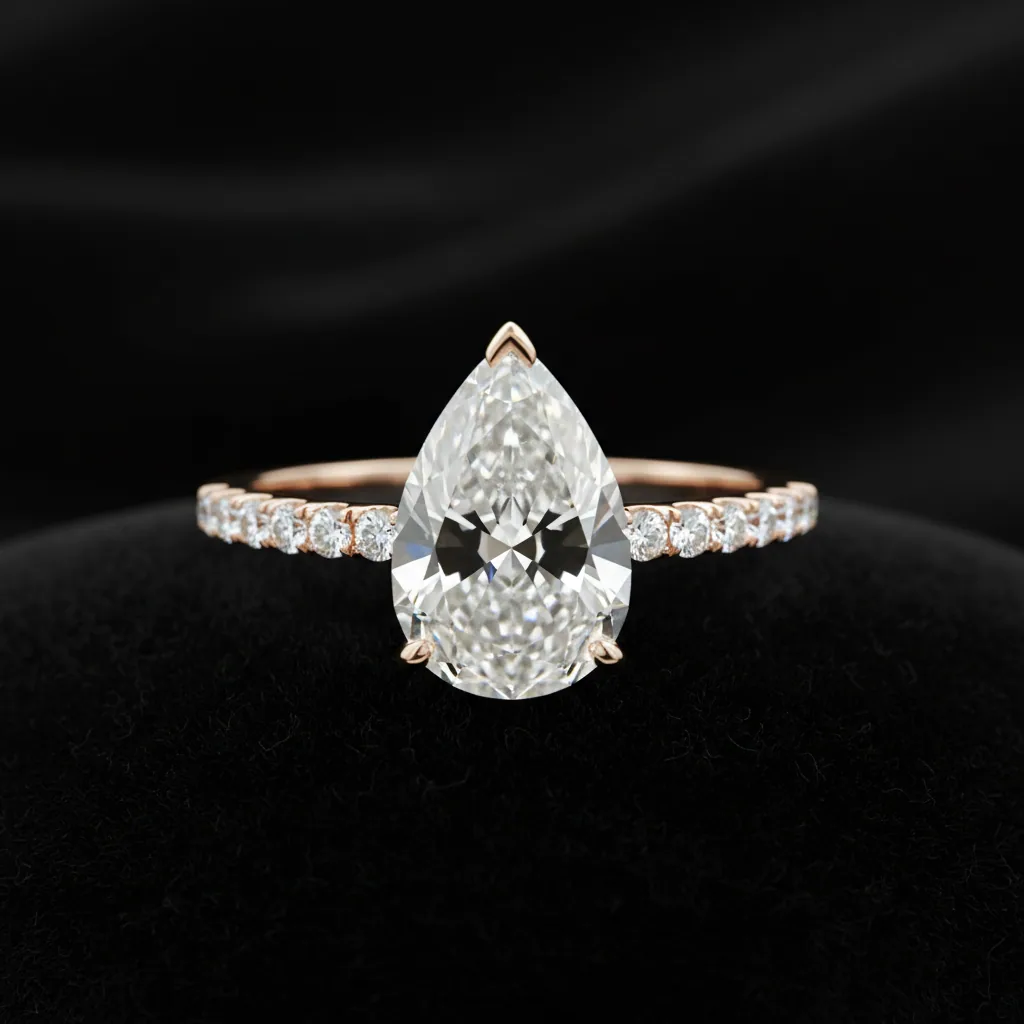
Hold any pear cut face up under good light. If a dark horizontal band runs across the middle and reads like a black bow tie, that is the effect. GIA defines it plainly: a bow tie is "a dark area across the center of an elongated brilliant cut", and per GIA many marquises, pears and ovals show one. It is not damage, and it is not an inclusion. It comes from pavilion angle variation, the pavilion facets throwing light out of the bottom of the stone instead of back at your eye.
So every pear shows some bow tie. The question is how aggressive it is. A subtle one that fades when you tilt the stone is fine. One so dark it stays visible from across the room is a no-go.
Here is the part that catches buyers out: there is no cut grade on a pear report to hide behind. GIA's cut grading system "applies only to colorless or near-colorless round brilliant cut diamonds. For other shapes and fancy colors, 'na' (not applicable) is indicated." Pear, marquise, oval, heart: cut grade reads not applicable. GIA graders do look at the bow tie when they assess a fancy cut's pavilion, but that judgement never lands on the report as a score. On a fancy shape, your eyes are the grading system.
Three quick checks before you buy:
- Video first, photo second. Ask for a 360 video. Photos hide bow tie. Video reveals it the moment the camera moves.
- Watch the symmetry. If one shoulder of the pear is fuller than the other, the bow tie usually gets worse. Symmetry deviations of more than 2-3% are visible to the naked eye.
- Look at the table size. Pears with tables above 65% tend to show stronger bow ties. A 58-62% table is usually safer.
The 30-second bow tie check
The version you can run in a shop, in half a minute:
| What you check | Green light | Walk away |
|---|---|---|
| Table facet size | 58 to 62% | Above 65% |
| Symmetry deviation | Under 2% | More than 2 to 3%, visible to the naked eye |
| How you view the stone | 360 video, stone in motion | Still photo only |
| Bow tie when you tilt it | Fades or breaks up | Stays dark from across the room |
| Cut grade on the report | Not applicable on any fancy shape, so judge with your eyes | Relying on a grade that pear reports never carry |
| Pavilion depth, sapphire only | Deep enough for colour, light still returns | Cut deep to darken pale rough |
One trap only bites on colored stones. In a sapphire, pavilion depth is a color lever and not just a light lever: GIA notes that Sri Lankan sapphires "might be cut deep to darken their appearance", because a lot of Ceylon rough comes out of the ground pale. Cutting deep to hold color and cutting deep enough to throw a bow tie are the same geometry. On a pear sapphire you are therefore reading two things at once, saturation and light return, and a cutter who chased the first can hand you the second.
Honestly, we have turned down pears with otherwise perfect specs because the bow tie killed them. A 1.20 ct G VS1 with a heavy bow tie reads worse than a 1.00 ct H VS2 with a clean center. Specs lie. Eyes do not.
Why Pair a Pear Cut With Gold Specifically?
Three reasons we like the pair, in order of how often we explain them to clients.
The shape benefits from warmth. The pear concentrates color in its pointed tip. In a colorless diamond, that means any tint shows there first. A yellow gold setting masks faint J to L color grades that would look obvious in white metal, and you can drop two color grades down without losing visual quality. That saves you 15 to 25% on a stone of similar size.
Gold sells the silhouette. Yellow gold has been climbing fast: requests are up roughly 40% year over year heading into 2026 (Mohana Jewels, 2026). The metal frames the pear's curve in a way that platinum often does not. White gold and rose gold work too, but the pairing with warm 18k pulls the cut into the spotlight.
Gold can be repaired. A pear's pointed tip is the most vulnerable element of the ring, and the prong protecting it will need attention every five to seven years. Gold welds, polishes, and re-tips easily on the bench. Platinum is harder to service in most workshops outside of Paris and New York.
What Length-to-Width Ratio Makes a Pear Look Best?
This is the single most important number when shopping a pear. Length divided by width tells you whether the stone reads round and squat or long and slender.
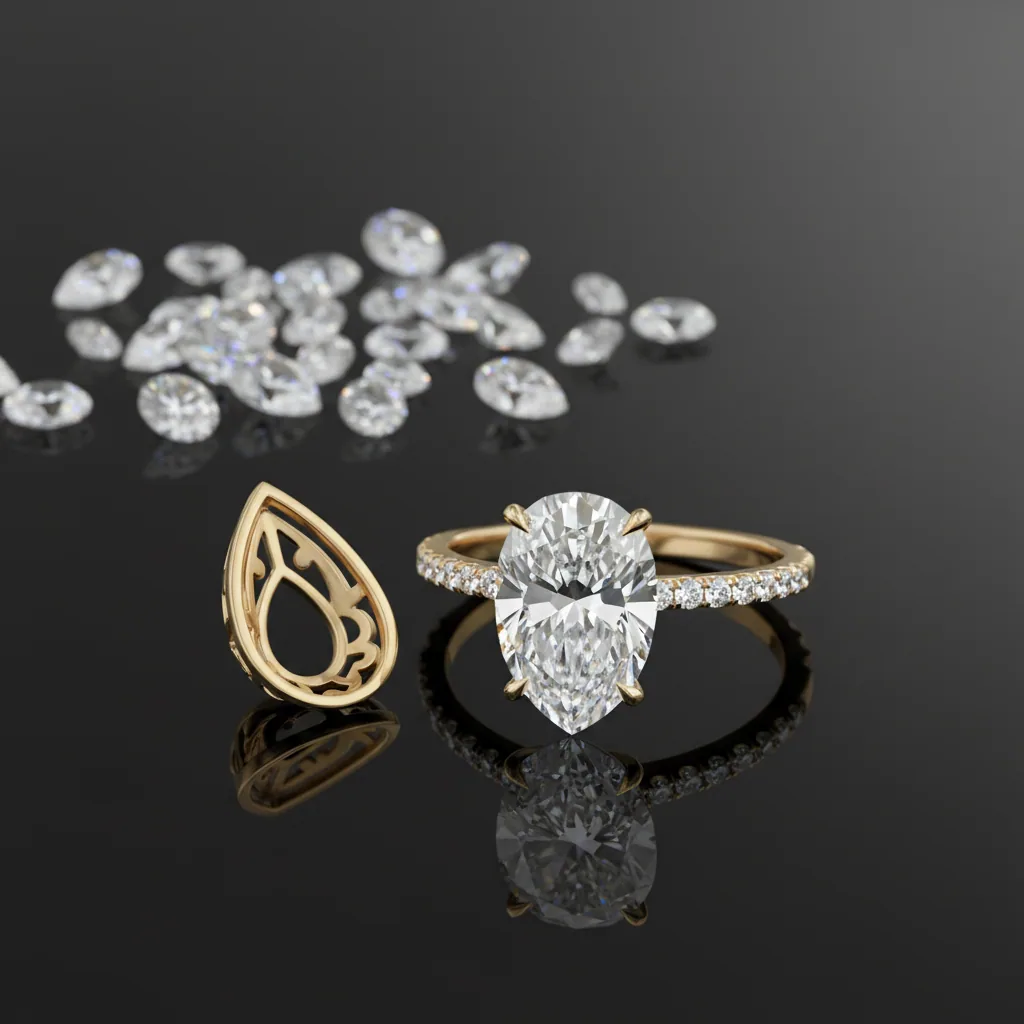
The sweet spot most cutters target is 1.50 to 1.65. Below 1.45 the stone looks like a deformed round and the curves at the shoulder go flat. Above 1.75 the pear starts looking like a marquise that lost a fight. Anything between 1.50 and 1.65 reads classic, which is what most setting designs assume.
That said, finger shape matters. We have watched 1.70 ratio pears go onto long elegant fingers and look spectacular. We have seen 1.45 pears on shorter fingers read as deliberate, almost antique. The point is to ask your jeweler to put the stone on your finger before committing, or at the very least to send measured tracings. Numbers on a certificate do not replace seeing the curve in real light.
One thing nobody tells you: a pear cut to maximize carat weight will usually fall outside this ratio range. When a cutter ignores ideal proportions to squeeze out an extra 0.05 ct, you get a wider, less elegant stone. That trade-off shows up later when the ring goes on the finger and looks heavier than its actual carat suggests. Cut for jewelry first, weight second.
Sapphire vs Diamond for a Pear Engagement Ring: What You Actually Gain
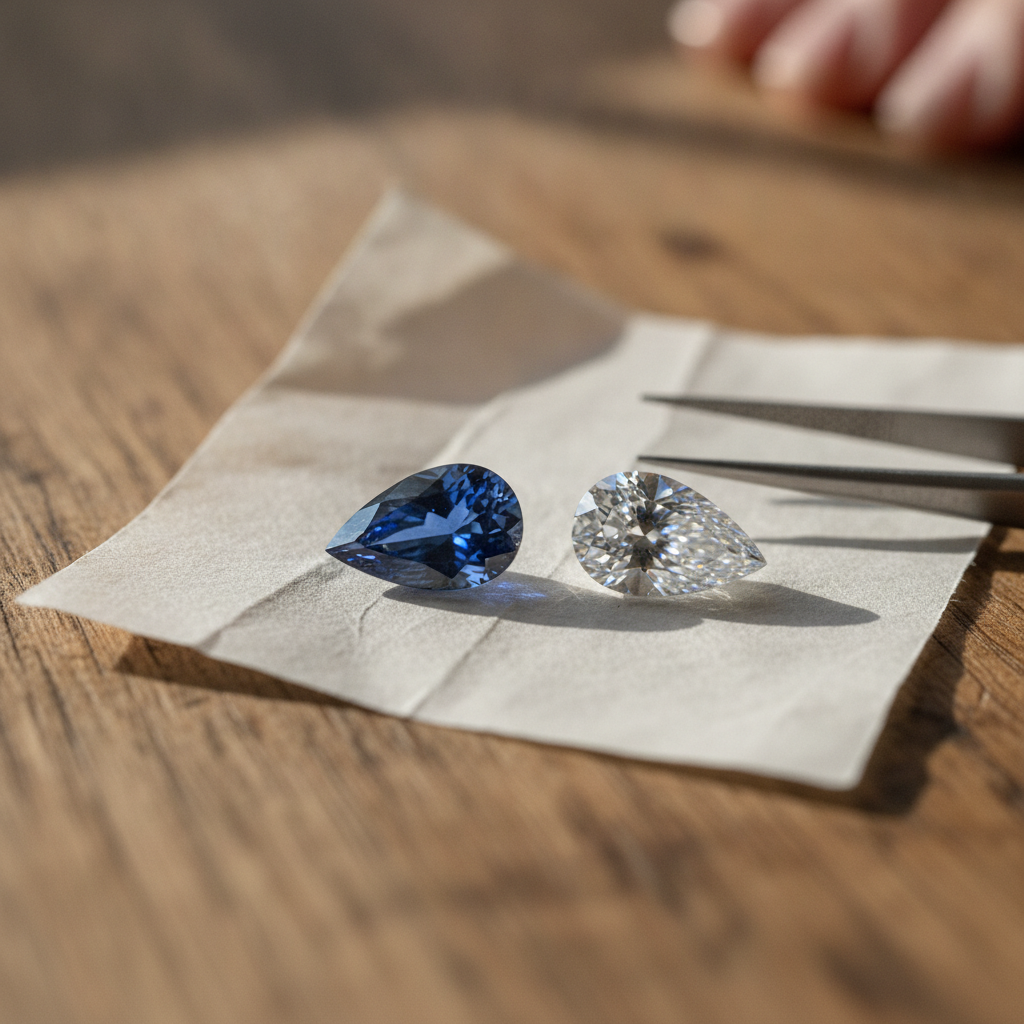
Here is an angle most engagement ring guides skip, and we think it matters. Most of the truly memorable pear engagement rings I have seen in the last two years were not diamonds. They were sapphires from Sri Lanka, set in 18k yellow gold.
JOALYS Expert Insight
Years sourcing on the ground in Ratnapura taught me something the trade does not advertise: pear cuts in colored stones are scarce. Cutters fear them. The pointed tip costs more rough, and you need depth to keep the brilliance high. So when a tailleur agrees to cut a Ceylon sapphire as a pear, you know two things: the rough was clean, and the cutter trusted the stone enough to risk the tip. That is the geometry of patience. Pear is the cut that rewards the patient cutter.
According to GIA reference data, sapphire scores 9 on the Mohs hardness scale, just below diamond's 10 [GCS · ch.03 · p.36]. That makes it one of the few colored stones GIA explicitly recommends for daily ring wear, alongside ruby: "Ruby and sapphire have a hardness of 9 on the Mohs scale, and make excellent ring stones" [GCS · ch.03 · p.36]. One step on Mohs sounds small, and because the scale is ordinal rather than linear, diamond is a good deal harder than sapphire in absolute terms. On the ground, though, sapphire stands up to daily wear in a way that emerald, with its inclusions and treatments, cannot.
What you get with a pear Ceylon sapphire in 18k yellow gold:
- Color that ranges from cornflower blue to royal blue, with the rare padparadscha and pink variants pulling premium prices
- Better value per carat: a 2 ct pear Ceylon sapphire in gold often costs 30-50% of the equivalent diamond ring
- A finger that nobody else in the room has
- No fluorescence anxiety, no D color obsession, no "is this really worth it" doubt three years in
This is what we mean when we say the pear belongs in colored stones first. The cut was made for stones with personality, not for stones that have to prove themselves with paperwork.
For a deeper look at Ceylon sapphire colors and how to read a sapphire certificate, our cornflower vs royal blue sapphire guide and complete sapphire reference go further.
14k vs 18k Gold for a Pear Ring: Which Should You Pick?
The honest answer: it depends on what your hands do for a living.
14k gold contains 58.3% pure gold by weight, alloyed with copper, silver, and zinc (Brilliant Earth, 2026). That extra alloy makes it harder, more scratch resistant, and roughly 43% more dent resistant than 18k under controlled testing. It is what 90% of US engagement rings use because most people do not realize how much they bang their ring on doors, keyboards, and steering wheels in an average week.
18k gold contains 75% pure gold, which gives it that deeper, richer warmth that buyers notice the second the box opens. The catch: it is softer. On the Mohs scale, 18k sits around 2.5 to 3 versus 14k at 3.5 to 4. You will see more surface scratches over five years, though those polish out easily.
Head to head, the two alloys that matter:
| 14k gold | 18k gold | |
|---|---|---|
| Pure gold content | 58.3% | 75% |
| Mohs hardness | 3.5 to 4 | 2.5 to 3 |
| Dent resistance | About 43% better | Baseline |
| Colour | Lighter, cooler yellow | Deeper, richer yellow |
| Band cost | Saves 8 to 12% | Baseline |
| Alloy load (nickel exposure) | More alloy | Less alloy |
| Best for | Hands-on daily wear | Maximum colour, sensitive skin |
Quick decision framework:
| If you... | Choose |
|---|---|
| Work with your hands daily (chef, surgeon, carpenter, gym) | 14k |
| Want maximum warmth and color saturation | 18k |
| Have a budget ceiling and want a larger center stone | 14k (saves 8-12% on band cost) |
| Plan to wear the ring as an heirloom, not daily | 18k |
| Have sensitive skin or react to nickel | 18k (less alloy) |
For pear engagement rings specifically, we slightly favor 18k. The pear's silhouette deserves the deeper gold warmth, and a properly built band with a thicker shank profile holds up fine even at 75% gold. If you go 18k, ask the bench to make the shank slightly heavier than standard so the softer alloy has more metal to work with.
Here is the part that is specific to this cut, and it is why the generic karat advice only gets you halfway. A pear concentrates its risk on one point, literally. The tip is the thinnest part of the stone and it sits inside a V-prong, so that small piece of metal takes knocks that a round would spread around its girdle. Softer metal gives first: at 2.5 to 3 on Mohs, an 18k V-prong opens up sooner than the same prong in 14k at 3.5 to 4. That is not an argument against 18k, we still lean that way for a pear, but it does mean asking the bench for a slightly heavier V-prong and having it checked once a year. Ask before the ring is made, not after the stone has shifted.
One number trips people up when they compare quotes. 14k works out to 58.3% gold, which is 14 parts in 24, and you will see that same alloy stamped 585 for the 58.5% fineness standard used across Europe. Same metal, two numbers, no trick. For the full purity ladder from 10k to 24k and how to read the hallmarks, our gold ring guide covers it properly.
Which Setting Protects and Flatters a Pear Best?
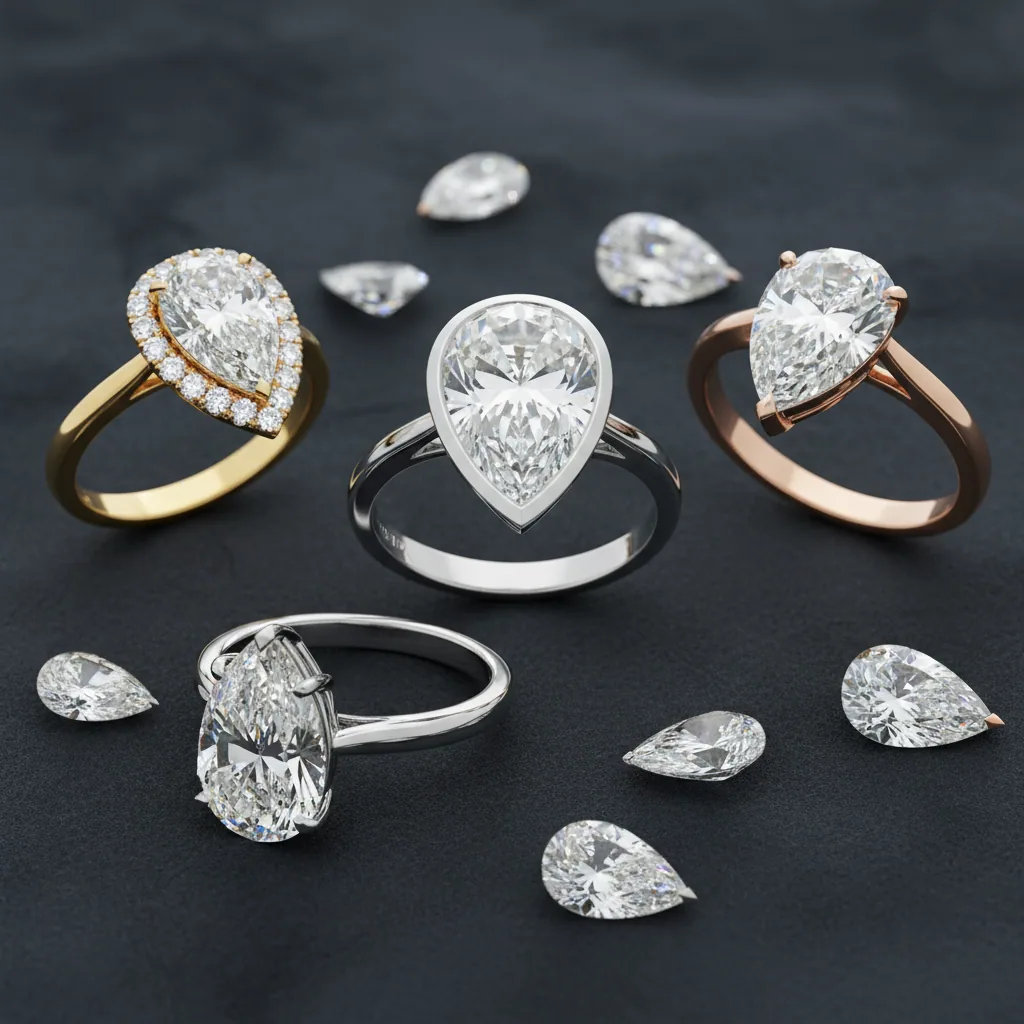
Setting choice does two jobs at once. It protects the pointed tip from chipping, and it tells the rest of the design what story to tell.
V-prong solitaire. The default for a reason. A V-shaped metal claw wraps the pointed tip and shields it from the most common damage, which is the tip catching on fabric and the prong bending outward. GIA's own setting documentation recommends V-prongs for any cut with a pointed corner. Five prong configurations (one V on the tip, two on each shoulder) are standard.
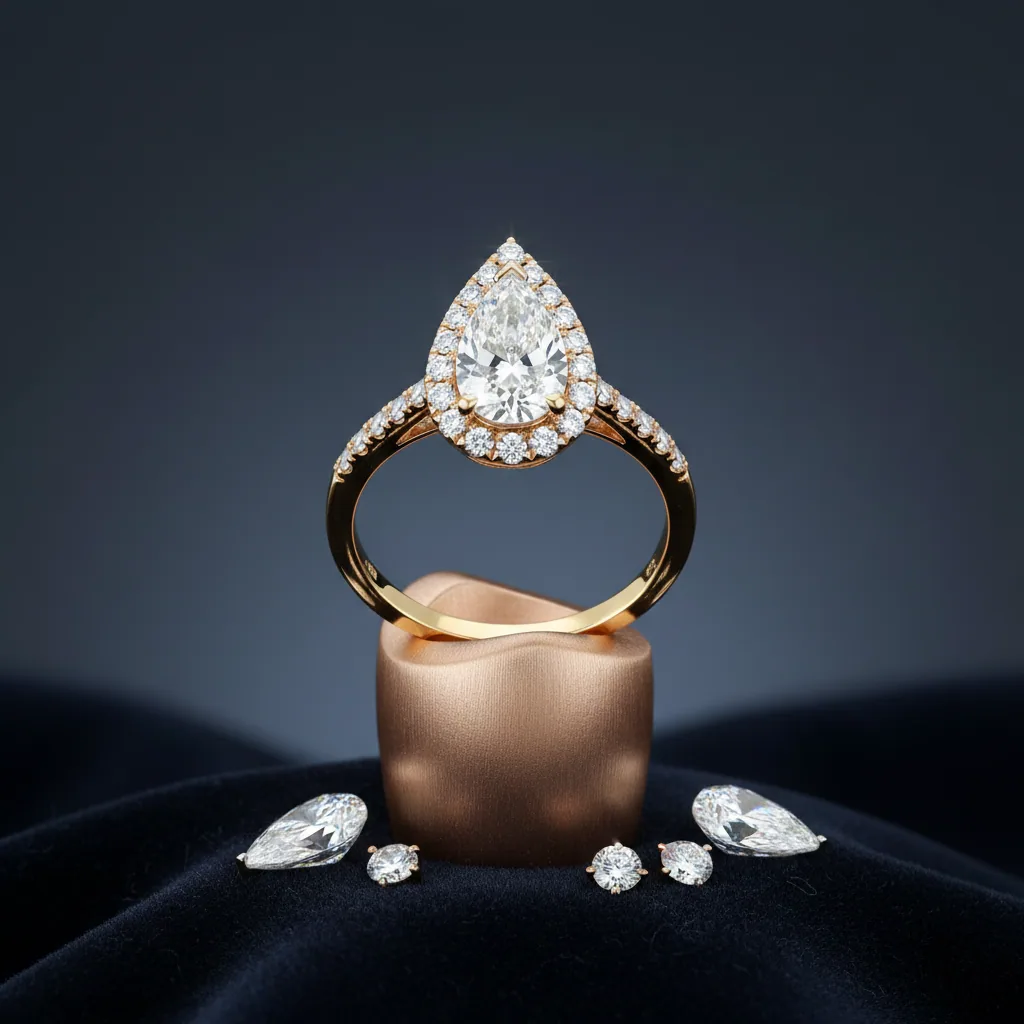
Halo. A ring of small diamonds or sapphires around the center stone makes the pear look 20 to 30% larger, hides minor color inconsistencies, and gives you visual mass without a bigger center stone. Ariana Grande's 3.03 carat pear from 2018 was set this way. If you want presence without the carat weight bill, this is the route.
Three stone (trilogy). Pear center, two side stones, usually trillions, pears, or rounds. Reads as more substantial. Works well if you want a statement piece without halo busy-ness. Cardi B's 8 carat pear is a double-halo version of this idea.
Bezel. A continuous gold rim around the entire stone. Maximum protection. Modern and minimalist. The trade-off: you cover more of the stone than a prong setting, which slightly reduces light return.
Split shank. The band splits as it approaches the center stone, giving the pear more visual real estate. Looks especially good with a pear oriented point-up.
Which way should the pear face? Most people wear it tip pointing toward the fingernail. We agree with this for one practical reason: the tip is then the highest point of the ring, which means when your hand brushes against something, the round shoulder takes the hit instead of the fragile point. The tip lasts longer this way. For more on classic ring shapes, our engagement ring styles guide covers the wider design vocabulary.
What Color and Clarity Grades Do You Actually Need?
The pear cut is the diva of the fancy shapes when it comes to color. The pointed tip concentrates whatever tint exists in the stone, so a color flaw that hides in a round cut shouts in a pear.
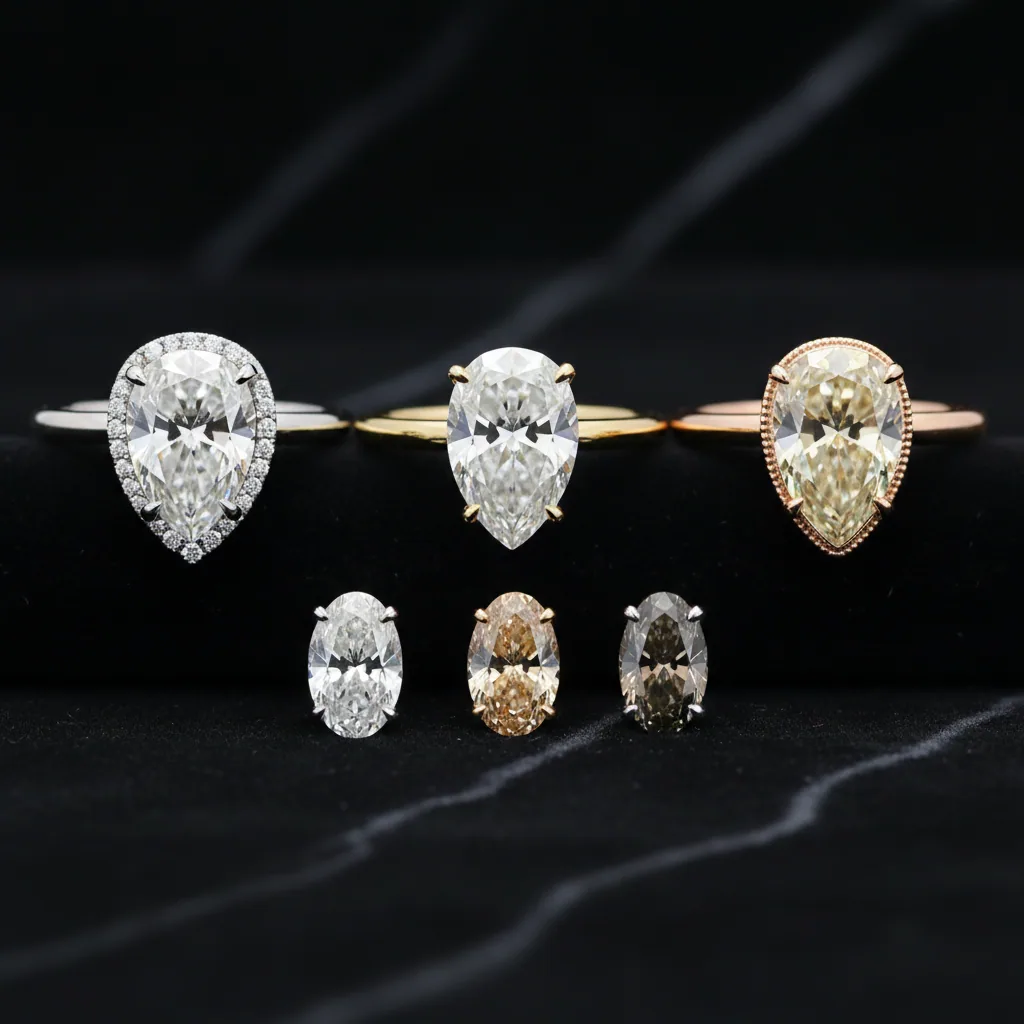
For a pear diamond in yellow gold: H to J color reads as bright. The yellow setting cancels minor warmth in the stone, so you can drop two grades from what a platinum ring requires. You save real money without the eye noticing.
For a pear diamond in white gold: Stay G or better. The cold metal amplifies any tint, especially at the tip.
For a pear sapphire: Color is not graded the same way. You want a saturation that is rich but not too dark to lose its blue at the tip. Ceylon sapphires from Ratnapura tend toward medium tone with high saturation, which is exactly the profile that holds up beautifully in a pear cut.
On clarity, eye-clean is the target. That means VS2 or better for diamonds in most cases. Anything below SI1 risks visible inclusions at the wide end. For sapphires, minor silk inclusions are normal and often confirm natural origin, but visible black or large white feathers will pull value down.
What Does a Pear Engagement Ring in Gold Actually Cost?
Real numbers, May 2026, GIA certified center stones, mid-grade clarity and color:
| Stone | Center weight | Setting | Approximate price USD |
|---|---|---|---|
| Pear diamond, G VS2 | 1.00 ct | 18k yellow solitaire | $5,500 to $7,500 |
| Pear diamond, G VS2 | 2.00 ct | 18k yellow solitaire | $15,000 to $24,000 |
| Pear Ceylon sapphire | 1.50 ct | 18k yellow solitaire | $2,200 to $4,800 |
| Pear Ceylon sapphire | 2.50 ct | 18k yellow halo | $5,800 to $9,500 |
| Pear lab grown diamond | 2.00 ct | 14k yellow halo | $2,800 to $4,200 |
Three quick notes on these numbers:
First, pear diamonds cost roughly 20-40% less per carat than rounds of equivalent quality, because the cut leaves less waste from the rough crystal (Diamond Mansion, 2026). The pear is one of the highest yield diamond cuts, and the savings get passed to you.
Second, sapphire pricing is notoriously opaque. A 2 ct Ceylon sapphire from a Bangkok wholesaler with no certificate might sell for $1,500 to a retailer who marks it up to $5,000 at the store. The same stone sourced direct from Ratnapura with GIA certification and a transparent chain runs closer to $3,000 to $3,500 retail and is provably natural. The chain matters more than the geography.
Third, lab grown diamonds are the cheapest path to a large pear. Prices have dropped 70% since 2020 and continue to fall. The trade-off is that resale value is essentially zero. For an engagement ring you plan to keep, that may not matter, but go in with eyes open.
Five Mistakes We See Couples Make With Pear Rings
From the questions we get in DMs and at the Joalys workshop, here are the avoidable errors:
- Buying from a photo alone. Pear cuts hide their flaws in stills. A bow tie that does not show in the listing photo will own your finger in real light. Always ask for video.
- Going below 1.45 length-to-width. The stone looks deformed. Even budget pears cut in this range are a step down. Insist on the 1.50 to 1.65 range minimum.
- Skipping the V-prong. We re-tip more chipped pears than any other shape. If the listing does not specify a V-prong on the point, walk away or budget for a remake within the first year.
- Picking yellow gold for the wrong reason. Yellow gold flatters warmer-tinted stones and earthy hues. If you have a pear diamond at D or E color and you want the icy look, white gold or platinum is the right call. Buying yellow gold because it is trending is a 30-year regret.
- Ignoring the side profile. A pear can look perfect from above and reveal a flat, depthless profile from the side. Check the height of the crown and the depth of the pavilion. A well-cut pear has visible volume from every angle.
Pear-Suitable Sapphires in the Joalys Catalog
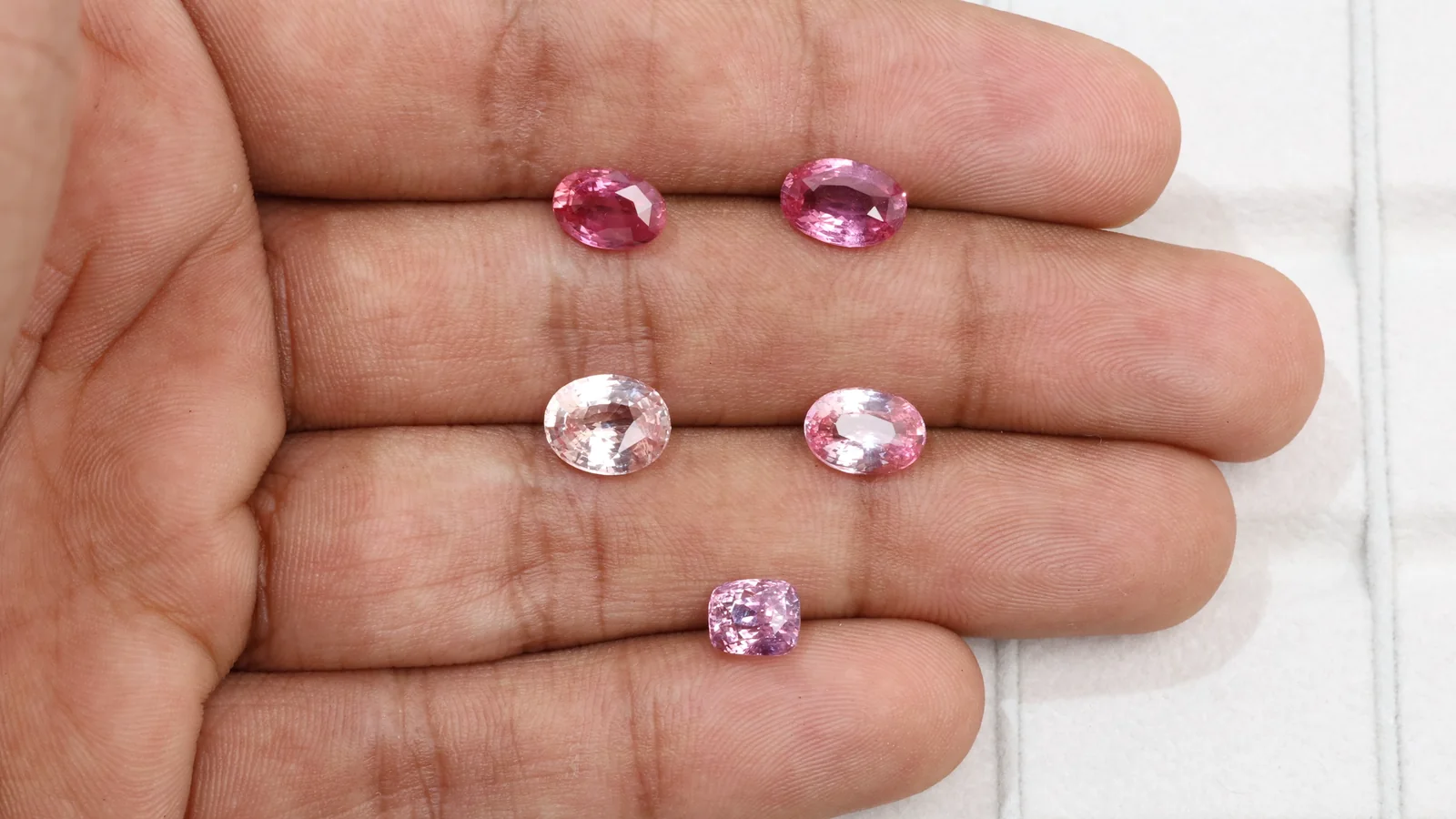
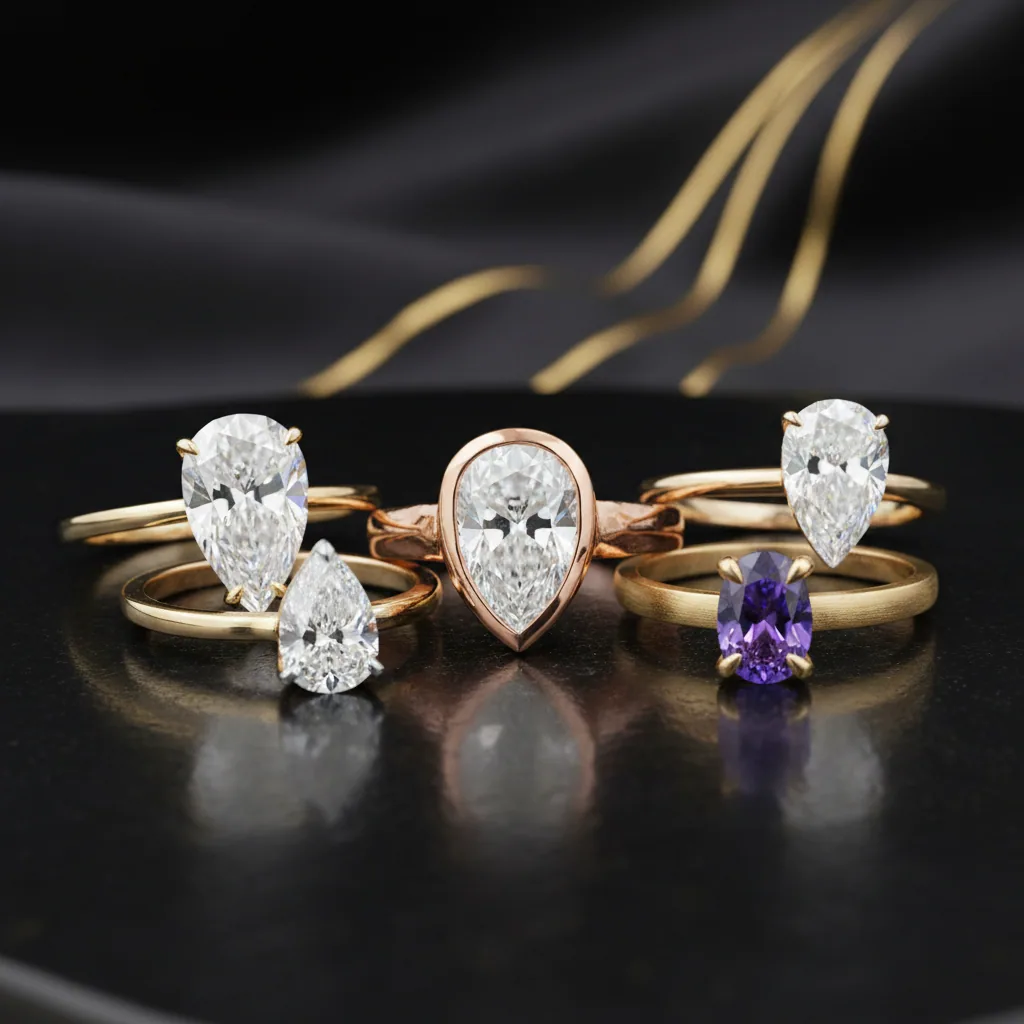
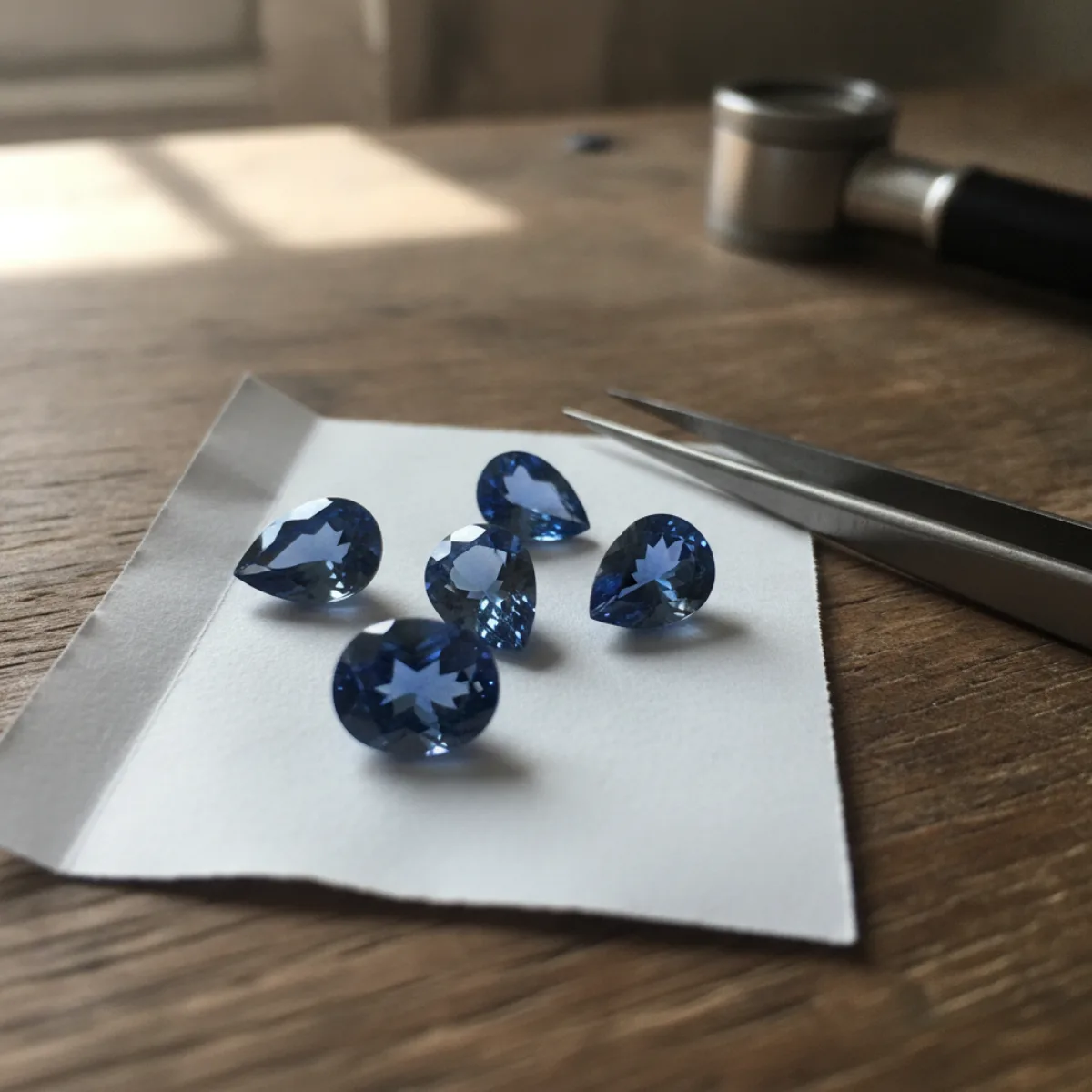
Below are pear-suitable stones currently in the Joalys catalog, all certified by an independent laboratory and sourced direct from Sri Lanka. We sell the stone first: you pick the pear, then the setting conversation happens. Nothing here is a finished ring pulled off a shelf.
Want a pear cut we do not currently have in stock? Custom sourcing typically takes four to eight weeks from rough selection to certified loose stone, depending on which mine cycle is active.
Watch: The Pear Cut Explained in Three Minutes
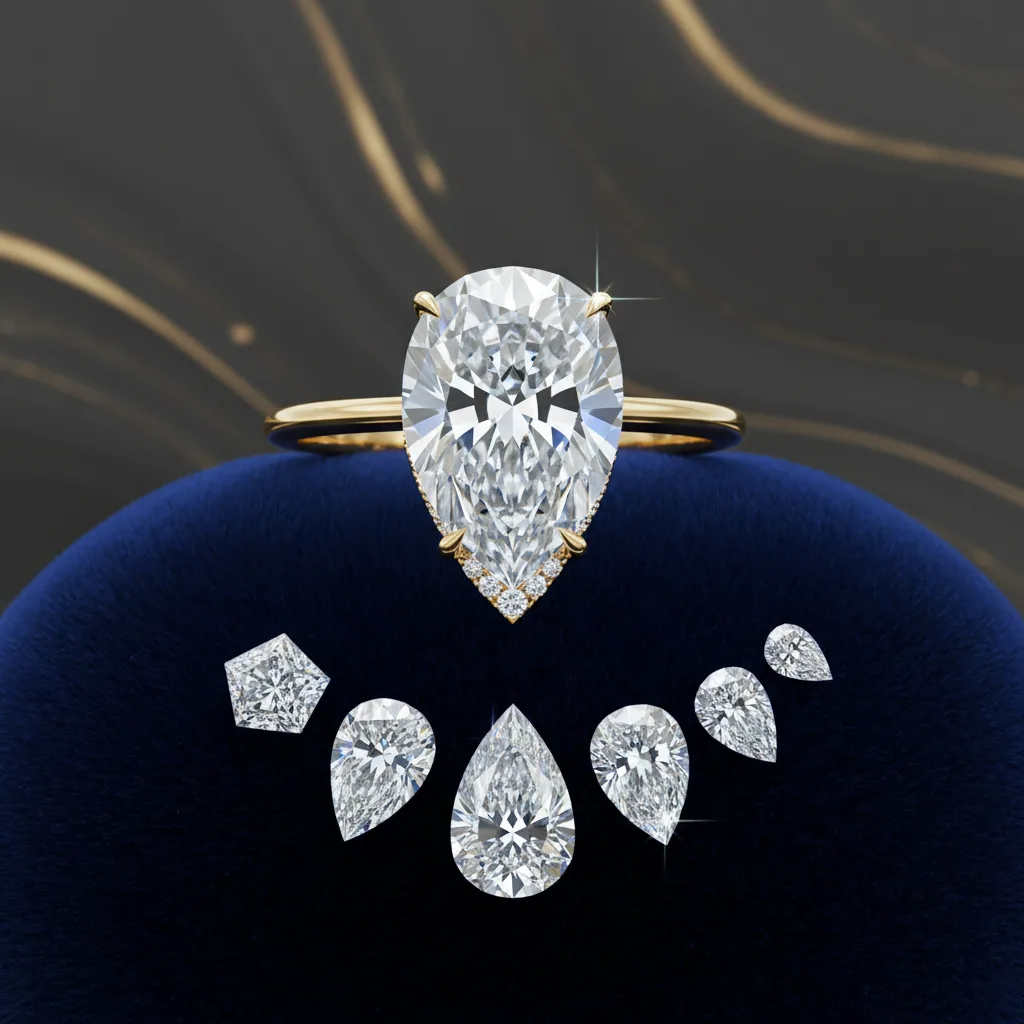
If you are still on the fence about whether the pear is right for you, this short guide walks through the cut characteristics, common pairings, and what to ask your jeweler:
Quick answers
What is the bow tie effect on a pear cut diamond, and how do you avoid it?
Does GIA give a cut grade to a pear shaped diamond?
What does a pear engagement ring symbolize?
Is yellow gold or white gold better for a pear engagement ring?
14k vs 18k gold: which is better for a pear engagement ring?
Are pear shaped engagement rings cheaper than round diamonds?
Sapphire vs diamond: is a pear sapphire a good engagement ring stone?
What length-to-width ratio is best for a pear cut?
How do I protect the point of a pear shaped diamond from chipping?
Which way should I wear a pear shaped engagement ring?
Is the pear cut a trend that will date quickly?
How much does a pear shaped sapphire engagement ring cost?
Do sapphires show a bow tie like diamonds do?
Bottom Line
Every pear shows a bow tie. That is the part most buyers get backwards: they go hunting for a stone without one, and no such stone exists. The real choice is between a dark band that fades as you tilt the stone and one that sits there like a smudge in every light. A 360 video answers that in about thirty seconds. A still photo, shot at the single angle where the shadow disappears, answers nothing.
GIA gives fancy shapes no cut grade, so the report will not settle it for you either. Use the numbers you do get. Table between 58 and 62%, symmetry inside 2 to 3%, a length-to-width ratio in the 1.50 to 1.65 range, and a V-prong wrapped over the point. Get those four right and the pear does what it is famous for: more spread per carat than a round, a longer line on the finger, and a real saving against a round of equivalent quality. On a Ceylon sapphire pear, run the same check with one extra caution, since a pavilion cut deep to hold color is the same geometry that darkens the center. That version, set in 18k yellow gold, is the one we wish more couples knew about.
If you are weighing diamond versus sapphire, or curious about how Ratnapura sourcing actually works, the door is open. We answer DMs at @joalys.paris on Instagram and we answer questions about specific stones from the parcels we bring back from Sri Lanka ourselves.